 Kwizi ya Ndiwe dino uti?
 Nkhondo ya madino
 Mpikisano wa madino
 Masewera ang'onoang'ono a madino
 Chimbale cha zomata
 Mindandanda ya TOP ya madino
 Ndidabwitse!
Ankakhala liti?

Anali wamkulu bwanji?
Anali wautali bwanji?
Msinkhu wake unali wautali bwanji?
kuyerekeza
 wautali ngati amphaka a pakhomo 3 otsatizana mphuno ndi mchira🍌wautali ngati nthochi 9 zotsatizana🏃akanatha kuthamanga mamita 100 m'masekondi 7.1 (munthu waliwiro kwambiri amafunika 9.6)
Hexing anali wamkulu bwanji poyerekeza ndi IWEYO?
Ndi masamu chabe mu msakatuli wako. Palibe chimene chimasungidwa kapena kutumizidwa kwina kulikonse.
Anali ndi liwiro lotani?


Mfundo zosangalatsa
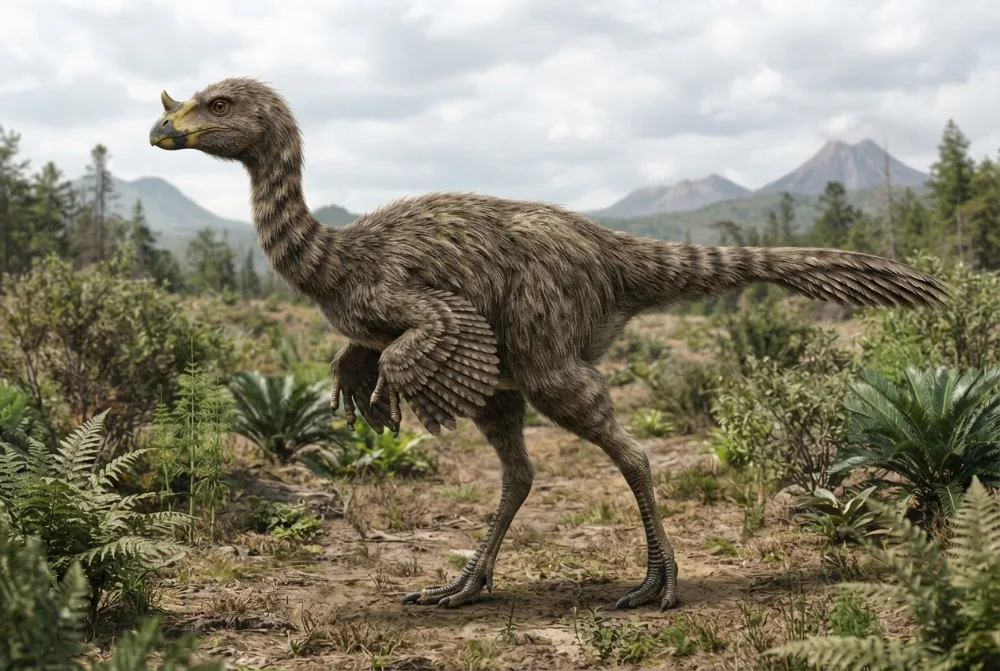
Hexing is one of the oldest known ornithomimosaurs, the group of ostrich-like dinosaurs.1
Its name means 'like a crane' in Chinese, and its species name means 'with slender wings'.1
The only fossil of Hexing was first found by a local farmer, who tried to make it look more valuable by adding fake parts. Scientists later removed those fake bits.1
Hexing had a very long hind leg compared to its thigh, which helped it run fast.3
Unlike later ornithomimosaurs, Hexing still had teeth in the front of its upper jaw.3
Hexing lived alongside many other amazing animals in the Jehol Biota, including early birds, mammals, and even feathered dinosaurs.3
Mafunso ofunsidwa kwambiri okhudza Hexing
?How big was Hexing?
Hexing was small, but its exact length is unknown because most of its backbone is missing. Comparing its thighbone to a similar dinosaur, Shenzhousaurus, which was 1.6 metres (about 5.2 feet) long, Hexing was probably smaller.1
?Did Hexing have teeth?
Yes, Hexing had a few small conical teeth in the front of its lower jaw, but its upper jaw was toothless. This is different from later ornithomimosaurs, which had no teeth at all.1
Kwa akatswiri a madino
- Dzina la sayansi
- Hexing
- Anapatsidwa dzina ndi
- Jin et al. 20124
- Gulu
- Madino a nthiwatiwa
- Banja / kladi
- Ornithomimosauria4
- Magawidwe a sayansi
- Theropoda > Ornithomimosauria4
- Zaka za miyala
- zaka 126 mpaka 120 miliyoni (Barremian / Aptian)4
- Mapangidwe a miyala
- Yixian4
- Mayiko
- China4
- Zolemba za mafosili
- 1 mu The Paleobiology Database4
- Kupezeka
- Hexing was named and described in 2012 by Jin Liyong, Chen Jun, and Pascal Godefroit. The fossil was found at Xiaobeigou in Liaoning, China, in rocks that are about 128 to 139 million years old.1
- Akukambiranabe
- Scientists are not sure whether Hexing or Shenzhousaurus was the more primitive ornithomimosaur, because the fossils of both are incomplete.3
Kumene mfundo zimachokera
- Hexing (en.wikipedia.org)
- PBDB Taxon (paleobiodb.org)
- IU Press uncorrected proof. Copyrighted material. For proofing purposes only. (dinoweb.ucoz.ru)
- Hexing in The Paleobiology Database (CC BY 4.0): zaka, malo, mapangidwe a miyala, magawidwe a sayansi.
Mfundo iliyonse patsamba lino ili ndi nambala yosonyeza kumene yachokera. Ngati talakwitsa kanthu, pepa, ndife okonda madino, osati magazini ya sayansi. Tiuze pa [email protected] ndipo tikonza.
 Rex ali ndi njala! Dino Wiki ndi ntchito ya bambo kwa mwana wawo wamwamuna wokonda madainoso, yaulere popanda zotsatsa ndi zokazonda. Akuluakulu angadyetse Rex zokhwasula-khwasula kuti tsambali lipitirize kupezeka pa intaneti.Dyetsa Rex
 Gallimimus
 Ornithomimus
 Struthiomimus
 Deinocheirus
 Dromiceiomimus
 Archaeornithomimus
 Stegosaurus
 Iguanodon
 Archaeopteryx
 Giganotosaurus
 Microraptor
 Deinonychus