 Kwizi ya Ndiwe dino uti?
 Nkhondo ya madino
 Mpikisano wa madino
 Masewera ang'onoang'ono a madino
 Chimbale cha zomata
 Mindandanda ya TOP ya madino
 Ndidabwitse!
Houornis
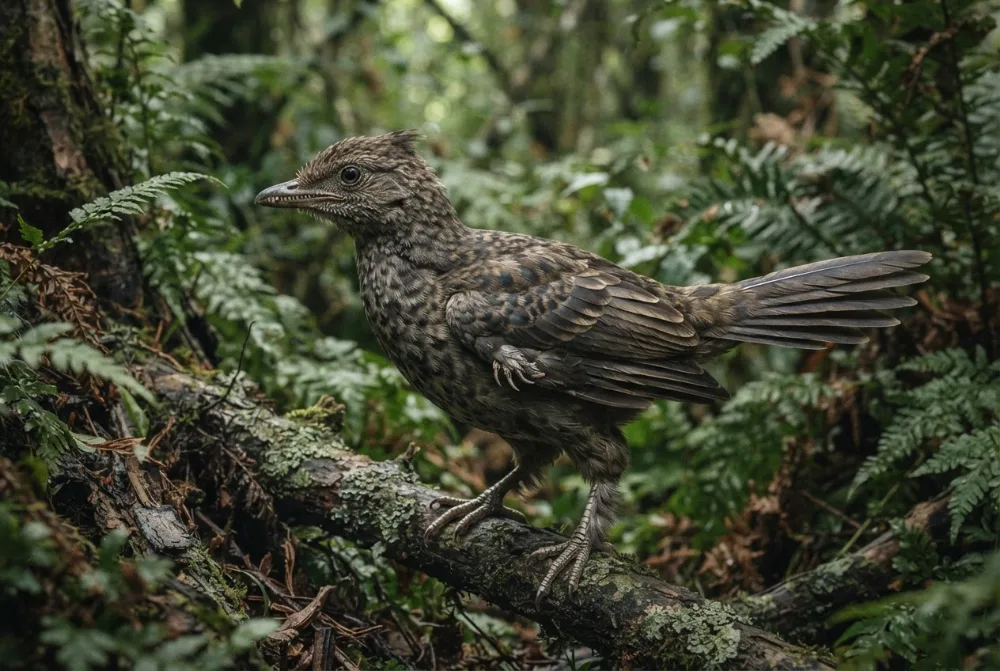
Houornis was a tiny, toothy bird that lived in China about 120 million years ago. It had perching feet and a surprisingly long tail made of fused bones. This little bird was an enantiornithean, a group of early birds that went extinct with the dinosaurs.1
Ankakhala liti?
Anali ndi liwiro lotani?


Mfundo zosangalatsa
Houornis is known from only one main fossil, which is not preserved as bones but as impressions left in the rock.1
Its tail was originally thought to be long and bony like Archaeopteryx, but scientists later realized it had a long pygostyle, a fused tail bone.1
The upper arm bone of Houornis is less than 30 millimeters (1.2 inches) long, making it a very small bird.1
Houornis was once classified as a species of Cathayornis, but in 2015 it was given its own genus because of unique features like its large pygostyle.1
Some scientists have considered Houornis a doubtful species because the fossil is poorly preserved, but a 2015 study found it was distinct enough to keep.1
Wothetsa nthano zabodza
Nthano: Houornis had a long, bony tail like a dinosaur.
Zoona: Houornis actually had a short tail with a long pygostyle (fused tail vertebrae), not a long bony tail. The original mistake came from misidentifying hip bones as tail vertebrae.1
Kwa akatswiri a madino
- Dzina la sayansi
- Houornis
- Anapatsidwa dzina ndi
- Wang and Liu 20152
- Gulu
- Mbalame zoyambirira
- Banja / kladi
- Enantiornithes2
- Magawidwe a sayansi
- Theropoda > Avialae2
- Zaka za miyala
- zaka 121 mpaka 113 miliyoni (Aptian)2
- Mapangidwe a miyala
- Jiufotang2
- Mayiko
- China2
- Zolemba za mafosili
- 1 mu The Paleobiology Database2
- Kupezeka
- The only known fossil of Houornis was found in 1993 by Zhou Zhonghe near Boluochi, China. It was first named Cathayornis caudatus by Hou Lianhu in 1997, and then renamed Houornis by Wang and Liu in 2015.1
- Akukambiranabe
- Scientists are not sure exactly how Houornis is related to other enantiornithean birds, because its fossil is too incomplete for a detailed family tree analysis.1
Kumene mfundo zimachokera
- Houornis (en.wikipedia.org)
- Houornis in The Paleobiology Database (CC BY 4.0): zaka, malo, mapangidwe a miyala, magawidwe a sayansi.
Mfundo iliyonse patsamba lino ili ndi nambala yosonyeza kumene yachokera. Ngati talakwitsa kanthu, pepa, ndife okonda madino, osati magazini ya sayansi. Tiuze pa [email protected] ndipo tikonza.
 Rex ali ndi njala! Dino Wiki ndi ntchito ya bambo kwa mwana wawo wamwamuna wokonda madainoso, yaulere popanda zotsatsa ndi zokazonda. Akuluakulu angadyetse Rex zokhwasula-khwasula kuti tsambali lipitirize kupezeka pa intaneti.Dyetsa Rex
 Archaeopteryx
 Hesperornis
 Ichthyornis
 Baptornis
 Jurapteryx
 Gobipteryx
 Stegosaurus
 Iguanodon
 Giganotosaurus
 Microraptor
 Deinonychus
 Baryonyx