 Kwizi ya Ndiwe dino uti?
 Nkhondo ya madino
 Mpikisano wa madino
 Masewera ang'onoang'ono a madino
 Chimbale cha zomata
 Mindandanda ya TOP ya madino
 Ndidabwitse!
Jiuquanornis
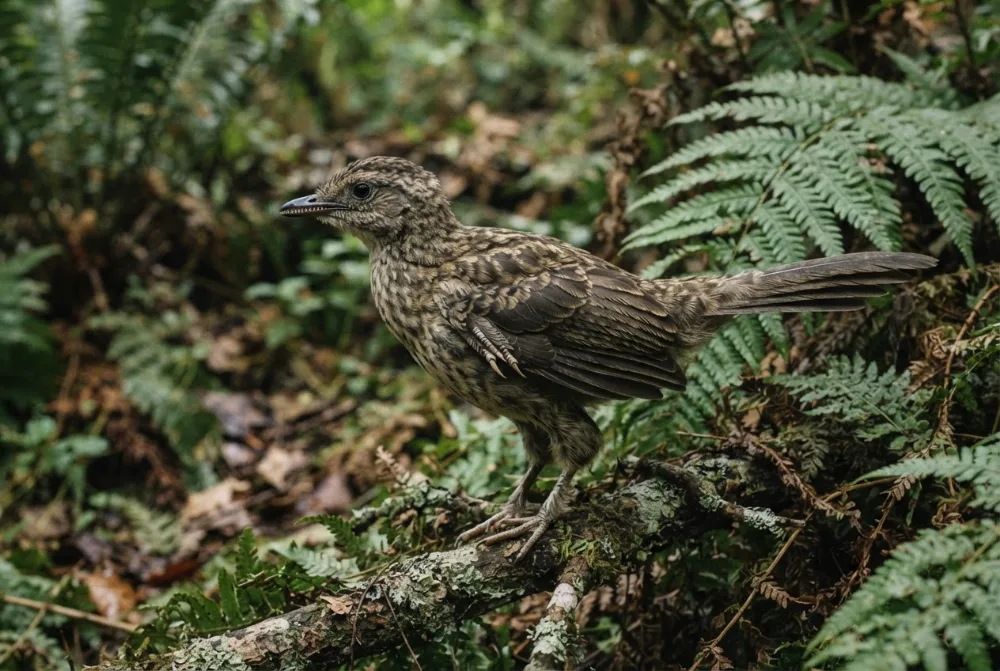
Jiuquanornis was a small, bird-like dinosaur that lived about 120 million years ago. It had a U-shaped wishbone and a sternum that looked like those of some modern ground birds. Scientists think it might have been a fast runner that ate meat.12
Ankakhala liti?
Anali ndi liwiro lotani?


Mfundo zosangalatsa
Jiuquanornis is known from a single fossil that was first described in 2013. The fossil includes parts of the sternum, furcula, and forelimb.1
Its sternum had long, thin projections called trabeculae, which are also seen in modern ground-dwelling birds like chickens and tinamous.1
Jiuquanornis had a U-shaped furcula (wishbone) with a low angle of about 36 degrees, and it lacked a hypocleidium, a small projection found in some birds.1
Scientists think Jiuquanornis was a basal ornithuromorph, meaning it was an early relative of modern birds but not a direct ancestor.1
The fossil of Jiuquanornis was found in the Xiagou Formation, which is about 121 to 113 million years old, from the Early Cretaceous period.21
Jiuquanornis was named after the city of Jiuquan, which is near the fossil site. The species name niui honors Professor Shao-Wu Niu for his geological work.1
The fossil of Jiuquanornis was originally thought to be too incomplete to name, but scientists later decided it was different enough from other birds to be a new species.1
Kwa akatswiri a madino
- Dzina la sayansi
- Jiuquanornis
- Anapatsidwa dzina ndi
- Wang et al. 20132
- Gulu
- Mbalame zoyambirira
- Banja / kladi
- Ornithuromorpha2
- Magawidwe a sayansi
- Theropoda > Avialae2
- Zaka za miyala
- zaka 121 mpaka 113 miliyoni (Aptian)2
- Mapangidwe a miyala
- Xiagou2
- Mayiko
- China2
- Zolemba za mafosili
- 1 mu The Paleobiology Database2
- Kupezeka
- Jiuquanornis was named in 2013 by Wang and colleagues. The fossil, specimen GSGM-05-CM-021, was found in the Xiagou Formation near Changma in Gansu Province, China. It was first described as an unnamed bird in 2005, but later recognized as a new species.12
- Akukambiranabe
- Scientists are not sure whether Jiuquanornis lived on the ground or in the water, because its fossil is too incomplete to tell. Its sternum shape suggests it might have been a fast runner, but more fossils are needed.1
Kumene mfundo zimachokera
- Previously Unrecognized Ornithuromorph Bird Diversity in the Early Cretaceous Changma Basin, Gansu Province, Northwestern China (journals.plos.org)
- Jiuquanornis in The Paleobiology Database (CC BY 4.0): zaka, malo, mapangidwe a miyala, magawidwe a sayansi.
Mfundo iliyonse patsamba lino ili ndi nambala yosonyeza kumene yachokera. Ngati talakwitsa kanthu, pepa, ndife okonda madino, osati magazini ya sayansi. Tiuze pa [email protected] ndipo tikonza.
 Rex ali ndi njala! Dino Wiki ndi ntchito ya bambo kwa mwana wawo wamwamuna wokonda madainoso, yaulere popanda zotsatsa ndi zokazonda. Akuluakulu angadyetse Rex zokhwasula-khwasula kuti tsambali lipitirize kupezeka pa intaneti.Dyetsa Rex
 Archaeopteryx
 Hesperornis
 Ichthyornis
 Baptornis
 Jurapteryx
 Gobipteryx
 Stegosaurus
 Iguanodon
 Giganotosaurus
 Microraptor
 Deinonychus
 Baryonyx