 Kwizi ya Ndiwe dino uti?
 Nkhondo ya madino
 Mpikisano wa madino
 Masewera ang'onoang'ono a madino
 Chimbale cha zomata
 Mindandanda ya TOP ya madino
 Ndidabwitse!
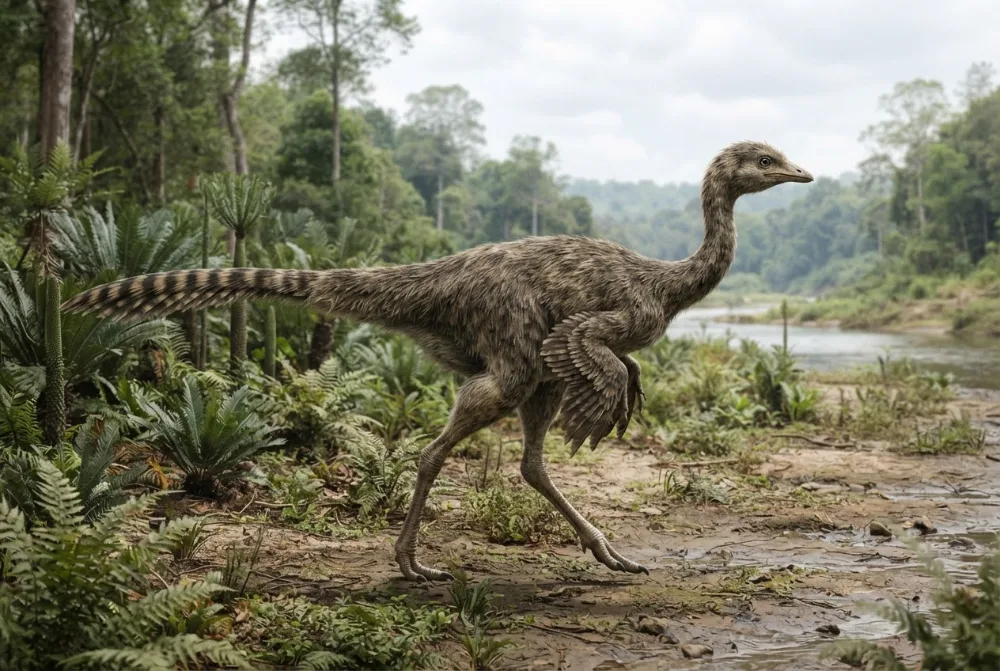
Kinnareemimus
Kinnareemimus was a small, fast dinosaur that looked a bit like an ostrich. It lived in what is now Thailand during the Early Cretaceous period, about 125 million years ago. Scientists think it could run quickly on its long, bird-like legs.1
Ankakhala liti?
Anali wamkulu bwanji?
Anali wautali bwanji?
Msinkhu wake unali wautali bwanji?
kuyerekeza
Ankalemera bwanji?
 wautali ngati amphaka a pakhomo 4 otsatizana mphuno ndi mchira🍌wautali ngati nthochi 10 zotsatizana🍌wolemera ngati nthochi 110🏃akanatha kuthamanga mamita 100 m'masekondi 7.1 (munthu waliwiro kwambiri amafunika 9.6)
Kinnareemimus anali wamkulu bwanji poyerekeza ndi IWEYO?
Ndi masamu chabe mu msakatuli wako. Palibe chimene chimasungidwa kapena kutumizidwa kwina kulikonse.
Anali ndi liwiro lotani?


Mfundo zosangalatsa
The name Kinnareemimus comes from a Kinnaree, a magical creature from Thai stories that has a woman's head and a bird's legs.1
Only a single foot bone, a metatarsal, was chosen as the main specimen. Other bones from the same site were also assigned to this dinosaur.1
Its foot had a special shape called semi-arctometatarsalian, where the middle toe bone gets narrow in the middle and then widens at the bottom.1
Kinnareemimus lived alongside many other dinosaurs, including the huge sauropod Phuwiangosaurus and the meat-eating Siamotyrannus.1
The fossils were found in red clay and sandstone that were once a river floodplain with lakes.1
Scientists think Kinnareemimus might have been a good runner, but not as fast as later ostrich dinosaurs like Gallimimus.1
Mafunso ofunsidwa kwambiri okhudza Kinnareemimus
?How big was Kinnareemimus?
About 1.8 metres (5.9 ft) long and possibly weighed around 13 kilograms (29 lb). Scientists are not sure because only a few foot bones have been found.1
?What did Kinnareemimus eat?
It was an ornithomimosaur, so it likely ate plants and small animals, like other ostrich dinosaurs. No direct evidence of its diet has been found.1
?Could Kinnareemimus run fast?
Probably yes, but not as fast as later ostrich dinosaurs like Gallimimus. Its leg bones suggest it was a good runner, though scientists are not certain.1
?Where was Kinnareemimus found?
In northeastern Thailand, in the Early Cretaceous Sao Khua Formation. The fossils were discovered at a site called Phu Wiang 5.1
Kwa akatswiri a madino
- Dzina la sayansi
- Kinnareemimus
- Anapatsidwa dzina ndi
- Buffetaut et al. 20093
- Gulu
- Madino a nthiwatiwa
- Banja / kladi
- Ornithomimosauria3
- Magawidwe a sayansi
- Theropoda > Ornithomimosauria3
- Zaka za miyala
- zaka 126 mpaka 121 miliyoni (Barremian)3
- Mapangidwe a miyala
- Sao Khua3
- Mayiko
- Thailand3
- Zolemba za mafosili
- 1 mu The Paleobiology Database3
- Kupezeka
- The first fossils were reported in 1997, but the dinosaur was officially named Kinnareemimus khonkaenensis in 2009 by Eric Buffetaut, Varavudh Suteethorn, and Haiyan Tong.1
- Akukambiranabe
- Because only a few bones are known, scientists are not sure exactly how big Kinnareemimus was or what its whole body looked like.1
Kumene mfundo zimachokera
- Kinnareemimus (en.wikipedia.org)
- PBDB Taxon (paleobiodb.org)
- Kinnareemimus in The Paleobiology Database (CC BY 4.0): zaka, malo, mapangidwe a miyala, magawidwe a sayansi.
Mfundo iliyonse patsamba lino ili ndi nambala yosonyeza kumene yachokera. Ngati talakwitsa kanthu, pepa, ndife okonda madino, osati magazini ya sayansi. Tiuze pa [email protected] ndipo tikonza.
 Rex ali ndi njala! Dino Wiki ndi ntchito ya bambo kwa mwana wawo wamwamuna wokonda madainoso, yaulere popanda zotsatsa ndi zokazonda. Akuluakulu angadyetse Rex zokhwasula-khwasula kuti tsambali lipitirize kupezeka pa intaneti.Dyetsa Rex
 Gallimimus
 Ornithomimus
 Struthiomimus
 Deinocheirus
 Dromiceiomimus
 Archaeornithomimus
 Stegosaurus
 Iguanodon
 Archaeopteryx
 Giganotosaurus
 Microraptor
 Deinonychus