 Kwizi ya Ndiwe dino uti?
 Nkhondo ya madino
 Mpikisano wa madino
 Masewera ang'onoang'ono a madino
 Chimbale cha zomata
 Mindandanda ya TOP ya madino
 Ndidabwitse!
Kunbarrasaurus
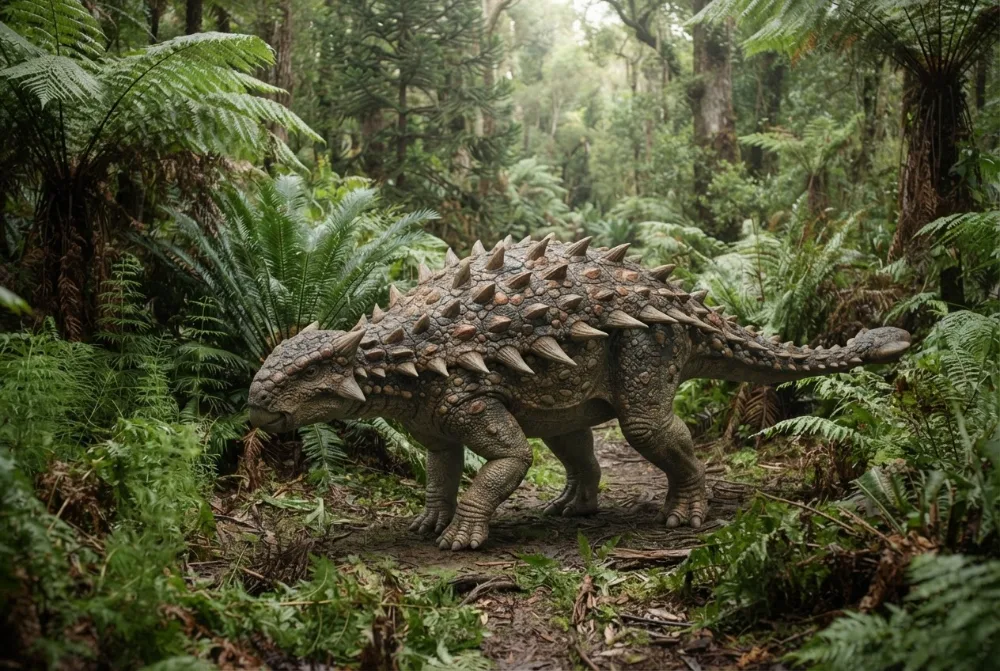
Kunbarrasaurus was a small, armoured dinosaur that walked on four legs and munched on plants. It had bony plates and spikes all over its body, like a walking tank. This dinosaur lived in Australia during the Early Cretaceous, about 105 million years ago.13
Ankakhala liti?
Anali wamkulu bwanji?
Anali wautali bwanji?
Msinkhu wake unali wautali bwanji?
kuyerekeza
 wautali ngati agalu 4 otsatizana mphuno ndi mchira🍌wautali ngati nthochi 19 zotsatizana🏃akanatha kuthamanga mamita 100 m'masekondi 16 (munthu waliwiro kwambiri amafunika 9.6)
Kunbarrasaurus anali wamkulu bwanji poyerekeza ndi IWEYO?
Ndi masamu chabe mu msakatuli wako. Palibe chimene chimasungidwa kapena kutumizidwa kwina kulikonse.
Anali ndi liwiro lotani?


Mfundo zosangalatsa
Kunbarrasaurus is one of the most complete armoured dinosaurs ever found, with most of its skeleton and skull preserved.1
Its gut contents show it ate fibrous plant parts, seeds, and fruiting bodies, and it probably chopped food in its mouth instead of using stomach stones.1
The dinosaur had a ring of scutes around its neck, and its body was covered with small, keeled plates and spikes.1
Kunbarrasaurus had a very large inner ear, unlike any other dinosaur known, which may have helped with balance or hearing.2
The fossil was found in marine rocks, so the dinosaur may have washed out to sea after death.1
It is the second genus of armoured dinosaur from Australia, and its name means 'shield lizard' in the local Aboriginal language.1
Mafunso ofunsidwa kwambiri okhudza Kunbarrasaurus
?How big was Kunbarrasaurus?
About 2.5 to 3.5 metres long. That is roughly the size of a large motorcycle.1
?What did Kunbarrasaurus eat?
It ate plants, including fibrous leaves, seeds and fruiting bodies. Scientists know this because its last meal was preserved inside its fossil.1
?Did Kunbarrasaurus have a tail club?
Probably not. Its tail is not fully preserved, but some of its relatives had a flat, blade-like structure at the tail tip instead of a club.1
?Where was Kunbarrasaurus found?
In Queensland, Australia, near Richmond. The fossil was discovered in marine rocks, so the dinosaur may have washed out to sea after death.1
?When did Kunbarrasaurus live?
It lived during the Early Cretaceous, about 105 million years ago.1
?Is Kunbarrasaurus a dinosaur?
Yes, it is a small armoured dinosaur called an ankylosaurian.1
Wothetsa nthano zabodza
Nthano: Kunbarrasaurus used its tail like a club to defend itself.
Zoona: There is no evidence of a tail club in Kunbarrasaurus. Its tail had triangular plates and scutes, but no club.1
Kwa akatswiri a madino
- Dzina la sayansi
- Kunbarrasaurus
- Anapatsidwa dzina ndi
- Leahey et al. 20153
- Gulu
- Madino a zishango
- Banja / kladi
- Parankylosauria3
- Magawidwe a sayansi
- Ornithischia > Ankylosauria > Thyreophora3
- Zaka za miyala
- zaka 106 mpaka 100 miliyoni (Albian)3
- Mapangidwe a miyala
- Toolebuc3
- Mayiko
- Australia3
- Zolemba za mafosili
- 2 mu The Paleobiology Database3
- Kupezeka
- The skeleton was found in 1989 by Ian Ievers on Marathon Station in Queensland, Australia. It was named Kunbarrasaurus ieversi in 2015 by scientists including Lucy Leahey.1
- Akukambiranabe
- Scientists are still debating whether Kunbarrasaurus is a primitive or derived ankylosaur, because it has a mix of both ancient and advanced features.2
Kumene mfundo zimachokera
- Kunbarrasaurus (en.wikipedia.org)
- doi:10.7717/peerj.1475 (people.ohio.edu)
- Kunbarrasaurus in The Paleobiology Database (CC BY 4.0): zaka, malo, mapangidwe a miyala, magawidwe a sayansi.
Mfundo iliyonse patsamba lino ili ndi nambala yosonyeza kumene yachokera. Ngati talakwitsa kanthu, pepa, ndife okonda madino, osati magazini ya sayansi. Tiuze pa [email protected] ndipo tikonza.
 Rex ali ndi njala! Dino Wiki ndi ntchito ya bambo kwa mwana wawo wamwamuna wokonda madainoso, yaulere popanda zotsatsa ndi zokazonda. Akuluakulu angadyetse Rex zokhwasula-khwasula kuti tsambali lipitirize kupezeka pa intaneti.Dyetsa Rex
 Ankylosaurus
 Sauropelta
 Pinacosaurus
 Scutellosaurus
 Struthiosaurus
 Euoplocephalus
 Stegosaurus
 Iguanodon
 Archaeopteryx
 Giganotosaurus
 Microraptor
 Deinonychus