 Kwizi ya Ndiwe dino uti?
 Nkhondo ya madino
 Mpikisano wa madino
 Masewera ang'onoang'ono a madino
 Chimbale cha zomata
 Mindandanda ya TOP ya madino
 Ndidabwitse!
Leptocleidus
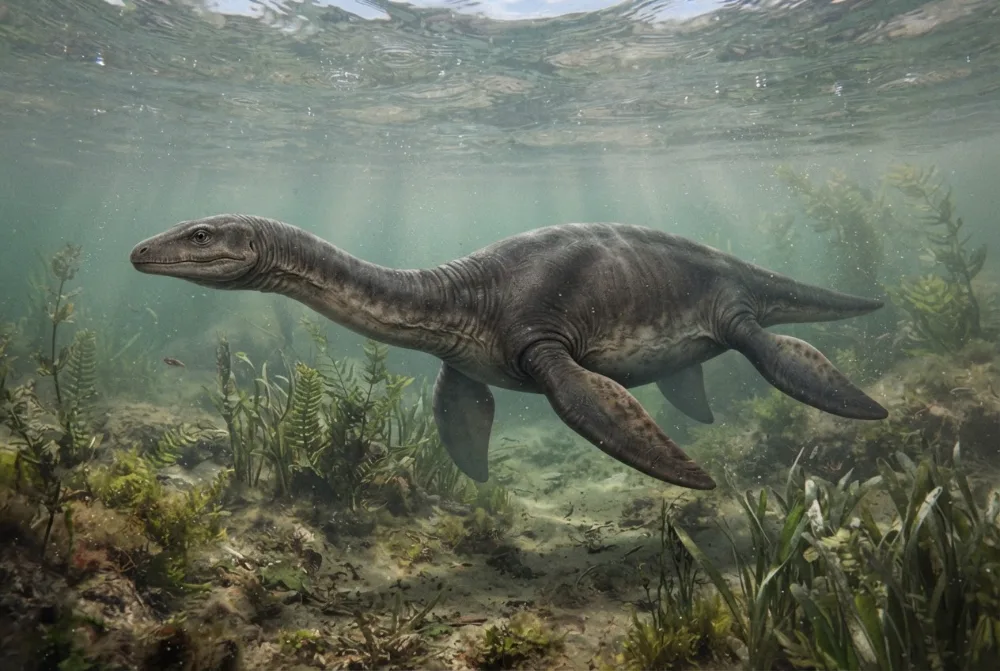
Leptocleidus was a small plesiosaur that swam in shallow seas and rivers during the Early Cretaceous. It had a long neck, a short body, and four flippers to paddle through the water. Unlike many other plesiosaurs, it lived in lagoons and even brackish or fresh water.1
Ankakhala liti?
Anali wamkulu bwanji?
Anali wautali bwanji?
 wautali ngati agalu 3 otsatizana mphuno ndi mchira🍌wautali ngati nthochi 17 zotsatizana🏊akanatha kusambira utali wa dziwe lalikulu losambira (50 m) m'masekondi 6.4
Leptocleidus anali wamkulu bwanji poyerekeza ndi IWEYO?
Ndi masamu chabe mu msakatuli wako. Palibe chimene chimasungidwa kapena kutumizidwa kwina kulikonse.
Anali ndi liwiro lotani?


Mfundo zosangalatsa
Leptocleidus had about 21 teeth on each side of its upper jaw and around 35 teeth on each side of its lower jaw.1
Its skull was triangle-shaped with a crest running from the tip of the nose to the nasal region.1
Unlike many plesiosaurs, Leptocleidus lived in shallow lagoons and may have entered brackish or fresh water, like river mouths.1
Scientists think Leptocleidus moved into fresh water to escape larger plesiosaurs and pliosaurs.1
The name Leptocleidus comes from Greek words meaning 'slender clavicle', referring to its thin collarbone.1
Leptocleidus had large clavicles and interclavicle bones but small shoulder blades, similar to the early Jurassic Rhomaleosaurus.1
A specimen from the Isle of Wight, once thought to be Leptocleidus, was later named a separate genus, Vectocleidus, in 2012.1
Mafunso ofunsidwa kwambiri okhudza Leptocleidus
?How big was Leptocleidus?
Leptocleidus was small for a plesiosaur, measuring up to 3 metres (9.8 feet) long. One species, Leptocleidus superstes, was even smaller at about 1.5 metres (5 feet).13
?Was Leptocleidus a dinosaur?
No, Leptocleidus was not a dinosaur. It was a plesiosaur, a type of extinct marine reptile that lived in the sea.13
Kwa akatswiri a madino
- Dzina la sayansi
- Leptocleidus
- Anapatsidwa dzina ndi
- Andrews 19224
- Gulu
- Maplesiosauri
- Banja / kladi
- Leptocleididae4
- Magawidwe a sayansi
- Plesiosauria > Sauropterygia4
- Zaka za miyala
- zaka 143 mpaka 100 miliyoni (Berriasian / Albian)4
- Mapangidwe a miyala
- Murderong Shale, Bulldog Shale, Weald Clay4
- Mayiko
- Australia, United Kingdom, South Africa4
- Zolemba za mafosili
- 7 mu The Paleobiology Database4
- Amadziwikanso kuti
- Peyerus (mayina akale tsopano amawerengedwa ngati nyama yomweyi)4
- Kupezeka
- Leptocleidus was named by Charles William Andrews in 1922 based on a partial skeleton and skull from the Weald Clay of Berwick, Sussex, England.41
- Akukambiranabe
- Scientists debate whether Leptocleidus belongs within the group Rhomaleosauridae or in its own separate clade called Leptocleididae.2
Kumene mfundo zimachokera
- Leptocleidus (en.wikipedia.org)
- Reassessment of the Lower Cretaceous (Barremian) pliosauroid Leptocleidus superstes Andrews, 1922 and other plesiosaur remains from the nonmarine Wealden succession of southern England | Zoological Journal of the Linnean Society | Oxford Academic (academic.oup.com)
- Leptocleidus Facts for Kids (kids.kiddle.co)
- Leptocleidus in The Paleobiology Database (CC BY 4.0): zaka, malo, mapangidwe a miyala, magawidwe a sayansi.
Mfundo iliyonse patsamba lino ili ndi nambala yosonyeza kumene yachokera. Ngati talakwitsa kanthu, pepa, ndife okonda madino, osati magazini ya sayansi. Tiuze pa [email protected] ndipo tikonza.
 Rex ali ndi njala! Dino Wiki ndi ntchito ya bambo kwa mwana wawo wamwamuna wokonda madainoso, yaulere popanda zotsatsa ndi zokazonda. Akuluakulu angadyetse Rex zokhwasula-khwasula kuti tsambali lipitirize kupezeka pa intaneti.Dyetsa Rex
 Elasmosaurus
 Pliosaurus
 Plesiosaurus
 Cimoliasaurus
 Colymbosaurus
 Trinacromerum
 Stegosaurus
 Iguanodon
 Archaeopteryx
 Giganotosaurus
 Microraptor
 Deinonychus