 Kwizi ya Ndiwe dino uti?
 Nkhondo ya madino
 Mpikisano wa madino
 Masewera ang'onoang'ono a madino
 Chimbale cha zomata
 Mindandanda ya TOP ya madino
 Ndidabwitse!
Malawania
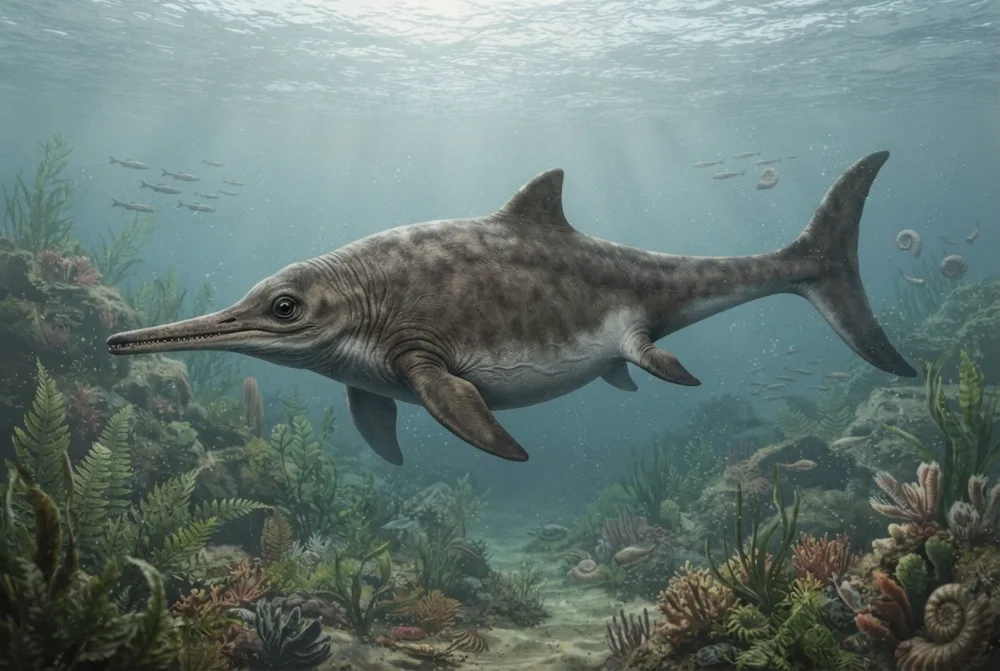
Malawania was a small ichthyosaur that lived in the Early Cretaceous seas. It looked a bit like a dolphin, with flippers instead of legs and a long snout. It is special because it was one of the last ichthyosaurs that did not belong to the ophthalmosaurid group.12
Ankakhala liti?
Anali wamkulu bwanji?
Anali wautali bwanji?
 wautali ngati agalu 3 otsatizana mphuno ndi mchira🍌wautali ngati nthochi 17 zotsatizana🏊akanatha kusambira utali wa dziwe lalikulu losambira (50 m) m'masekondi 3.8
Malawania anali wamkulu bwanji poyerekeza ndi IWEYO?
Ndi masamu chabe mu msakatuli wako. Palibe chimene chimasungidwa kapena kutumizidwa kwina kulikonse.
Anali ndi liwiro lotani?


Mfundo zosangalatsa
Malawania is the first non-ophthalmosaurid ichthyosaur known from after the Jurassic,Cretaceous boundary, meaning it survived a time when most of its relatives had died out.1
Its scientific name means 'out-of-time swimmer' because it seemed to belong to an earlier time period.1
The only fossil of Malawania was found in 1952, but scientists did not know its age until 2013 when they studied tiny fossils called palynomorphs in the rock.2
Malawania had a short, trapezoid-shaped humerus (upper arm bone) and an intermedium bone in its flipper that was almost as big as the radius.2
Its forefin had four main fingers and no extra digits, unlike many later ichthyosaurs.2
The fossil was found in Iraq, which is the first post-Triassic ichthyosaur ever reported from the Middle East.2
Mafunso ofunsidwa kwambiri okhudza Malawania
?How big was Malawania?
About 3 metres (9.8 feet) long. That is roughly as long as a small car.1
?What did Malawania eat?
Scientists are not sure exactly, but like other ichthyosaurs it probably ate fish and squid. Its long snout and sharp teeth were good for catching slippery prey.1
?When did Malawania live?
It lived during the Early Cretaceous period, about 130 to 125 million years ago. That is after most of its relatives had already died out.12
?Where was Malawania found?
The only fossil was discovered in 1952 in Iraqi Kurdistan, near the town of Amadia. It is the first post-Triassic ichthyosaur ever found in the Middle East.1
Kwa akatswiri a madino
- Dzina la sayansi
- Malawania
- Anapatsidwa dzina ndi
- Fischer et al. 20133
- Gulu
- Maikitiosauri
- Banja / kladi
- Thunnosauria3
- Magawidwe a sayansi
- Ichthyosauria > Ichthyosauromorpha3
- Zaka za miyala
- zaka 133 mpaka 121 miliyoni (Hauterivian / Barremian)3
- Mayiko
- Iraki3
- Zolemba za mafosili
- 1 mu The Paleobiology Database3
- Kupezeka
- The only known fossil of Malawania was discovered in 1952 near Amadia in Iraq. It was named Malawania anachronus by Fischer and colleagues in 2013.12
- Akukambiranabe
- Scientists are still debating exactly how Malawania is related to other ichthyosaurs, because it has a mix of ancient and modern features.2
Kumene mfundo zimachokera
- Malawania (en.wikipedia.org)
- biblio.naturalsciences.be (biblio.naturalsciences.be)
- Malawania in The Paleobiology Database (CC BY 4.0): zaka, malo, mapangidwe a miyala, magawidwe a sayansi.
Mfundo iliyonse patsamba lino ili ndi nambala yosonyeza kumene yachokera. Ngati talakwitsa kanthu, pepa, ndife okonda madino, osati magazini ya sayansi. Tiuze pa [email protected] ndipo tikonza.
 Rex ali ndi njala! Dino Wiki ndi ntchito ya bambo kwa mwana wawo wamwamuna wokonda madainoso, yaulere popanda zotsatsa ndi zokazonda. Akuluakulu angadyetse Rex zokhwasula-khwasula kuti tsambali lipitirize kupezeka pa intaneti.Dyetsa Rex
 Ichthyosaurus
 Platypterygius
 Stenopterygius
 Khudiakovia
 Ophthalmosaurus
 Chonespondylus
 Stegosaurus
 Iguanodon
 Archaeopteryx
 Giganotosaurus
 Microraptor
 Deinonychus