 Kwizi ya Ndiwe dino uti?
 Nkhondo ya madino
 Mpikisano wa madino
 Masewera ang'onoang'ono a madino
 Chimbale cha zomata
 Mindandanda ya TOP ya madino
 Ndidabwitse!
Pervushovisaurus
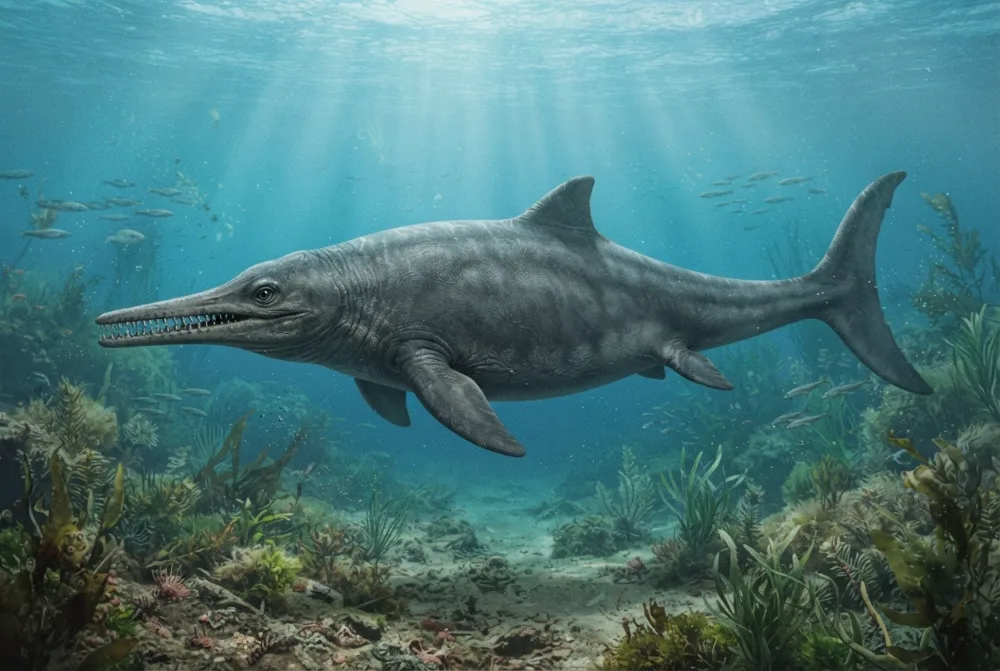
Pervushovisaurus was a fast-swimming marine reptile that looked like a dolphin with a long snout full of sharp teeth. It lived in the seas that covered Europe during the time of the dinosaurs, about 113 to 94 million years ago.31
Ankakhala liti?
Anali wamkulu bwanji?
Anali wautali bwanji?
 wautali ngati agalu 6 otsatizana mphuno ndi mchira🍌wautali ngati nthochi 32 zotsatizana🏊akanatha kusambira utali wa dziwe lalikulu losambira (50 m) m'masekondi 4.1
Pervushovisaurus anali wamkulu bwanji poyerekeza ndi IWEYO?
Ndi masamu chabe mu msakatuli wako. Palibe chimene chimasungidwa kapena kutumizidwa kwina kulikonse.
Anali ndi liwiro lotani?


Mfundo zosangalatsa
Pervushovisaurus was first thought to be a type of Platypterygius, but scientists later decided it was different enough to be its own genus.1
This ichthyosaur had a straight snout, unlike some of its relatives that had curved jaws.1
Its teeth had square roots with sharp 90-degree angles, which is unusual for an ichthyosaur.1
One species, Pervushovisaurus campylodon, was originally named Ichthyosaurus campylodon in 1846.1
Pervushovisaurus lived during the Cretaceous period, at the same time as dinosaurs like Tyrannosaurus and Triceratops, but in the ocean.3
Fossils of Pervushovisaurus have been found in the Melovatka Formation in Russia and the La Penthiève Beds in France.1
Like other ichthyosaurs, Pervushovisaurus gave birth to live young, not laying eggs on land.2
Mafunso ofunsidwa kwambiri okhudza Pervushovisaurus
?How big was Pervushovisaurus?
It was a medium-sized ichthyosaur, measuring about 5.8 metres (19 feet) long.1
?What did Pervushovisaurus eat?
It was a carnivore that ate fish and other sea creatures, using its long snout full of sharp teeth to catch prey.3
?Where did Pervushovisaurus live?
It lived in the seas that covered Europe during the Cretaceous period, and its fossils have been found in Russia, France, and the United Kingdom.1
?Is Pervushovisaurus a dinosaur?
No, it is not a dinosaur. It is an ichthyosaur, a marine reptile that lived in the ocean at the same time as dinosaurs.1
Kwa akatswiri a madino
- Dzina la sayansi
- Pervushovisaurus
- Anapatsidwa dzina ndi
- Arkhangelsky 19983
- Gulu
- Maikitiosauri
- Banja / kladi
- Ophthalmosauridae3
- Magawidwe a sayansi
- Ichthyosauria > Ichthyosauromorpha3
- Zaka za miyala
- zaka 113 mpaka 94 miliyoni (Albian / Cenomanian)3
- Mapangidwe a miyala
- West Melbury Marly Chalk, Melovatskaya, La Penthiève Beds3
- Mayiko
- Falansa, United Kingdom, Rasha, Jeremani3
- Zolemba za mafosili
- 14 mu The Paleobiology Database3
- Kupezeka
- The genus Pervushovisaurus was named by Russian paleontologist M. S. Arkhangelsky in 1998, based on a partial skull from the Saratov region of Russia.13
- Akukambiranabe
- Scientists are still debating whether the two species Pervushovisaurus bannovkensis and Pervushovisaurus campylodon are truly distinct or if they represent the same animal.1
Kumene mfundo zimachokera
- Pervushovisaurus (en.wikipedia.org)
- PBDB Taxon (paleobiodb.org)
- Pervushovisaurus in The Paleobiology Database (CC BY 4.0): zaka, malo, mapangidwe a miyala, magawidwe a sayansi.
Mfundo iliyonse patsamba lino ili ndi nambala yosonyeza kumene yachokera. Ngati talakwitsa kanthu, pepa, ndife okonda madino, osati magazini ya sayansi. Tiuze pa [email protected] ndipo tikonza.
 Rex ali ndi njala! Dino Wiki ndi ntchito ya bambo kwa mwana wawo wamwamuna wokonda madainoso, yaulere popanda zotsatsa ndi zokazonda. Akuluakulu angadyetse Rex zokhwasula-khwasula kuti tsambali lipitirize kupezeka pa intaneti.Dyetsa Rex
 Ichthyosaurus
 Platypterygius
 Stenopterygius
 Khudiakovia
 Ophthalmosaurus
 Chonespondylus
 Stegosaurus
 Iguanodon
 Archaeopteryx
 Giganotosaurus
 Microraptor
 Deinonychus