 Kwizi ya Ndiwe dino uti?
 Nkhondo ya madino
 Mpikisano wa madino
 Masewera ang'onoang'ono a madino
 Chimbale cha zomata
 Mindandanda ya TOP ya madino
 Ndidabwitse!
Petrodactyle
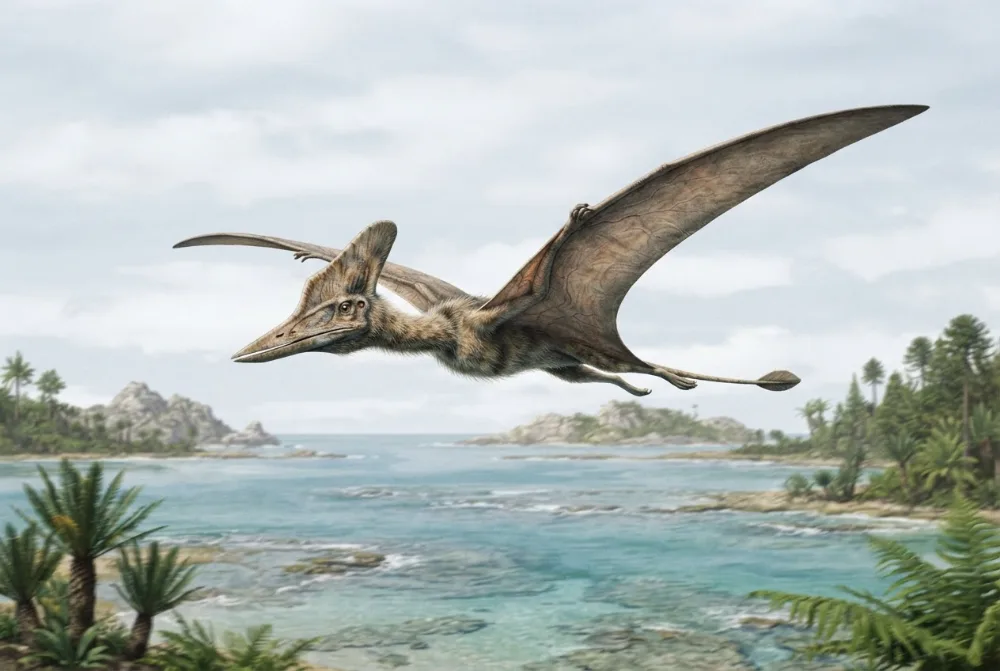
Petrodactyle was a flying reptile that lived in the Late Jurassic period, about 150 million years ago. It had a wingspan of about 2.1 metres (6.9 feet), making it one of the largest pterosaurs from the Solnhofen area of Germany. It also had one of the biggest bony crests on its head of any Jurassic pterosaur.1
Ankakhala liti?
Anali wamkulu bwanji?
Mapiko ake anali otambalala bwanji?
 wautali ngati amphaka a pakhomo 4 otsatizana mphuno ndi mchira⚽akanatha kuuluka kudutsa bwalo lonse la mpira m'masekondi 7.9
Petrodactyle anali wamkulu bwanji poyerekeza ndi IWEYO?
Ndi masamu chabe mu msakatuli wako. Palibe chimene chimasungidwa kapena kutumizidwa kwina kulikonse.
Anali ndi liwiro lotani?


Mfundo zosangalatsa
Petrodactyle is one of the largest pterosaurs known from the Jurassic period, with a wingspan of about 2.1 metres (6.9 feet).1
It had a large bony crest on the back of its skull, which helped give it a powerful bite.1
Its teeth were short and spike-like, and only found in the front half of its jaws. This suggests it grabbed prey with a strong grip.1
Petrodactyle had long legs and could probably wade in shallow water to hunt.1
The only known fossil was found in 2010 in a public quarry in Germany. It is a mostly complete skeleton of a subadult.1
The name Petrodactyle means 'stone finger', a nod to the first pterosaur ever named, Pterodactylus.1
Mafunso ofunsidwa kwambiri okhudza Petrodactyle
?What did Petrodactyle eat?
Petrodactyle was a carnivore, likely feeding on small fish, crustaceans, and other small prey. Its strong bite and spike-like teeth helped it grab slippery food.1
?How big was Petrodactyle?
Petrodactyle had a wingspan of about 2.1 metres (6.9 feet), making it one of the largest pterosaurs from the Solnhofen area and one of the largest Jurassic pterosaurs.21
?Where did Petrodactyle live?
Petrodactyle lived in what is now Germany about 150 million years ago, during the Late Jurassic. Its fossils were found in the Mörnsheim Formation in Bavaria.23
?Why did Petrodactyle have a crest?
The large bony crest on Petrodactyle's skull likely helped anchor jaw muscles, giving it a stronger bite. It may have also been used for display.1
Kwa akatswiri a madino
- Dzina la sayansi
- Petrodactyle
- Anapatsidwa dzina ndi
- Hone et al. 20234
- Gulu
- Zokwawa zouluka
- Banja / kladi
- Gallodactylidae4
- Magawidwe a sayansi
- Pterosauria > Pterodactyloidea4
- Zaka za miyala
- zaka 149 mpaka 145 miliyoni (Tithonian)4
- Mapangidwe a miyala
- Mörnsheim4
- Mayiko
- Jeremani4
- Zolemba za mafosili
- 1 mu The Paleobiology Database4
- Kupezeka
- Petrodactyle was named in 2023 by David Hone, René Lauer, and Frederik Spindler. The only known fossil was found in 2010 in a public quarry in Bavaria, Germany, by Günther Zehetner.1
- Akukambiranabe
- Scientists are not sure exactly what Petrodactyle ate. It may have been a fish-eater, but its strong bite and worn tooth tips suggest it also ate hard-shelled animals like crustaceans.1
Kumene mfundo zimachokera
- A new Solnhofen pterosaur (palaeo-electronica.org)
- Petrodactyle (en.wikipedia.org)
- Jurassic Pterosaur Had Giant Bony Crest on Its Head | Sci.News (sci.news)
- Petrodactyle in The Paleobiology Database (CC BY 4.0): zaka, malo, mapangidwe a miyala, magawidwe a sayansi.
Mfundo iliyonse patsamba lino ili ndi nambala yosonyeza kumene yachokera. Ngati talakwitsa kanthu, pepa, ndife okonda madino, osati magazini ya sayansi. Tiuze pa [email protected] ndipo tikonza.
 Rex ali ndi njala! Dino Wiki ndi ntchito ya bambo kwa mwana wawo wamwamuna wokonda madainoso, yaulere popanda zotsatsa ndi zokazonda. Akuluakulu angadyetse Rex zokhwasula-khwasula kuti tsambali lipitirize kupezeka pa intaneti.Dyetsa Rex
 Pteranodon
 Quetzalcoatlus
 Dorygnathus
 Rhamphorhynchus
 Anhanguera
 Pterodactylus
 Brachiosaurus
 Diplodocus
 Allosaurus
 Brontosaurus
 Compsognathus
 Camarasaurus