 Kwizi ya Ndiwe dino uti?
 Nkhondo ya madino
 Mpikisano wa madino
 Masewera ang'onoang'ono a madino
 Chimbale cha zomata
 Mindandanda ya TOP ya madino
 Ndidabwitse!
Protopteryx
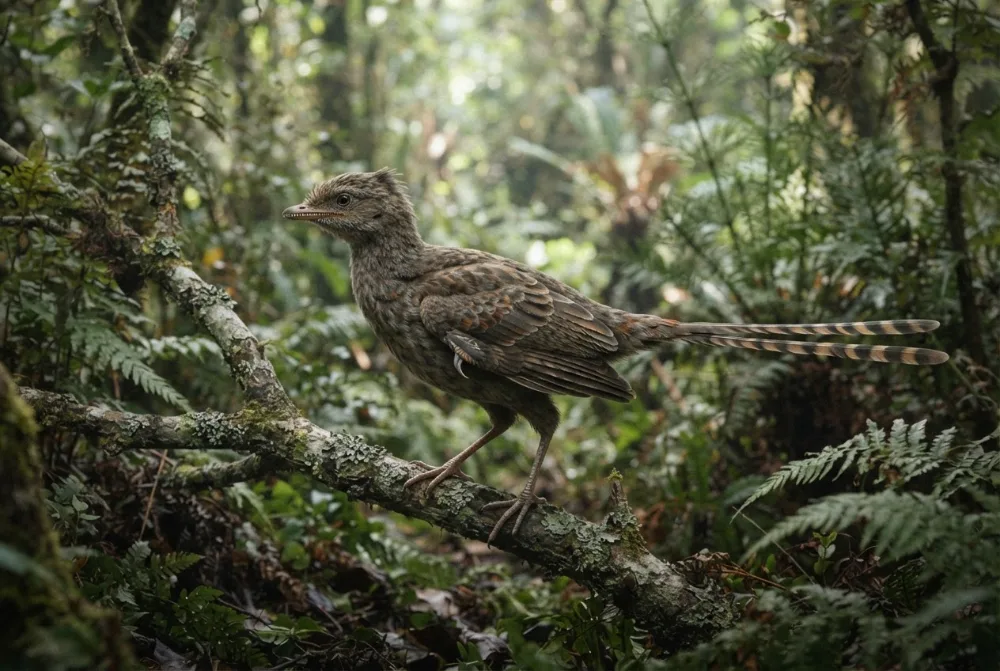
Protopteryx was a tiny early bird that lived about 131 million years ago in what is now China. It had two long, ribbon-like tail feathers that were different from any modern bird's feathers. This little bird could fly and probably ate small animals like insects.14
Ankakhala liti?
Anali wamkulu bwanji?
Anali wautali bwanji?
Msinkhu wake unali wautali bwanji?
kuyerekeza
Ankalemera bwanji?
Protopteryx anali wamkulu bwanji poyerekeza ndi IWEYO?
Ndi masamu chabe mu msakatuli wako. Palibe chimene chimasungidwa kapena kutumizidwa kwina kulikonse.
Anali ndi liwiro lotani?


Mfundo zosangalatsa
Protopteryx is one of the oldest and most primitive members of the group Enantiornithes, which were early birds that lived alongside dinosaurs.1
Its two central tail feathers were scalelike without barbs near the body, only having barbs at the tips. This is similar to the tail feathers of the modern red bird-of-paradise.12
Protopteryx was about the size of a modern starling, with a body length of only 10 centimetres (3.9 inches) not counting its long tail feathers.1
Its body was covered in three types of feathers: down feathers, flight feathers, and the long ribbon-like tail feathers.1
The down feathers of Protopteryx had flat, frayed tips instead of the hairlike barbs seen in modern birds.1
Protopteryx had a triosseal canal, a feature in the shoulder that helped with flight, and this is one of the earliest examples in birds.2
Mafunso ofunsidwa kwambiri okhudza Protopteryx
?How big was Protopteryx?
About 10 centimetres long, not counting its long tail feathers. It was roughly the size of a modern starling.1
?What did Protopteryx eat?
It probably ate small animals like insects. Its teeth are similar to those of Archaeopteryx, which suggests a similar diet.1
?Could Protopteryx fly?
Yes, it was adapted for flying. It had a triosseal canal in its shoulder and asymmetric wing feathers, just like modern flying birds.1
?Why did Protopteryx have long tail feathers?
The long, ribbon-like tail feathers were probably used for display, not for flying. They only had barbs at the tips, similar to the red bird-of-paradise today.1
Kwa akatswiri a madino
- Dzina la sayansi
- Protopteryx
- Anapatsidwa dzina ndi
- Zhang and Zhou 20004
- Gulu
- Mbalame zoyambirira
- Banja / kladi
- Enantiornithes4
- Magawidwe a sayansi
- Theropoda > Avialae4
- Zaka za miyala
- zaka 133 mpaka 121 miliyoni (Hauterivian / Barremian)4
- Mapangidwe a miyala
- Huajiying4
- Mayiko
- China4
- Zolemba za mafosili
- 2 mu The Paleobiology Database4
- Kupezeka
- Protopteryx was named by Chinese paleontologists Fucheng Zhang and Zhonghe Zhou in 2000 based on a fossil found in the Yixian Formation of Hebei Province, China.14
- Akukambiranabe
- Scientists are still debating whether the long, ribbon-like tail feathers of Protopteryx were used for display, thermoregulation, or sensing the environment.1
Kumene mfundo zimachokera
- Protopteryx (en.wikipedia.org)
- A Primitive Enantiornithine Bird and the Origin of Feathers (science.org)
- Anatomy and Flight Performance of the Early Enantiornithine Bird Protopteryx fengningensis : Information from New Specimens of the Early Cretaceous Huajiying Formation of China (anatomypubs.onlinelibrary.wiley.com)
- Protopteryx in The Paleobiology Database (CC BY 4.0): zaka, malo, mapangidwe a miyala, magawidwe a sayansi.
Mfundo iliyonse patsamba lino ili ndi nambala yosonyeza kumene yachokera. Ngati talakwitsa kanthu, pepa, ndife okonda madino, osati magazini ya sayansi. Tiuze pa [email protected] ndipo tikonza.
 Rex ali ndi njala! Dino Wiki ndi ntchito ya bambo kwa mwana wawo wamwamuna wokonda madainoso, yaulere popanda zotsatsa ndi zokazonda. Akuluakulu angadyetse Rex zokhwasula-khwasula kuti tsambali lipitirize kupezeka pa intaneti.Dyetsa Rex
 Archaeopteryx
 Hesperornis
 Ichthyornis
 Baptornis
 Jurapteryx
 Gobipteryx
 Stegosaurus
 Iguanodon
 Giganotosaurus
 Microraptor
 Deinonychus
 Baryonyx