 Kwizi ya Ndiwe dino uti?
 Nkhondo ya madino
 Mpikisano wa madino
 Masewera ang'onoang'ono a madino
 Chimbale cha zomata
 Mindandanda ya TOP ya madino
 Ndidabwitse!
Simbirskiasaurus
Simbirskiasaurus was a fast-swimming marine reptile that lived in the Early Cretaceous seas. It had a long snout and sharp teeth for catching fish and squid. This ichthyosaur was not a dinosaur, but a reptile that breathed air like a dolphin.31
Ankakhala liti?
Anali wamkulu bwanji?
Anali wautali bwanji?
 wautali ngati agalu 5 otsatizana mphuno ndi mchira🍌wautali ngati nthochi 28 zotsatizana🏊akanatha kusambira utali wa dziwe lalikulu losambira (50 m) m'masekondi 3.9
Simbirskiasaurus anali wamkulu bwanji poyerekeza ndi IWEYO?
Ndi masamu chabe mu msakatuli wako. Palibe chimene chimasungidwa kapena kutumizidwa kwina kulikonse.
Anali ndi liwiro lotani?


Mfundo zosangalatsa
Simbirskiasaurus had a divided nostril opening, with a bony pillar separating it into two parts. This is a rare feature among ichthyosaurs.1
Its skull bones show deep interlocking joints between the prefrontal and lacrimal bones, similar to the much older ichthyosaur Temnodontosaurus.1
The only known fossil is a partial skull and backbone, found in clay from the Simbirskites Clay formation.13
Scientists once thought Simbirskiasaurus was a doubtful name, but a 2014 study confirmed it is a valid genus of platypterygiine ichthyosaur.2
It lived about 130 million years ago, during the early Barremian stage of the Early Cretaceous.1
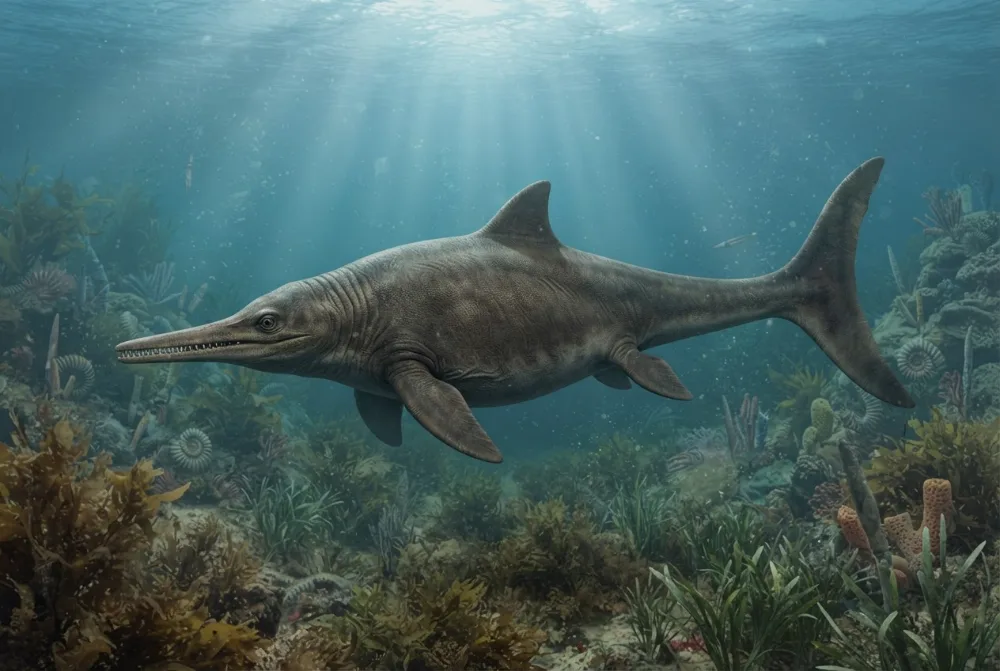
Wothetsa nthano zabodza
Nthano: Simbirskiasaurus is a dinosaur.
Zoona: Simbirskiasaurus is an ichthyosaur, a marine reptile that lived in the ocean and was not a dinosaur.1
Kwa akatswiri a madino
- Dzina la sayansi
- Simbirskiasaurus
- Anapatsidwa dzina ndi
- Otschev and Efimov 19853
- Gulu
- Maikitiosauri
- Banja / kladi
- Ophthalmosauridae3
- Magawidwe a sayansi
- Ichthyosauria > Ichthyosauromorpha3
- Zaka za miyala
- zaka 126 mpaka 121 miliyoni (Barremian)3
- Mapangidwe a miyala
- Simbirskites Clay3
- Mayiko
- Rasha3
- Zolemba za mafosili
- 1 mu The Paleobiology Database3
- Kupezeka
- Simbirskiasaurus was named by Russian paleontologists V. G. Otschev and V. M. Efimov in 1985, based on a fragmentary skull and backbone found near the Volga River in Russia.31
- Akukambiranabe
- Scientists are not sure about the exact size of Simbirskiasaurus because only a partial skull and backbone have been found.1
Kumene mfundo zimachokera
- Simbirskiasaurus (en.wikipedia.org)
- Simbirskiasaurus and Pervushovisaurus reassessed: implications for the taxonomy and cranial osteology of Cretaceous platypterygiine ichthyosaurs - Fischer - 2014 - Zoological Journal of the Linnean Society - Wiley Online Library (onlinelibrary.wiley.com)
- Simbirskiasaurus in The Paleobiology Database (CC BY 4.0): zaka, malo, mapangidwe a miyala, magawidwe a sayansi.
Mfundo iliyonse patsamba lino ili ndi nambala yosonyeza kumene yachokera. Ngati talakwitsa kanthu, pepa, ndife okonda madino, osati magazini ya sayansi. Tiuze pa [email protected] ndipo tikonza.
 Rex ali ndi njala! Dino Wiki ndi ntchito ya bambo kwa mwana wawo wamwamuna wokonda madainoso, yaulere popanda zotsatsa ndi zokazonda. Akuluakulu angadyetse Rex zokhwasula-khwasula kuti tsambali lipitirize kupezeka pa intaneti.Dyetsa Rex
 Ichthyosaurus
 Platypterygius
 Stenopterygius
 Khudiakovia
 Ophthalmosaurus
 Chonespondylus
 Stegosaurus
 Iguanodon
 Archaeopteryx
 Giganotosaurus
 Microraptor
 Deinonychus