 Kwizi ya Ndiwe dino uti?
 Nkhondo ya madino
 Mpikisano wa madino
 Masewera ang'onoang'ono a madino
 Chimbale cha zomata
 Mindandanda ya TOP ya madino
 Ndidabwitse!
Sisteronia
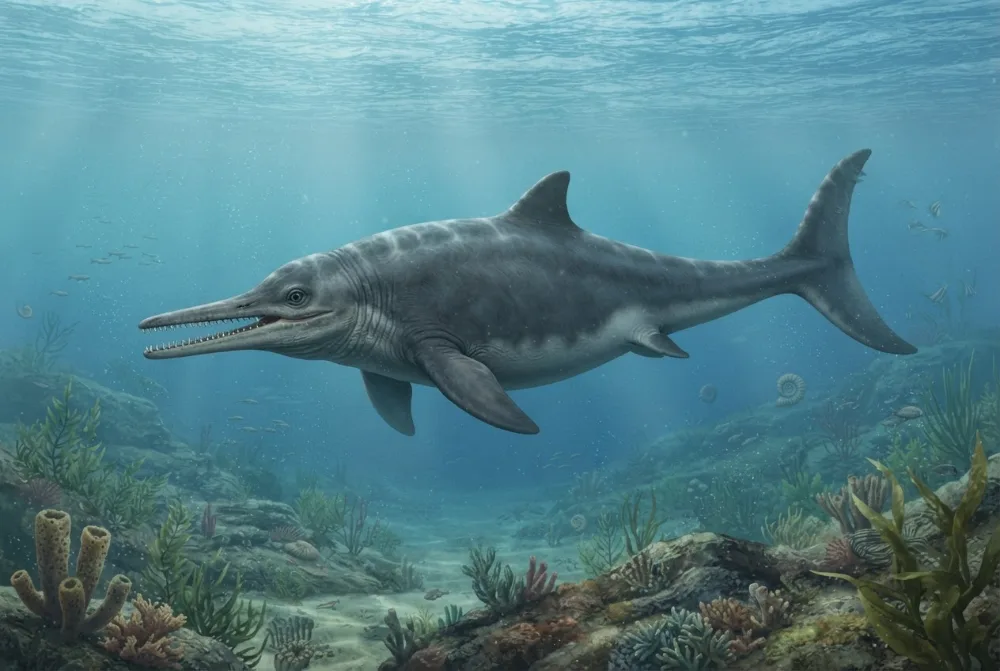
Sisteronia was a fast-swimming marine reptile that lived in the Cretaceous seas. It had sharp teeth for catching small fish and squid. Sisteronia was an ichthyosaur, not a dinosaur, and looked a bit like a modern dolphin.12
Ankakhala liti?
Anali ndi liwiro lotani?


Mfundo zosangalatsa
Sisteronia had teeth that were rectangular in cross-section, which is unusual among ichthyosaurs.2
It lived during the Albian and early Cenomanian stages of the Cretaceous, about 112 to 100 million years ago.2
Sisteronia is known from fossils found in England, France, and Russia, showing it lived in the seas of western Europe.3
This ichthyosaur belonged to the group Platypterygiinae, which were the last surviving ichthyosaurs before they went extinct.2
The name Sisteronia comes from the town of Sisteron in France, near where some of its fossils were found.1
Sisteronia had a raised process on the floor of the foramen magnum (the hole in the skull for the spinal cord), a unique feature not seen in other ichthyosaurs.2
Kwa akatswiri a madino
- Dzina la sayansi
- Sisteronia
- Anapatsidwa dzina ndi
- Fischer et al. 20143
- Gulu
- Maikitiosauri
- Banja / kladi
- Ophthalmosauridae3
- Magawidwe a sayansi
- Ichthyosauria > Ichthyosauromorpha3
- Zaka za miyala
- zaka 113 mpaka 94 miliyoni (Albian / Cenomanian)3
- Mapangidwe a miyala
- Marnes bleues, West Melbury Marly Chalk, Gault3
- Mayiko
- United Kingdom, Falansa, Rasha3
- Zolemba za mafosili
- 6 mu The Paleobiology Database3
- Kupezeka
- Sisteronia was named by Fischer and colleagues in 2014, based on fossils from the Cambridge Greensand Member in England and the Vocontian Basin in France.31
- Akukambiranabe
- Scientists are still debating exactly how diverse late Cretaceous ichthyosaurs were, and whether Sisteronia was part of a broader European hotspot of ichthyosaur diversity.1
Kumene mfundo zimachokera
- High Diversity in Cretaceous Ichthyosaurs from Europe Prior to Their Extinction (pmc.ncbi.nlm.nih.gov)
- Sisteronia (en.wikipedia.org)
- Sisteronia in The Paleobiology Database (CC BY 4.0): zaka, malo, mapangidwe a miyala, magawidwe a sayansi.
Mfundo iliyonse patsamba lino ili ndi nambala yosonyeza kumene yachokera. Ngati talakwitsa kanthu, pepa, ndife okonda madino, osati magazini ya sayansi. Tiuze pa [email protected] ndipo tikonza.
 Rex ali ndi njala! Dino Wiki ndi ntchito ya bambo kwa mwana wawo wamwamuna wokonda madainoso, yaulere popanda zotsatsa ndi zokazonda. Akuluakulu angadyetse Rex zokhwasula-khwasula kuti tsambali lipitirize kupezeka pa intaneti.Dyetsa Rex
 Ichthyosaurus
 Platypterygius
 Stenopterygius
 Khudiakovia
 Ophthalmosaurus
 Chonespondylus
 Stegosaurus
 Iguanodon
 Archaeopteryx
 Giganotosaurus
 Microraptor
 Deinonychus