 Kwizi ya Ndiwe dino uti?
 Nkhondo ya madino
 Mpikisano wa madino
 Masewera ang'onoang'ono a madino
 Chimbale cha zomata
 Mindandanda ya TOP ya madino
 Ndidabwitse!
Ankakhala liti?

Anali wamkulu bwanji?
Anali wautali bwanji?
Msinkhu wake unali wautali bwanji?
kuyerekeza
Ankalemera bwanji?
 wautali ngati magalimoto 4 oimikidwa pamzere🍌wautali ngati nthochi 99 zotsatizana
 wolemera ngati njovu 1.5🍉wolemera ngati mavwende 1600🎒wolemera ngati makalasi athunthu a ana a sukulu 10🐻❄️wolemera ngati zimbalangondo zoyera 18🏃akanatha kuthamanga mamita 100 m'masekondi 22 (munthu waliwiro kwambiri amafunika 9.6)
Tambatitanis anali wamkulu bwanji poyerekeza ndi IWEYO?
Ndi masamu chabe mu msakatuli wako. Palibe chimene chimasungidwa kapena kutumizidwa kwina kulikonse.
Anali ndi liwiro lotani?


Mfundo zosangalatsa
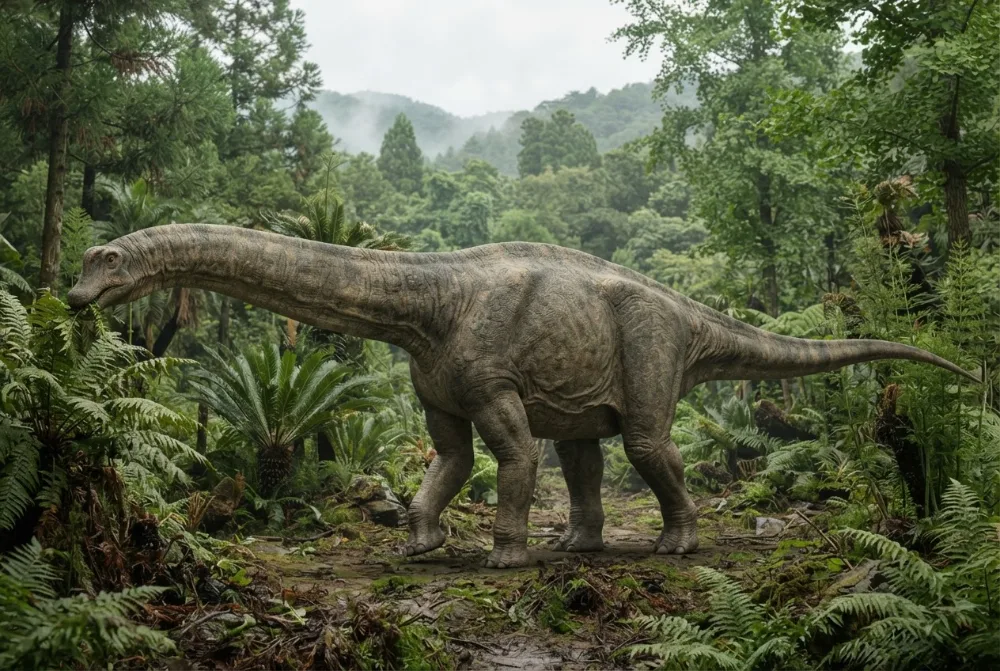
Tambatitanis is known from a partial skeleton that includes 22 tail bones and 17 chevrons (bones under the tail).1
Its front chevron is the longest of any sauropod when compared to body size.2
The fossil was found in a riverbed and took five field seasons to dig out because water covered it most of the year.1
Tambatitanis lived about 113 to 110 million years ago, during the Early Cretaceous.4
Scientists think Tambatitanis might belong to a group of sauropods called Euhelopodidae, which are only found in East Asia.2
The name Tambatitanis comes from Tamba, the area in Japan where it was found, and the Greek word for giant.1
Mafunso ofunsidwa kwambiri okhudza Tambatitanis
?How big was Tambatitanis?
Nobody knows for sure because only a partial skeleton has been found. It was a large sauropod, but its exact length and weight are not known.1
?What did Tambatitanis eat?
It was a plant-eater. It used its peg-like teeth to munch on leaves.1
?Where was Tambatitanis found?
Its fossils were discovered in a riverbed in Tamba-Sasayama, Hyōgo Prefecture, Japan. It took five field seasons to dig them out because water covered the site most of the year.1
?Is Tambatitanis a dinosaur?
Yes, it is a dinosaur. It is a titanosauriform sauropod from the Early Cretaceous.1
Kwa akatswiri a madino
- Dzina la sayansi
- Tambatitanis
- Anapatsidwa dzina ndi
- Saegusa and Ikeda 20144
- Gulu
- Makosi atali
- Banja / kladi
- Euhelopodidae4
- Magawidwe a sayansi
- Sauropodomorpha > Sauropoda > Macronaria4
- Zaka za miyala
- zaka 113 mpaka 110 miliyoni (Albian)4
- Mapangidwe a miyala
- Ohyamashimo4
- Mayiko
- Japani4
- Zolemba za mafosili
- 1 mu The Paleobiology Database4
- Kupezeka
- Tambatitanis was discovered in August 2006 by Shigeru Murakami and Kiyoshi Adachi in a riverbed in Hyogo, Japan. It was named and described by Haruo Saegusa and Tadahiro Ikeda in 2014.1
- Akukambiranabe
- Scientists are not sure whether Tambatitanis was a basal titanosauriform or a true titanosaur. Its exact place in the family tree is still debated.1
Kumene mfundo zimachokera
- Tambatitanis (en.wikipedia.org)
- A new titanosauriform sauropod (Dinosauria: Saurischia) from the Lower Cretaceous of Hyogo, Japan | Zootaxa (mapress.com)
- Tambatitanis amicitiae | Dinosaur Database by DinoAnimals.com (dinoanimals.com)
- Tambatitanis in The Paleobiology Database (CC BY 4.0): zaka, malo, mapangidwe a miyala, magawidwe a sayansi.
Mfundo iliyonse patsamba lino ili ndi nambala yosonyeza kumene yachokera. Ngati talakwitsa kanthu, pepa, ndife okonda madino, osati magazini ya sayansi. Tiuze pa [email protected] ndipo tikonza.
 Rex ali ndi njala! Dino Wiki ndi ntchito ya bambo kwa mwana wawo wamwamuna wokonda madainoso, yaulere popanda zotsatsa ndi zokazonda. Akuluakulu angadyetse Rex zokhwasula-khwasula kuti tsambali lipitirize kupezeka pa intaneti.Dyetsa Rex
 Brachiosaurus
 Diplodocus
 Brontosaurus
 Argentinosaurus
 Camarasaurus
 Morosaurus
 Stegosaurus
 Iguanodon
 Archaeopteryx
 Giganotosaurus
 Microraptor
 Deinonychus