 Kwizi ya Ndiwe dino uti?
 Nkhondo ya madino
 Mpikisano wa madino
 Masewera ang'onoang'ono a madino
 Chimbale cha zomata
 Mindandanda ya TOP ya madino
 Ndidabwitse!
Triceratops
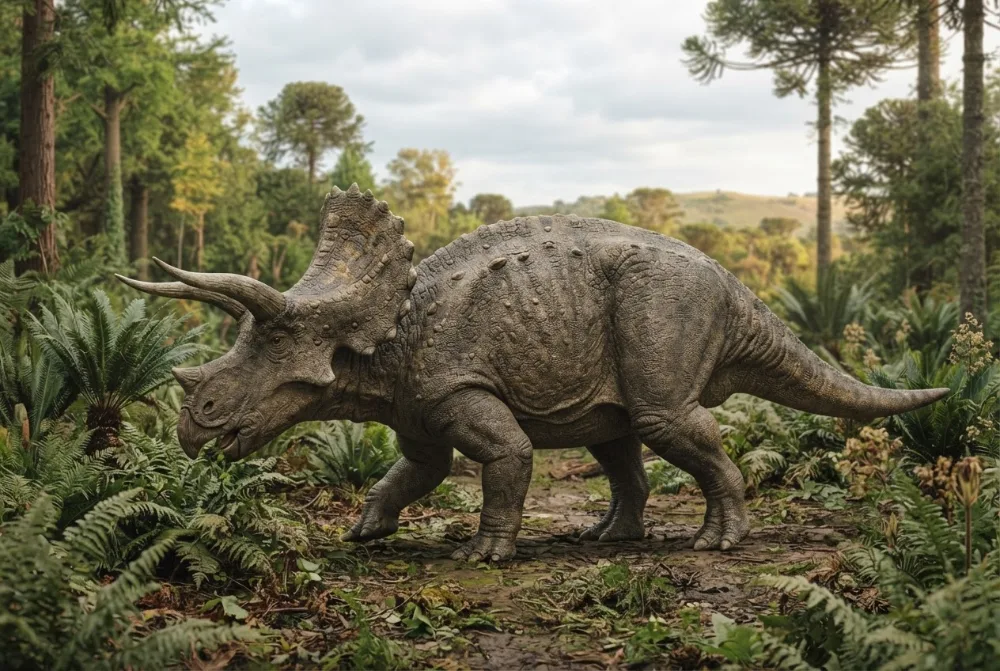
Triceratops was a huge plant-eater with a big frill on its head and three horns. It lived at the very end of the age of dinosaurs, about 66 million years ago. It was one of the last horned dinosaurs to walk the Earth.1
Ankakhala liti?
Anali wamkulu bwanji?
Anali wautali bwanji?
Msinkhu wake unali wautali bwanji?
Ankalemera bwanji?

 wautali ngati magalimoto 2 oimikidwa pamzere🍌wautali ngati nthochi 50 zotsatizanawolemera ngati magalimoto 8🍉wolemera ngati mavwende 2400🎒wolemera ngati makalasi athunthu a ana a sukulu 15🐻❄️wolemera ngati zimbalangondo zoyera 27🏃akanatha kuthamanga mamita 100 m'masekondi 12 (munthu waliwiro kwambiri amafunika 9.6)
Triceratops anali wamkulu bwanji poyerekeza ndi IWEYO?
Ndi masamu chabe mu msakatuli wako. Palibe chimene chimasungidwa kapena kutumizidwa kwina kulikonse.
Anali ndi liwiro lotani?


Mfundo zosangalatsa
Triceratops had a huge frill made of solid bone at the back of its skull, which may have been used to attract mates or scare off rivals.1
Its name means 'three-horned face' because it had two long brow horns and a smaller horn on its nose.1
Triceratops lived right up to the mass extinction that killed the non-bird dinosaurs, about 66 million years ago.1
Fossils of Triceratops have been found in huge bonebeds, with many individuals together, suggesting they may have lived in herds.1
Triceratops had a strong beak like a parrot's, which it used to bite off tough plants.1
Some scientists think Triceratops could have fought predators like Tyrannosaurus rex using its sharp horns.1
Mafunso ofunsidwa kwambiri okhudza Triceratops
?How big was Triceratops?
Triceratops was about 8 to 9 metres (26 to 30 feet) long and weighed between 6 and 10 tonnes (13,000 to 22,000 pounds). That is roughly as long as a school bus and as heavy as a large elephant.12
?What did Triceratops eat?
Triceratops was a plant-eater that ate low-growing plants like ferns, cycads and palms. It used its sharp, parrot-like beak to snip off tough leaves and had up to 800 teeth to grind them up.23
?Did Triceratops live in herds?
Most Triceratops fossils are found alone, so scientists think they usually lived alone. However, a few young Triceratops were found together, which suggests they might have stayed in small groups sometimes.23
?Could Triceratops fight T. rex?
Yes, Triceratops probably fought Tyrannosaurus rex. One fossil shows a Triceratops horn that was bitten by a T. rex and then healed, proving these dinosaurs really did battle.21
?Why did Triceratops have a frill?
The frill may have helped protect its neck, but it was not always enough since T. rex bite marks have been found on frills. It was also used to attract mates and help Triceratops recognize each other.23
?How fast could Triceratops run?
Up to about 30 km/h (19 mph) for a short dash, about as fast as a fast human runner. This is an estimate: nobody knows for sure. Triceratops was very heavy and walked on four legs, but its legs were strong, a bit like a rhino's.1
?When did Triceratops go extinct?
Triceratops died out about 66 million years ago, at the same time as the big mass extinction that killed all non-bird dinosaurs. It was one of the last horned dinosaurs alive.21
?Where was Triceratops found?
Triceratops fossils have been found in western North America, especially in the United States (Wyoming, Montana, Colorado, South Dakota) and in Canada (Alberta and Saskatchewan).23
?How many horns did Triceratops have?
Triceratops had three horns: two long ones above its eyes, each up to 1 metre (3.3 feet) long, and a shorter one on its nose. Its name means 'three-horned face'.24
?Was Triceratops bigger than T. rex?
Triceratops was generally smaller than T. rex. Triceratops was about 8 to 9 metres long, while T. rex could reach over 12 metres in length.1
Wothetsa nthano zabodza
Nthano: Triceratops was a slow, clumsy animal that could barely move.
Zoona: Triceratops was actually quite fast for its size, able to run at speeds of up to 30 km/h (about 20 mph) on its strong legs.1
Kwa akatswiri a madino
- Dzina la sayansi
- Triceratops
- Anapatsidwa dzina ndi
- Marsh 18895
- Gulu
- Madino a nyanga
- Banja / kladi
- Ceratopsidae5
- Magawidwe a sayansi
- Ornithischia > Ceratopsia > Ceratopsidae5
- Zaka za miyala
- zaka 84 mpaka 66 miliyoni (Campanian / Maastrichtian)5
- Mapangidwe a miyala
- Lance, Hell Creek, Frenchman5
- Mayiko
- Amereka, Kanada5
- Zolemba za mafosili
- 166 mu The Paleobiology Database5
- Amadziwikanso kuti
- Diceratops, Diceratus, Nedoceratops, Sterrholophus (mayina akale tsopano amawerengedwa ngati nyama yomweyi)5
- Kupezeka
- Triceratops was named by paleontologist Othniel Charles Marsh in 1889, based on fossils found in Wyoming, USA.5
- Akukambiranabe
- Scientists still debate whether some fossils belong to Triceratops or to a separate, related dinosaur called Torosaurus.1
Kumene mfundo zimachokera
- Triceratops (en.wikipedia.org)
- Triceratops | Natural History Museum (nhm.ac.uk)
- Triceratops | The Canadian Encyclopedia (thecanadianencyclopedia.ca)
- Triceratops summary | Britannica (britannica.com)
- Triceratops in The Paleobiology Database (CC BY 4.0): zaka, malo, mapangidwe a miyala, magawidwe a sayansi.
Mfundo iliyonse patsamba lino ili ndi nambala yosonyeza kumene yachokera. Ngati talakwitsa kanthu, pepa, ndife okonda madino, osati magazini ya sayansi. Tiuze pa [email protected] ndipo tikonza.
 Rex ali ndi njala! Dino Wiki ndi ntchito ya bambo kwa mwana wawo wamwamuna wokonda madainoso, yaulere popanda zotsatsa ndi zokazonda. Akuluakulu angadyetse Rex zokhwasula-khwasula kuti tsambali lipitirize kupezeka pa intaneti.Dyetsa Rex
 Protoceratops
 Ojoceratops
 Tatankaceratops
 Psittacosaurus
 Centrosaurus
 Chasmosaurus
 Tyrannosaurus
 Velociraptor
 Spinosaurus
 Ankylosaurus
 Parasaurolophus
 Pteranodon