 Kwizi ya Ndiwe dino uti?
 Nkhondo ya madino
 Mpikisano wa madino
 Masewera ang'onoang'ono a madino
 Chimbale cha zomata
 Mindandanda ya TOP ya madino
 Ndidabwitse!
Tyrannosaurus
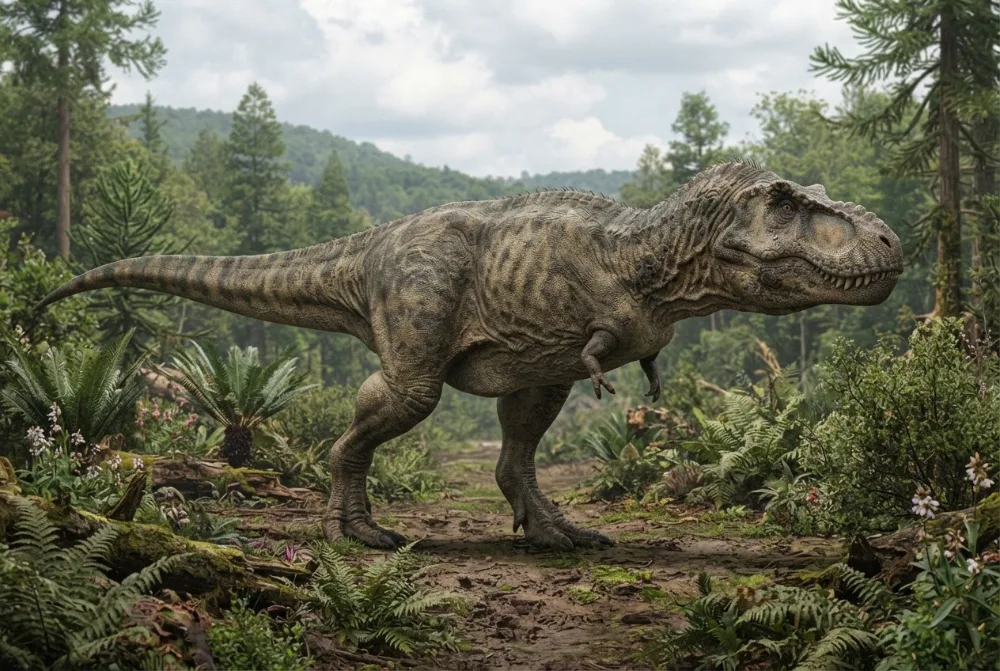
Tyrannosaurus rex was one of the biggest meat-eating dinosaurs that ever lived. It stomped across western North America about 69 to 66 million years ago, at the very end of the Age of Dinosaurs. With its huge skull, powerful legs, and tiny arms, it was the king of its prehistoric world.1
Ankakhala liti?
Anali wamkulu bwanji?
Anali wautali bwanji?
Msinkhu wake unali wautali bwanji?
Ankalemera bwanji?
 wautali ngati magalimoto 3 oimikidwa pamzere🍌wautali ngati nthochi 72 zotsatizana
 wolemera ngati njovu 1.5🍉wolemera ngati mavwende 1800🎒wolemera ngati makalasi athunthu a ana a sukulu 11🐻❄️wolemera ngati zimbalangondo zoyera 20🏃akanatha kuthamanga mamita 100 m'masekondi 15 (munthu waliwiro kwambiri amafunika 9.6)
Tyrannosaurus anali wamkulu bwanji poyerekeza ndi IWEYO?
Ndi masamu chabe mu msakatuli wako. Palibe chimene chimasungidwa kapena kutumizidwa kwina kulikonse.
Anali ndi liwiro lotani?


Mfundo zosangalatsa
Tyrannosaurus had the most powerful bite of any land animal ever, with a force of 35,000 to 57,000 newtons in its back teeth.1
Its arms were very short but surprisingly strong, with two clawed fingers on each hand.1
The first Tyrannosaurus rex fossil was a tooth found in Colorado in 1874, but the animal wasn't named until 1905.1
A set of footprints from Wyoming shows that a young Tyrannosaurus walked at a speed of about 2.8 to 5 miles per hour.1
Tyrannosaurus lived on an island continent called Laramidia, which was separated by a shallow sea from the eastern part of North America.1
Mafunso ofunsidwa kwambiri okhudza Tyrannosaurus
?How big was Tyrannosaurus?
About 12 to 13 metres (40 to 43 feet) long, 3.7 to 4 metres (12 to 13 feet) tall at the hip, and weighed up to 8.8 tonnes (9.7 tons).13
?What did Tyrannosaurus eat?
It was a meat-eater that hunted large dinosaurs like Edmontosaurus and Triceratops, and probably also scavenged. Its powerful jaws and serrated teeth could crush bone.43
?How fast could Tyrannosaurus run?
Up to about 24 km/h (15 mph), about as fast as a grown-up riding a bike. T. rex was too heavy to really run like a horse, so most scientists think it moved with a big, fast power walk. That was still fast enough to catch other large dinosaurs.43
?Why were Tyrannosaurus arms so small?
Nobody knows for sure. One idea is that as its head grew bigger, the arms got shorter to keep the dinosaur balanced. They were still very strong and had two claws.43
?When did Tyrannosaurus live?
It lived about 69 to 66 million years ago, at the very end of the Cretaceous Period, just before the dinosaurs went extinct.14
?Where did Tyrannosaurus live?
It lived in western North America, on an island continent called Laramidia. Fossils have been found in the United States (like Montana and Wyoming) and Canada.14
?Was Tyrannosaurus the biggest meat-eating dinosaur?
It was one of the largest land predators ever, but some other dinosaurs like Giganotosaurus and Spinosaurus were similar in size. T. rex was the biggest predator in its own time and place.41
?Did Tyrannosaurus have feathers?
Some scientists think young T. rex may have had a light covering of feathers, but adults probably had mostly scaly skin. No direct fossil feathers have been found on T. rex.1
?How strong was Tyrannosaurus bite?
It had the most powerful bite of any land animal ever, with a force of 35,000 to 57,000 newtons in its back teeth. That is a very strong bite.1
Wothetsa nthano zabodza
Nthano: Tyrannosaurus rex was just a slow scavenger that only ate dead animals.
Zoona: Most paleontologists now agree that T. rex was an active predator that hunted live prey, though it also scavenged when it had the chance.1
Kwa akatswiri a madino
- Dzina la sayansi
- Tyrannosaurus
- Anapatsidwa dzina ndi
- Osborn 19055
- Gulu
- Matiranosauri
- Banja / kladi
- Tyrannosauridae5
- Magawidwe a sayansi
- Theropoda > Tyrannosauroidea > Tyrannosauridae5
- Zaka za miyala
- zaka 84 mpaka 66 miliyoni (Campanian / Maastrichtian)5
- Mapangidwe a miyala
- Hell Creek, Lance, Denver5
- Mayiko
- Amereka, Kanada, Rasha, Mekisiko, China5
- Zolemba za mafosili
- 87 mu The Paleobiology Database5
- Amadziwikanso kuti
- Dinotyrannus, Dynamosaurus, Manospondylus, Stygivenator (mayina akale tsopano amawerengedwa ngati nyama yomweyi)5
- Kupezeka
- Barnum Brown of the American Museum of Natural History found the first partial skeleton in Wyoming in 1900, and a more complete one in Montana in 1902. Henry Fairfield Osborn named it Tyrannosaurus rex in 1905.12
- Akukambiranabe
- Scientists still debate whether some smaller tyrannosaur fossils belong to a separate genus called Nanotyrannus or are just young Tyrannosaurus rex.1
Kumene mfundo zimachokera
- Tyrannosaurus (en.wikipedia.org)
- Bulletin of the American Museum of Natural History/Volume 21/Tyrannosaurus and Other Cretaceous Carnivorous Dinosaurs - Wikisource, the free online library (en.wikisource.org)
- Dinosaur - Tyrannosaurus rex - The Australian Museum (australian.museum)
- si.edu (si.edu)
- Tyrannosaurus in The Paleobiology Database (CC BY 4.0): zaka, malo, mapangidwe a miyala, magawidwe a sayansi.
Mfundo iliyonse patsamba lino ili ndi nambala yosonyeza kumene yachokera. Ngati talakwitsa kanthu, pepa, ndife okonda madino, osati magazini ya sayansi. Tiuze pa [email protected] ndipo tikonza.
 Rex ali ndi njala! Dino Wiki ndi ntchito ya bambo kwa mwana wawo wamwamuna wokonda madainoso, yaulere popanda zotsatsa ndi zokazonda. Akuluakulu angadyetse Rex zokhwasula-khwasula kuti tsambali lipitirize kupezeka pa intaneti.Dyetsa Rex
 Tarbosaurus
 Albertosaurus
 Daspletosaurus
 Gorgosaurus
 Alectrosaurus
 Dryptosaurus
 Triceratops
 Velociraptor
 Spinosaurus
 Ankylosaurus
 Parasaurolophus
 Pteranodon