 Kwizi ya Ndiwe dino uti?
 Nkhondo ya madino
 Mpikisano wa madino
 Masewera ang'onoang'ono a madino
 Chimbale cha zomata
 Mindandanda ya TOP ya madino
 Ndidabwitse!
Xingxiulong
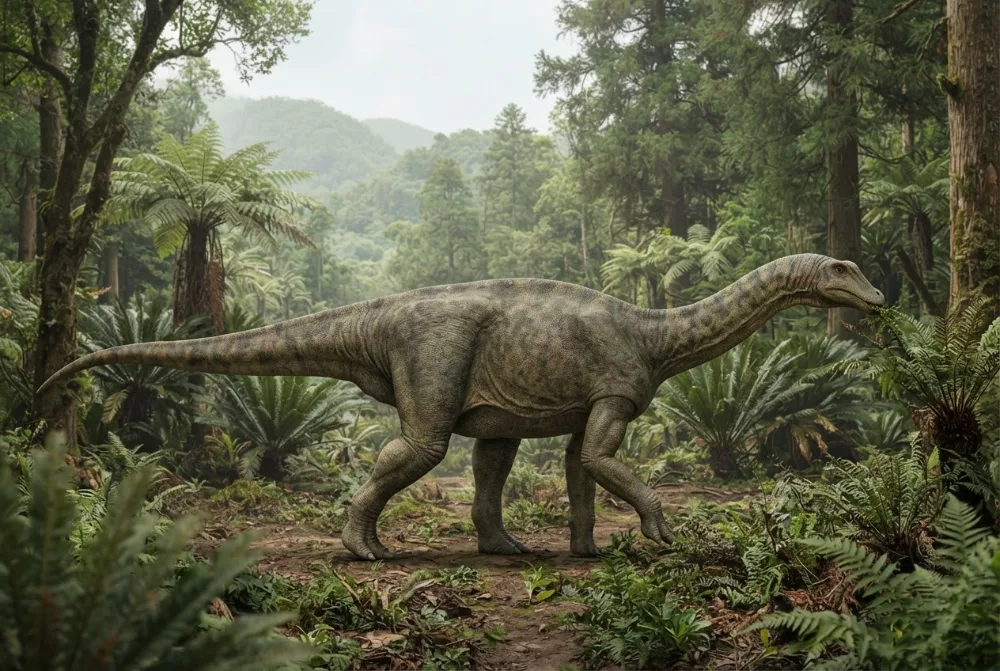
Xingxiulong was a long-necked plant-eater that lived in China during the Early Jurassic. It walked on two legs and had a strong, heavy body like a small sauropod. Three skeletons were found buried together, including two adults and a teenager.21
Ankakhala liti?
Anali wamkulu bwanji?
Anali wautali bwanji?
Msinkhu wake unali wautali bwanji?
 wautali ngati agalu 5 otsatizana mphuno ndi mchira🍌wautali ngati nthochi 28 zotsatizana🏃akanatha kuthamanga mamita 100 m'masekondi 10 (munthu waliwiro kwambiri amafunika 9.6)
Xingxiulong anali wamkulu bwanji poyerekeza ndi IWEYO?
Ndi masamu chabe mu msakatuli wako. Palibe chimene chimasungidwa kapena kutumizidwa kwina kulikonse.
Anali ndi liwiro lotani?


Mfundo zosangalatsa
Xingxiulong had four vertebrae in its sacrum (hip region), which is a feature usually seen in true sauropods.21
Its pubis (hip bone) had a very long top plate, about 40% of the total length of the bone.2
Xingxiulong was bipedal, meaning it walked on two legs, unlike later sauropods that used all four legs.1
The three skeletons were found together in purple silty mudstone from the Shawan Member of the Lufeng Formation.21
One skeleton was about 14% smaller than the others and had unfused vertebrae, showing it was a subadult.21
Xingxiulong is one of the oldest and most primitive members of the group Sauropodiformes, which includes all sauropods.2
Mafunso ofunsidwa kwambiri okhudza Xingxiulong
?How big was Xingxiulong?
About 4 to 5 metres (13 to 16 ft) long and 1 to 1.5 metres (3.3 to 4.9 ft) tall at the hip for the first species. A second species was larger, at 8 to 10 metres (26 to 33 ft) long.12
?Did Xingxiulong walk on two legs?
Yes, it was bipedal. Unlike later sauropods that used all four legs, Xingxiulong walked on two legs.12
?What did Xingxiulong eat?
It was a plant-eater. Its strong, heavy body and large gut helped it digest tough plants.1
Kwa akatswiri a madino
- Dzina la sayansi
- Xingxiulong
- Anapatsidwa dzina ndi
- Wang et al. 20173
- Gulu
- Makosi atali
- Banja / kladi
- Sauropodiformes3
- Magawidwe a sayansi
- Sauropodomorpha3
- Zaka za miyala
- zaka 201 mpaka 175 miliyoni (Hettangian / Toarcian)3
- Mapangidwe a miyala
- Lufeng3
- Mayiko
- China3
- Zolemba za mafosili
- 2 mu The Paleobiology Database3
- Kupezeka
- Xingxiulong was named in 2017 by Wang, You, and Wang. The fossils were dug up in 2013 near Sankeshu Village in Lufeng County, China.21
- Akukambiranabe
- Scientists are not sure whether Xingxiulong was more closely related to Jingshanosaurus or to other sauropodiformes.1
Kumene mfundo zimachokera
- Xingxiulong (en.wikipedia.org)
- A new basal sauropodiform dinosaur from the Lower Jurassic of Yunnan Province, China | Scientific Reports (nature.com)
- Xingxiulong in The Paleobiology Database (CC BY 4.0): zaka, malo, mapangidwe a miyala, magawidwe a sayansi.
Mfundo iliyonse patsamba lino ili ndi nambala yosonyeza kumene yachokera. Ngati talakwitsa kanthu, pepa, ndife okonda madino, osati magazini ya sayansi. Tiuze pa [email protected] ndipo tikonza.
 Rex ali ndi njala! Dino Wiki ndi ntchito ya bambo kwa mwana wawo wamwamuna wokonda madainoso, yaulere popanda zotsatsa ndi zokazonda. Akuluakulu angadyetse Rex zokhwasula-khwasula kuti tsambali lipitirize kupezeka pa intaneti.Dyetsa Rex
 Brachiosaurus
 Diplodocus
 Brontosaurus
 Argentinosaurus
 Camarasaurus
 Morosaurus
 Dilophosaurus
 Stenopterygius
 Dorygnathus
 Scutellosaurus
 Sinosaurus
 Temnodontosaurus