 Kwizi ya Ndiwe dino uti?
 Nkhondo ya madino
 Mpikisano wa madino
 Masewera ang'onoang'ono a madino
 Chimbale cha zomata
 Mindandanda ya TOP ya madino
 Ndidabwitse!
Zhengheornis
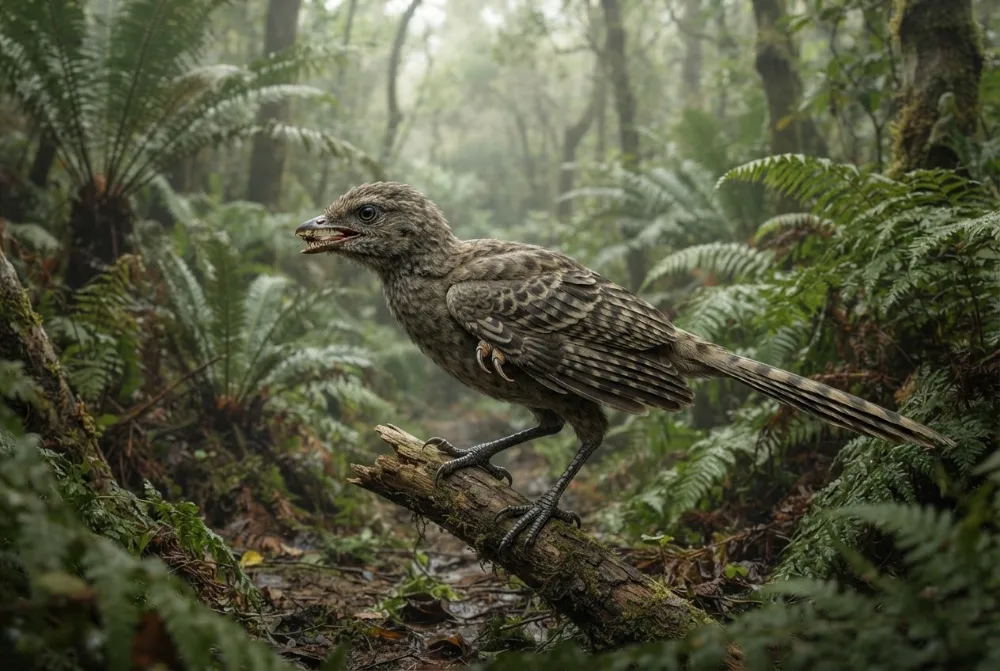
Zhengheornis was a tiny bird-like dinosaur that lived about 150 million years ago in what is now China. It had a short tail made of 15 bones, but no pygostyle, which is the fused tailbone modern birds have. This little creature helps scientists understand how bird tails evolved step by step.21
Ankakhala liti?
Anali wamkulu bwanji?
Ankalemera bwanji?
Zhengheornis anali wamkulu bwanji poyerekeza ndi IWEYO?
Ndi masamu chabe mu msakatuli wako. Palibe chimene chimasungidwa kapena kutumizidwa kwina kulikonse.
Anali ndi liwiro lotani?


Mfundo zosangalatsa
Zhengheornis is one of the smallest known early bird relatives, weighing only about as much as a modern robin (74 to 163 grams).2
Its tail had 15 short vertebrae but no pygostyle, showing that tail shortening happened before the bones fused together in bird evolution.2
The name 'buyu' means 'unexpected' in Mandarin, because scientists were surprised by its unusual tail and pelvis.1
Zhengheornis lived alongside other early birds like Fujianvenator and Baminornis in the Zhenghe Fauna of Late Jurassic China.2
Scientists think Zhengheornis was not especially good at climbing trees or walking on the ground, unlike some of its relatives.2
The only known fossil was found in 2024 and includes bones, feather traces, and parts of the arms, legs, and pelvis.1
Mafunso ofunsidwa kwambiri okhudza Zhengheornis
?How big was Zhengheornis?
Zhengheornis was incredibly tiny, weighing only about 74 to 163 grams, similar to a modern robin. It is one of the smallest known long-tailed early bird relatives.34
?When did Zhengheornis live?
Zhengheornis lived during the Early Cretaceous period, about 120 to 130 million years ago, in what is now China.13
Kwa akatswiri a madino
- Dzina la sayansi
- Zhengheornis
- Anapatsidwa dzina ndi
- Wang et al. 20265
- Gulu
- Mbalame zoyambirira
- Banja / kladi
- Avialae5
- Magawidwe a sayansi
- Theropoda > Avialae5
- Zaka za miyala
- zaka 152 mpaka 145 miliyoni (Kimmeridgian / Tithonian)5
- Mapangidwe a miyala
- Nanyuan5
- Mayiko
- China5
- Zolemba za mafosili
- 1 mu The Paleobiology Database5
- Kupezeka
- Zhengheornis was discovered in 2024 during fieldwork in Fujian Province, China, and named by Min Wang and colleagues in 2026.1
- Akukambiranabe
- Scientists are still debating exactly where Zhengheornis fits on the family tree of early birds, though most agree it is one of the earliest avialans.2
Kumene mfundo zimachokera
- Zhengheornis (en.wikipedia.org)
- Jurassic avialan reveals stepwise evolution of bony tail in birds (dinodata.de)
- China Jurassic Pocket-Sized Bird Fills a Puzzle of the Evolution of Bird Tail_Headline_Institute of Vertebrate Paleontology and Paleoanthropology, Chinese Academy of Sciences (english.ivpp.cas.cn)
- China Jurassic Pocket-Sized Bird Fills a Puzzle of the Evolution of Bird Tail_Research Progress_Institute of Vertebrate Paleontology and Paleoanthropology, Chinese Academy of Sciences (english.ivpp.cas.cn)
- Zhengheornis in The Paleobiology Database (CC BY 4.0): zaka, malo, mapangidwe a miyala, magawidwe a sayansi.
Mfundo iliyonse patsamba lino ili ndi nambala yosonyeza kumene yachokera. Ngati talakwitsa kanthu, pepa, ndife okonda madino, osati magazini ya sayansi. Tiuze pa [email protected] ndipo tikonza.
 Rex ali ndi njala! Dino Wiki ndi ntchito ya bambo kwa mwana wawo wamwamuna wokonda madainoso, yaulere popanda zotsatsa ndi zokazonda. Akuluakulu angadyetse Rex zokhwasula-khwasula kuti tsambali lipitirize kupezeka pa intaneti.Dyetsa Rex
 Archaeopteryx
 Hesperornis
 Ichthyornis
 Baptornis
 Jurapteryx
 Gobipteryx
 Brachiosaurus
 Diplodocus
 Allosaurus
 Brontosaurus
 Compsognathus
 Camarasaurus