 Ati daayinoo kami? Qormaata
 Lola daayinoo
 Dorgommii daayinoo
 Taphoota daayinoo xixiqqoo
 Albamii istiikarii
 Tarreewwan TOP daayinoo
 Na dinqisiisi!
Yoom jiraate?

Hammam guddaa ture?
Hammam dheeraa ture?
Hammam ol-dheeraa ture?
tilmaama
Hammam ulfaataa ture?

 akka saree 8 funyaan hanga eegeetti dheeraa🍌akka muuzii 44 walitti hiriiran dheeraaakka saree 150 ulfaata🍉akka habxuu 600 ulfaata🎒akka kutaalee mana barumsaa guutuu 4 ulfaata🐻❄️akka beeraa adii 7 ulfaata🏃meetira 100 sekondii 15 keessatti fiiguu danda'a (namni hunda caalaa saffisaan 9.6 barbaada)
SI wajjin yoo wal bira qabamu, Amurosaurus hammam guddaa ture?
Herrega qofa barbaadduu kee keessatti. Wanti tokkollee hin olkaa'amu, eessayyuu hin ergamu.
Hammam saffisaa ture?


Odeeffannoowwan bashannansiisoo
Amurosaurus is named after the Amur River, which forms the border between Russia and China.1
Most of the bones found in its bonebed belong to young Amurosaurus, not adults.1
Theropod teeth are common in the bonebed, and many bones have tooth marks, showing that predators or scavengers chewed on them.1
Amurosaurus had a unique S-shaped curve in its lower arm bone, the ulna.1
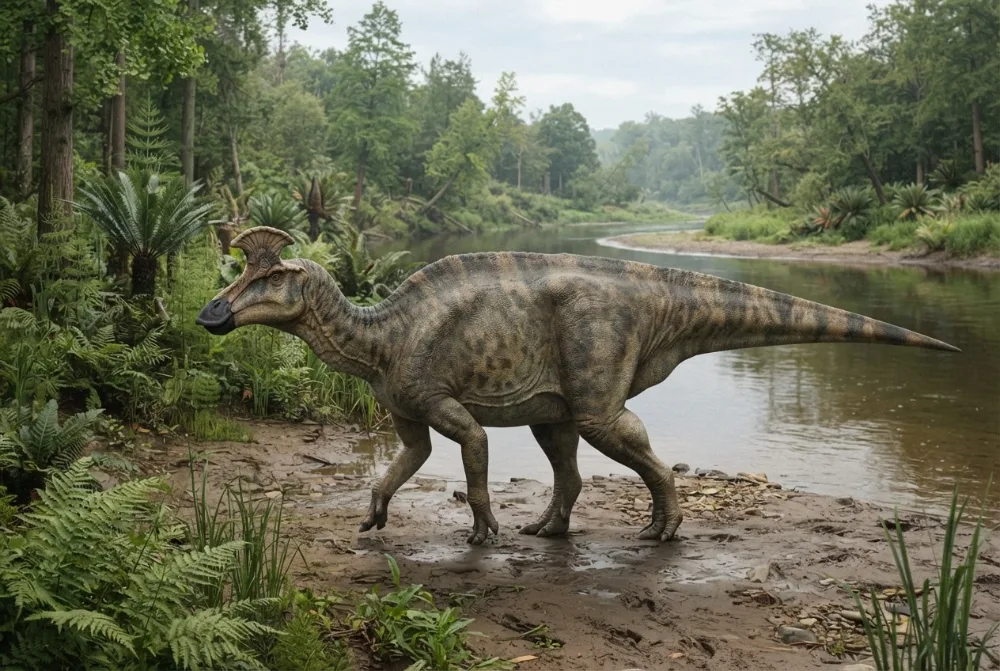
Although the crest bones are missing, the skull roof shows it likely had a hollow crest like other lambeosaurines.1
Amurosaurus had a relatively large brain compared to some other plant-eaters, which might mean it lived in groups.1
Gaaffiiwwan waa'ee Amurosaurus baay'ee gaafataman
?How big was Amurosaurus?
About 8 metres (26 feet) long and around 3 metric tons (3.3 short tons) in weight, though one source says it may have been up to 12 metres (39 feet) long.12
?What did Amurosaurus eat?
It was a plant-eater, or herbivore, like all hadrosaurid dinosaurs.1
?Did Amurosaurus have a crest?
Yes, it probably had a hollow crest on its head, even though the crest bones themselves have not been found yet.1
?When did Amurosaurus live?
It lived during the Late Cretaceous period, about 70 to 66 million years ago.1
?Where was Amurosaurus found?
All its fossils come from a single bonebed in Blagoveschensk, Russia, near the Amur River.1
?Was Amurosaurus a dinosaur?
Yes, it was a lambeosaurine hadrosaurid dinosaur.1
Seenaa sobaa diigaa
Seenaa sobaa: Amurosaurus was a meat-eater because it had sharp teeth.
Dhugaa: Amurosaurus was a plant-eater, as shown by its beak and teeth made for grinding plants.1
Ogeeyyii daayinootiif
- Maqaa saayinsii
- Amurosaurus
- Kan maqaa baase
- Bolotsky and Kurzanov 19913
- Garee
- Afaan-daakiyyee
- Maatii / kilaadii
- Hadrosauridae3
- Ramaddii
- Ornithischia > Ornithopoda > Iguanodontia > Hadrosauridae3
- Umurii dhagaawwanii
- waggaa miliyoona 72 hanga 66 (Maastrichtian)3
- Caasaawwan dhagaa
- Udurchukan, Yuliangzi3
- Biyyoota
- Raashiyaa, Chaayinaa3
- Galmee fosilii
- 2 The Paleobiology Database keessa3
- Maqaan biraa
- Sahaliyania (maqaawwan durii amma akka bineensa tokkootti lakkaa'amu)3
- Argannoo
- Russian paleontologists Yuri Bolotsky and Sergei Kurzanov named Amurosaurus in 1991. The first fossils were found in 1984 in a bonebed inside the city of Blagoveschensk, Russia.1
- Ammallee falmisiisaa
- Scientists are still debating whether Amurosaurus had a crest and what it looked like, because the crest bones have not been found.1
Odeeffannoon eessaa dhufa
- Amurosaurus (en.wikipedia.org)
- Amurosaurus State Darwin Museum (darwinmuseum.ru)
- Amurosaurus in The Paleobiology Database (CC BY 4.0): umurii, bakkeewwan, caasaawwan dhagaa, ramaddii.
Odeeffannoon fuula kana irra jiru hundi lakkoofsa madda isaa agarsiisu qaba. Yoo waa dogoggorre, dhiifama, nuti jaallattoota daayinoo malee joornaalii saayinsii miti. [email protected] irratti nutti himi, nus ni sirreessina.
 Rex beela'eera! Dino Wiki pirojektii abbaa tokkoo kan ilma isaa daayinoo jaallatuuf hojjetame, bilisa, beeksisa malee fi hordoftuu malee. Ga'eessonni akka inni interneetii irra turuuf Rexiif nyaata xiqqoo kennuu danda'u.Rex soori
 Parasaurolophus
 Edmontosaurus
 Saurolophus
 Hypacrosaurus
 Corythosaurus
 Kritosaurus
 Tyrannosaurus
 Triceratops
 Velociraptor
 Spinosaurus
 Ankylosaurus
 Pteranodon