 Ati daayinoo kami? Qormaata
 Lola daayinoo
 Dorgommii daayinoo
 Taphoota daayinoo xixiqqoo
 Albamii istiikarii
 Tarreewwan TOP daayinoo
 Na dinqisiisi!
Bagualia
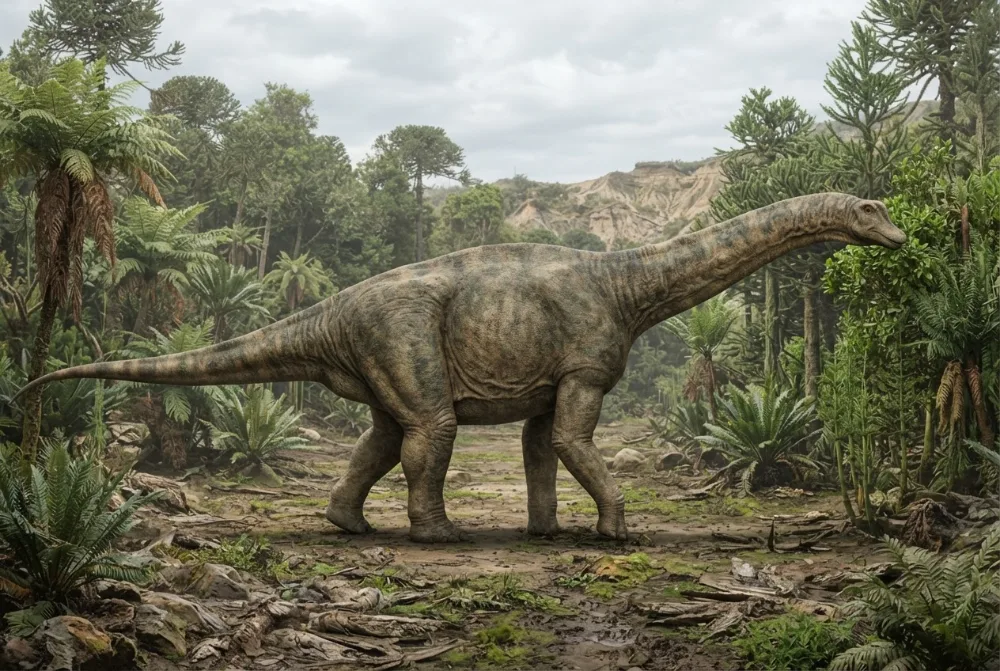
Bagualia was an early long-necked dinosaur that lived about 180 million years ago. It is one of the oldest known true sauropods, the group that later included giants like Brachiosaurus. Bagualia had a deep skull and big spoon-shaped teeth for eating tough plants.21
Yoom jiraate?
Hammam guddaa ture?
Hammam dheeraa ture?
Hammam ol-dheeraa ture?
tilmaama
Hammam ulfaataa ture?
 akka konkolaataa 2.5 tarreen dhaabatan dheeraa🍌akka muuzii 67 walitti hiriiran dheeraa
 akka arba 1.5 ulfaata🍉akka habxuu 2000 ulfaata🎒akka kutaalee mana barumsaa guutuu 12 ulfaata🐻❄️akka beeraa adii 22 ulfaata🏃meetira 100 sekondii 24 keessatti fiiguu danda'a (namni hunda caalaa saffisaan 9.6 barbaada)
SI wajjin yoo wal bira qabamu, Bagualia hammam guddaa ture?
Herrega qofa barbaadduu kee keessatti. Wanti tokkollee hin olkaa'amu, eessayyuu hin ergamu.
Hammam saffisaa ture?


Odeeffannoowwan bashannansiisoo
Bagualia lived during a time of major climate change, when a huge volcanic event warmed the Earth and many other plant-eating dinosaurs died out.2
The holotype specimen includes the back half of a skull and the first seven neck bones, all still connected together.2
Scientists found remains of at least three Bagualia individuals at the same site, all about the same size.2
Bagualia had a short, deep snout and large nostrils that were set far back on its skull, like later sauropods.2
Gaaffiiwwan waa'ee Bagualia baay'ee gaafataman
?How big was Bagualia?
Scientists estimate Bagualia weighed over 10 tonnes, making it one of the first truly giant sauropods. Its exact length is not known, but it had a long neck and a large body.5
?What did Bagualia eat?
Bagualia ate tough plants like conifers. Its spoon-shaped teeth had very thick enamel, about seven times thicker than other plant-eaters, to help shear leaves.1
?When did Bagualia live?
Bagualia lived about 179 million years ago, during the Early Jurassic period. That makes it one of the oldest known true sauropods.15
?Where was Bagualia found?
Bagualia fossils were found in Bagual Canyon in Chubut, Argentina. The remains were discovered in 2007 and 2009 by scientists from the Museo Paleontológico Egidio Feruglio.1
Ogeeyyii daayinootiif
- Maqaa saayinsii
- Bagualia
- Kan maqaa baase
- Pol et al. 20206
- Garee
- Morma-dheertota
- Maatii / kilaadii
- Eusauropoda6
- Ramaddii
- Sauropodomorpha > Sauropoda6
- Umurii dhagaawwanii
- waggaa miliyoona 183 hanga 180 (Toarcian)6
- Caasaawwan dhagaa
- Cañadón Asfalto6
- Biyyoota
- Arjentiinaa6
- Galmee fosilii
- 1 The Paleobiology Database keessa6
- Argannoo
- Bagualia was named in 2020 by Diego Pol and colleagues. The fossils were found in the Cañadón Asfalto Formation in Chubut, Argentina, at a site called Bagual Canyon.12
- Ammallee falmisiisaa
- Scientists are still debating exactly how Bagualia is related to other early sauropods and how quickly the group evolved after the Toarcian warming event.2
Odeeffannoon eessaa dhufa
- Bagualia (en.wikipedia.org)
- Extinction of herbivorous dinosaurs linked to Early Jurassic global warming event (royalsocietypublishing.org)
- PBDB Taxon (paleobiodb.org)
- Nuevos hallazgos sobre Bagualia alba, un dinosaurio saurópodo qu (iipg.conicet.gov.ar)
- Axial skeleton of Bagualia (palaeo-electronica.org)
- Bagualia in The Paleobiology Database (CC BY 4.0): umurii, bakkeewwan, caasaawwan dhagaa, ramaddii.
Odeeffannoon fuula kana irra jiru hundi lakkoofsa madda isaa agarsiisu qaba. Yoo waa dogoggorre, dhiifama, nuti jaallattoota daayinoo malee joornaalii saayinsii miti. [email protected] irratti nutti himi, nus ni sirreessina.
 Rex beela'eera! Dino Wiki pirojektii abbaa tokkoo kan ilma isaa daayinoo jaallatuuf hojjetame, bilisa, beeksisa malee fi hordoftuu malee. Ga'eessonni akka inni interneetii irra turuuf Rexiif nyaata xiqqoo kennuu danda'u.Rex soori
 Brachiosaurus
 Diplodocus
 Brontosaurus
 Argentinosaurus
 Camarasaurus
 Morosaurus
 Dilophosaurus
 Stenopterygius
 Dorygnathus
 Scutellosaurus
 Sinosaurus
 Temnodontosaurus