 Ati daayinoo kami? Qormaata
 Lola daayinoo
 Dorgommii daayinoo
 Taphoota daayinoo xixiqqoo
 Albamii istiikarii
 Tarreewwan TOP daayinoo
 Na dinqisiisi!
Yoom jiraate?

Hammam guddaa ture?
Hammam dheeraa ture?
Hammam ol-dheeraa ture?
tilmaama
Hammam ulfaataa ture?
 akka saree 4 funyaan hanga eegeetti dheeraa🍌akka muuzii 21 walitti hiriiran dheeraa🍉akka habxuu 54 ulfaata🧸akka ijoollee KG 14 ulfaata🎒akka ijoollee mana barumsaa 8 ulfaata🏃meetira 100 sekondii 8.6 keessatti fiiguu danda'a (namni hunda caalaa saffisaan 9.6 barbaada)
SI wajjin yoo wal bira qabamu, Canardia hammam guddaa ture?
Herrega qofa barbaadduu kee keessatti. Wanti tokkollee hin olkaa'amu, eessayyuu hin ergamu.
Hammam saffisaa ture?


Odeeffannoowwan bashannansiisoo
Canardia is known only from juvenile specimens, so scientists think the fossils found so far are from young animals.1
Its name comes from the French word 'canard', which means 'duck', because it belongs to the duck-billed dinosaur group.1
Canardia lived between 67.5 and 66 million years ago, right up to the end of the Cretaceous Period.1
The first fossils of Canardia were discovered in 1999 near the village of Marignac-Laspeyres in France.1
Some scientists think Canardia is closely related to Aralosaurus from Central Asia, while others place it in a group with other European and North African duck-billed dinosaurs.1
One Canardia fossil was found just one metre below the layer that marks the dinosaur extinction event, showing it was one of the very last non-bird dinosaurs in Europe.1
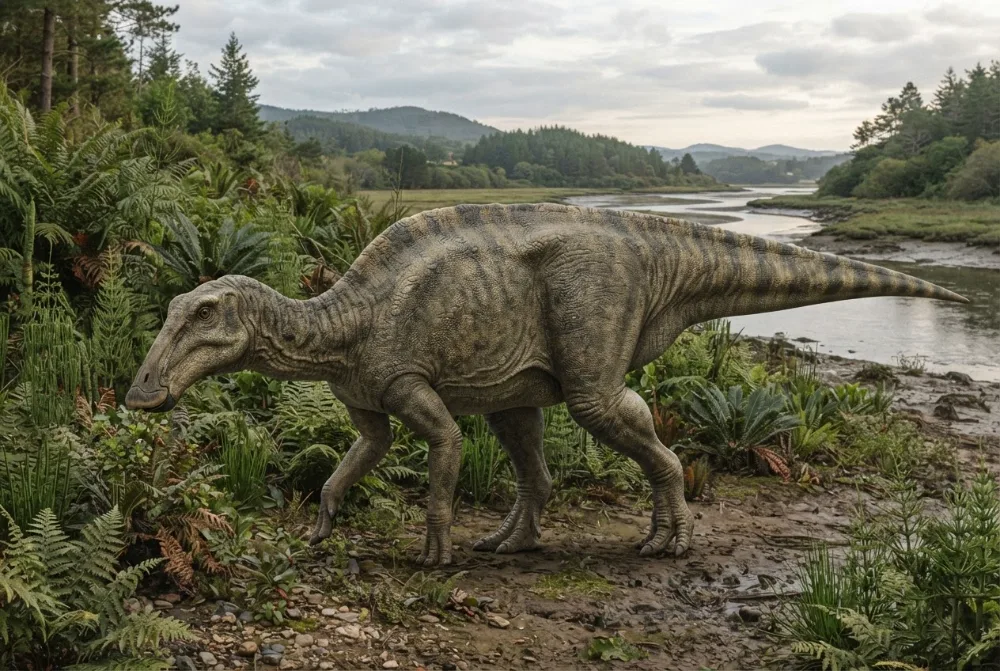
Gaaffiiwwan waa'ee Canardia baay'ee gaafataman
?How big was Canardia?
Scientists are not sure of its full adult size because all known fossils are from juveniles. The biggest bones found are a maxilla 16.9 cm long, a scapula 21.8 cm long, and a humerus 19.4 cm long.1
?Did Canardia have a crest?
Nobody knows for sure. No complete skull has been found, so scientists cannot tell if it had a hollow bony crest like many other lambeosaurines.1
?What did Canardia eat?
Like other duck-billed dinosaurs, Canardia was a plant-eater. It had teeth with ridges for grinding plants, and its duck-like beak helped it bite off leaves.1
?When did Canardia live?
Canardia lived between 67.5 and 66 million years ago, during the very end of the Cretaceous Period. It was one of the last non-bird dinosaurs before the big extinction.1
?Where was Canardia found?
All Canardia fossils have been found in southwestern France, in the Haute-Garonne department. The first ones were discovered in 1999 near the village of Marignac-Laspeyres.1
?Is Canardia a dinosaur?
Yes, Canardia is a dinosaur. It is a type of duck-billed dinosaur called a lambeosaurine hadrosaurid.1
Ogeeyyii daayinootiif
- Maqaa saayinsii
- Canardia
- Kan maqaa baase
- Prieto-Marquez et al. 20133
- Garee
- Afaan-daakiyyee
- Maatii / kilaadii
- Hadrosauridae3
- Ramaddii
- Ornithischia > Ornithopoda > Iguanodontia > Hadrosauridae3
- Umurii dhagaawwanii
- waggaa miliyoona 72 hanga 66 (Maastrichtian)3
- Caasaawwan dhagaa
- Marno-calcaires jaunes de Gensac, Marnes d'Auzas3
- Biyyoota
- Faransaay3
- Galmee fosilii
- 2 The Paleobiology Database keessa3
- Argannoo
- Canardia was named in 2013 by Albert Prieto-Márquez and colleagues. The first fossils were found in 1999 by a team from the Musée des Dinosaures d'Espéraza in southwestern France.1
- Ammallee falmisiisaa
- Scientists are not sure exactly where Canardia fits in the duck-billed dinosaur family tree. Some think it belongs to a group called Aralosaurini, while others place it in Arenysaurini.1
Odeeffannoon eessaa dhufa
- Canardia (en.wikipedia.org)
- Canardia garonnensis | Dinosaur Database by DinoAnimals.com (dinoanimals.com)
- Canardia in The Paleobiology Database (CC BY 4.0): umurii, bakkeewwan, caasaawwan dhagaa, ramaddii.
Odeeffannoon fuula kana irra jiru hundi lakkoofsa madda isaa agarsiisu qaba. Yoo waa dogoggorre, dhiifama, nuti jaallattoota daayinoo malee joornaalii saayinsii miti. [email protected] irratti nutti himi, nus ni sirreessina.
 Rex beela'eera! Dino Wiki pirojektii abbaa tokkoo kan ilma isaa daayinoo jaallatuuf hojjetame, bilisa, beeksisa malee fi hordoftuu malee. Ga'eessonni akka inni interneetii irra turuuf Rexiif nyaata xiqqoo kennuu danda'u.Rex soori
 Parasaurolophus
 Edmontosaurus
 Saurolophus
 Hypacrosaurus
 Corythosaurus
 Kritosaurus
 Tyrannosaurus
 Triceratops
 Velociraptor
 Spinosaurus
 Ankylosaurus
 Pteranodon