 Ati daayinoo kami? Qormaata
 Lola daayinoo
 Dorgommii daayinoo
 Taphoota daayinoo xixiqqoo
 Albamii istiikarii
 Tarreewwan TOP daayinoo
 Na dinqisiisi!
Ceratocaudia
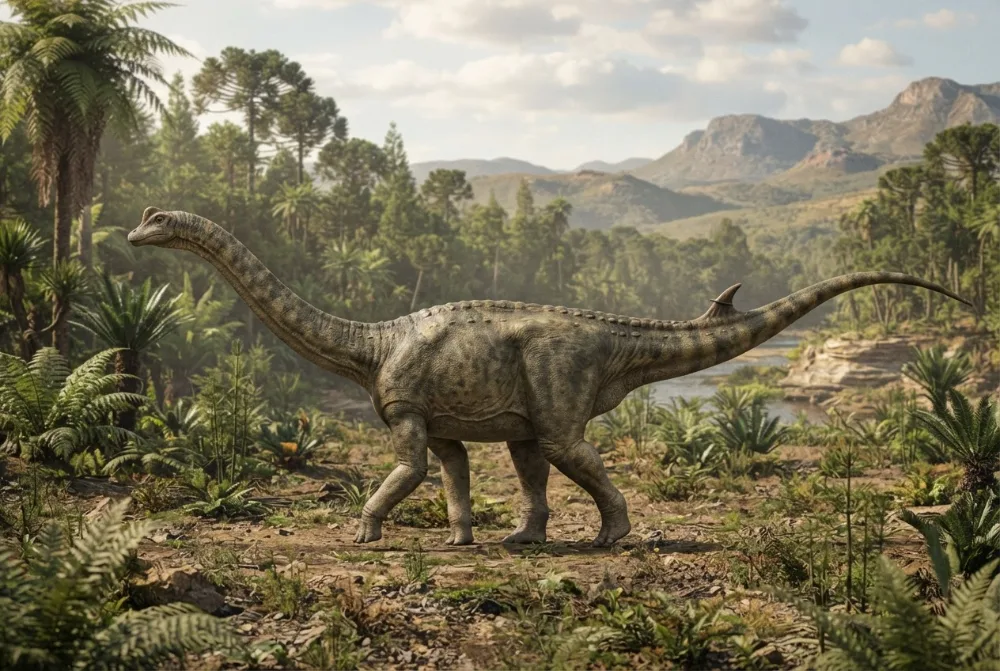
Ceratocaudia was a small, plant-eating sauropod dinosaur that lived in what is now India during the Jurassic Period. It had a horn-like crest on its tail bones, and scientists think it might have used its tail to scare away predators.1
Yoom jiraate?
Hammam guddaa ture?
Hammam dheeraa ture?
Hammam ol-dheeraa ture?
tilmaama
 akka saree 7 funyaan hanga eegeetti dheeraa🍌akka muuzii 39 walitti hiriiran dheeraa🏃meetira 100 sekondii 12 keessatti fiiguu danda'a (namni hunda caalaa saffisaan 9.6 barbaada)
SI wajjin yoo wal bira qabamu, Ceratocaudia hammam guddaa ture?
Herrega qofa barbaadduu kee keessatti. Wanti tokkollee hin olkaa'amu, eessayyuu hin ergamu.
Hammam saffisaa ture?


Odeeffannoowwan bashannansiisoo
Ceratocaudia is one of the smallest known macronarian sauropods, measuring only about 7 metres (23 feet) long.1
The horn-like crest on its tail vertebrae gave the dinosaur its name, meaning 'horned tail'.1
Scientists think Ceratocaudia might have been a dwarf species because the only known skeleton is from an old individual but is still very small.13
The holotype skeleton includes neck bones, tail bones, an ulna, thighbones, shinbones, and even finger and toe bones.1
Ceratocaudia lived in an estuary environment alongside petrified wood, clams, and a much larger sauropod that was about 20 metres long.1
Gaaffiiwwan waa'ee Ceratocaudia baay'ee gaafataman
?How big was Ceratocaudia?
Ceratocaudia was about 7 metres (23 feet) long, making it one of the smallest known macronarian sauropods.1
?Did Ceratocaudia have a horn on its tail?
Yes, it had a horn-like crest on its tail bones, which is why its name means 'horned tail'.1
?What did Ceratocaudia eat?
Ceratocaudia was a plant-eater, or herbivore.4
?When did Ceratocaudia live?
Ceratocaudia lived during the Jurassic Period, from about 201 to 168 million years ago.4
?Where was Ceratocaudia found?
Its fossils were found in Gujarat, India, in rocks that were once a low-energy estuary.1
?Could Ceratocaudia use its tail to fight?
Scientists think it could swing its tail as a mild deterrent to scare away predators.1
Ogeeyyii daayinootiif
- Maqaa saayinsii
- Ceratocaudia
- Kan maqaa baase
- Natarajan et al. 20264
- Garee
- Morma-dheertota
- Maatii / kilaadii
- Macronaria4
- Ramaddii
- Sauropodomorpha > Sauropoda > Macronaria4
- Umurii dhagaawwanii
- waggaa miliyoona 201 hanga 168 (Hettangian / Bajocian)4
- Caasaawwan dhagaa
- Kaladongar4
- Biyyoota
- Hindii4
- Galmee fosilii
- 1 The Paleobiology Database keessa4
- Argannoo
- Ceratocaudia antiqua was named by Abhishek Natarajan and colleagues in 2026 based on a partial skeleton found in the Kaladongar Formation of Gujarat, India.12
- Ammallee falmisiisaa
- Scientists are not sure if Ceratocaudia was a true dwarf species or just a small adult, and they debate its exact place on the sauropod family tree.13
Odeeffannoon eessaa dhufa
- Ceratocaudia (en.wikipedia.org)
- PBDB Taxon (paleobiodb.org)
- A new diminutive Jurassic neosauropod from the Kaladongar Formation (Khadir Uplift) of the Kachchh Basin, western India (exa.ai)
- Ceratocaudia in The Paleobiology Database (CC BY 4.0): umurii, bakkeewwan, caasaawwan dhagaa, ramaddii.
Odeeffannoon fuula kana irra jiru hundi lakkoofsa madda isaa agarsiisu qaba. Yoo waa dogoggorre, dhiifama, nuti jaallattoota daayinoo malee joornaalii saayinsii miti. [email protected] irratti nutti himi, nus ni sirreessina.
 Rex beela'eera! Dino Wiki pirojektii abbaa tokkoo kan ilma isaa daayinoo jaallatuuf hojjetame, bilisa, beeksisa malee fi hordoftuu malee. Ga'eessonni akka inni interneetii irra turuuf Rexiif nyaata xiqqoo kennuu danda'u.Rex soori
 Brachiosaurus
 Diplodocus
 Brontosaurus
 Argentinosaurus
 Camarasaurus
 Morosaurus
 Dilophosaurus
 Stenopterygius
 Dorygnathus
 Scutellosaurus
 Sinosaurus
 Temnodontosaurus