 Ati daayinoo kami? Qormaata
 Lola daayinoo
 Dorgommii daayinoo
 Taphoota daayinoo xixiqqoo
 Albamii istiikarii
 Tarreewwan TOP daayinoo
 Na dinqisiisi!
Giraffatitan
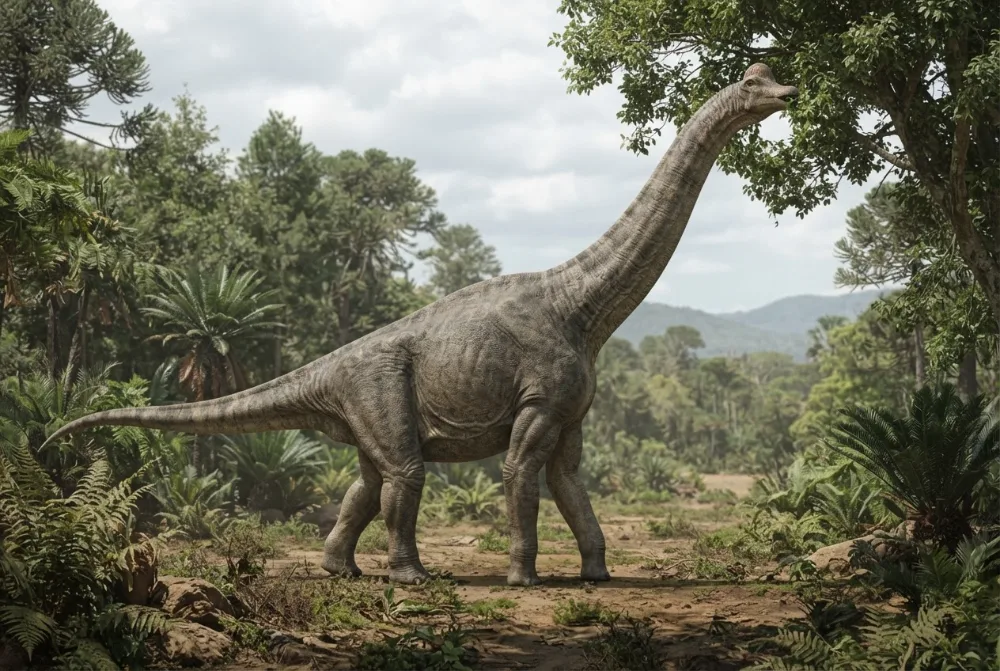
Giraffatitan was a giant, long-necked plant-eater that lived in what is now Tanzania. It had a giraffe-like shape with very long front legs and a tall skull. This dinosaur could reach high into the trees to munch on leaves that other dinosaurs couldn't reach.1
Yoom jiraate?
Hammam guddaa ture?
Hammam dheeraa ture?
Hammam ol-dheeraa ture?
Hammam ulfaataa ture?

 akka konkolaataa 6 tarreen dhaabatan dheeraa🍌akka muuzii 140 walitti hiriiran dheeraa🍉akka habxuu 9600 ulfaata🦒akka sattawwaa 3 wal irra dhaabatan ol-dheeraa🎒akka kutaalee mana barumsaa guutuu 60 ulfaata🐻❄️akka beeraa adii 110 ulfaata🏢akka foddaa darbii 6 keessa ilaaluu danda'utti ol-dheeraa🏃meetira 100 sekondii 40 keessatti fiiguu danda'a (namni hunda caalaa saffisaan 9.6 barbaada)
SI wajjin yoo wal bira qabamu, Giraffatitan hammam guddaa ture?
Herrega qofa barbaadduu kee keessatti. Wanti tokkollee hin olkaa'amu, eessayyuu hin ergamu.
Hammam saffisaa ture?


Odeeffannoowwan bashannansiisoo
Giraffatitan was first thought to be an African species of Brachiosaurus, but scientists now think it is a separate genus because of many differences in its bones.1
The name Giraffatitan means 'titanic giraffe' because its long neck and sloping body reminded scientists of a giraffe.1
Most size estimates come from a subadult skeleton called HMN SII, but a larger leg bone suggests some Giraffatitan grew even bigger, up to 26 metres long.1
Its nostrils were once thought to be on top of its head, like a snorkel, but modern studies show they were near the tip of the snout.1
Giraffatitan lived about 150 to 145 million years ago, during the Late Jurassic period, in a warm, seasonal climate with forests and coastal lagoons.1
It had a very long neck that could only move up and down a little, so it probably fed on treetop leaves without swinging its head sideways much.1
Gaaffiiwwan waa'ee Giraffatitan baay'ee gaafataman
?How big was Giraffatitan?
About 23 metres (75 feet) long and 12 metres (39 feet) tall. The largest individuals may have reached 26 metres (85 feet) and weighed up to 48 tonnes (53 tons).12
?What did Giraffatitan eat?
It was a plant-eater (herbivore) that ate leaves from the tops of trees. Its long neck and chisel-like teeth helped it reach and bite off foliage that other dinosaurs couldn't.12
?When did Giraffatitan live?
It lived during the Late Jurassic Period, about 154 to 142 million years ago.2
?Where was Giraffatitan found?
Its fossils were discovered in Tanzania, Africa, at a place called Tendaguru.12
?Was Giraffatitan bigger than T. rex?
Yes, much bigger. Giraffatitan was about 23 metres long and weighed up to 48 tonnes, while T. rex was only about 12 metres long and weighed around 8 tonnes.1
?Is Giraffatitan a dinosaur?
Yes, it is a dinosaur. It is a sauropod, a group of four-legged, long-necked plant-eating dinosaurs.12
?Why did Giraffatitan have a long neck?
Its long neck helped it reach high into trees to eat leaves that other dinosaurs could not reach. Its neck could only move up and down a little, so it probably fed on treetop leaves without swinging its head sideways much.1
?Could Giraffatitan swim?
No, scientists now think it was a fully land animal. Water pressure would have made it hard to breathe if it was submerged, and its feet were too narrow for swimming.1
Seenaa sobaa diigaa
Seenaa sobaa: Some people think Giraffatitan spent most of its time in water to support its heavy body.
Dhugaa: Scientists now believe it was fully land-living, because water pressure would have made breathing difficult and its feet were not good for swimming.1
Ogeeyyii daayinootiif
- Maqaa saayinsii
- Giraffatitan
- Kan maqaa baase
- (Paul 1988)3
- Garee
- Morma-dheertota
- Maatii / kilaadii
- Brachiosauridae3
- Ramaddii
- Sauropodomorpha > Sauropoda > Macronaria3
- Umurii dhagaawwanii
- waggaa miliyoona 162 hanga 143 (Oxfordian / Tithonian)3
- Caasaawwan dhagaa
- Tendaguru3
- Biyyoota
- Taanzaaniyaa3
- Galmee fosilii
- 42 The Paleobiology Database keessa3
- Argannoo
- Giraffatitan was discovered in Tanzania by a German expedition led by Werner Janensch, who first named it Brachiosaurus brancai in 1914. It was later given its own genus name Giraffatitan by Gregory S. Paul in 1988.1
- Ammallee falmisiisaa
- Scientists still debate whether Giraffatitan should be a separate genus from Brachiosaurus or just a close relative.1
Odeeffannoon eessaa dhufa
- Giraffatitan (en.wikipedia.org)
- Giraffatitan | Natural History Museum (nhm.ac.uk)
- Giraffatitan in The Paleobiology Database (CC BY 4.0): umurii, bakkeewwan, caasaawwan dhagaa, ramaddii.
Odeeffannoon fuula kana irra jiru hundi lakkoofsa madda isaa agarsiisu qaba. Yoo waa dogoggorre, dhiifama, nuti jaallattoota daayinoo malee joornaalii saayinsii miti. [email protected] irratti nutti himi, nus ni sirreessina.
 Rex beela'eera! Dino Wiki pirojektii abbaa tokkoo kan ilma isaa daayinoo jaallatuuf hojjetame, bilisa, beeksisa malee fi hordoftuu malee. Ga'eessonni akka inni interneetii irra turuuf Rexiif nyaata xiqqoo kennuu danda'u.Rex soori
 Brachiosaurus
 Diplodocus
 Brontosaurus
 Argentinosaurus
 Camarasaurus
 Morosaurus
 Allosaurus
 Compsognathus
 Camptosaurus
 Nanosaurus
 Rhamphorhynchus
 Ceratosaurus