 Ati daayinoo kami? Qormaata
 Lola daayinoo
 Dorgommii daayinoo
 Taphoota daayinoo xixiqqoo
 Albamii istiikarii
 Tarreewwan TOP daayinoo
 Na dinqisiisi!
Rhamphorhynchus
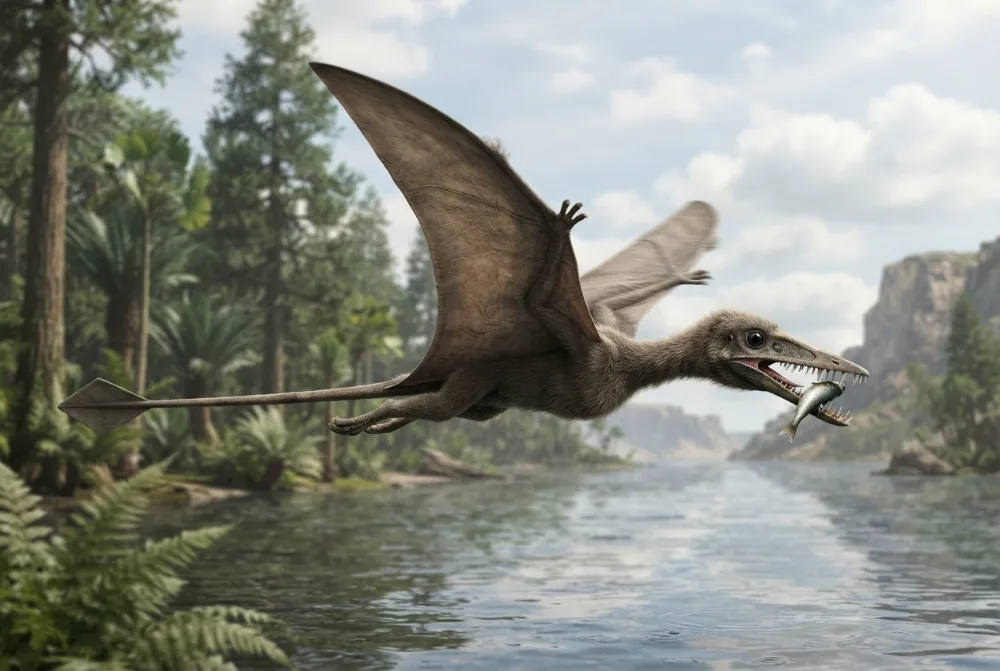
Rhamphorhynchus was a flying reptile that lived in the Late Jurassic. It had a very long tail with a diamond-shaped flap at the tip. It used its needle-like teeth to catch slippery fish.12
Yoom jiraate?
Hammam guddaa ture?
Hammam dheeraa ture?
Hammam ulfaataa ture?
 gara ulfaatina adurree manaa🍌akka muuzii 17 ulfaata🧱akka bilookii ijaarsaa taphaa 16 tarreen dheeraa⚽dirree kubbaa miilaa guutuu sekondii 6.8 keessatti balali'ee ce'uu danda'a
SI wajjin yoo wal bira qabamu, Rhamphorhynchus hammam guddaa ture?
Herrega qofa barbaadduu kee keessatti. Wanti tokkollee hin olkaa'amu, eessayyuu hin ergamu.
Hammam saffisaa ture?


Odeeffannoowwan bashannansiisoo
Its tail was stiffened with ligaments and ended in a diamond-shaped rudder, which may have helped it steer while flying.12
Rhamphorhynchus had no teeth at the very tip of its beak, but the rest of its beak held many forward-angled teeth that interlocked to trap fish.1
Fossils of Rhamphorhynchus often show impressions of soft parts, including wing membranes and fuzz-like pycnofibers.1
It probably swam and launched from the water like modern birds, not just flew over the waves.1
Rhamphorhynchus lived about 150 to 148 million years ago, during the late Jurassic Period.1
Gaaffiiwwan waa'ee Rhamphorhynchus baay'ee gaafataman
?How big was Rhamphorhynchus?
Most adults had a wingspan of about 1 metre (3.3 feet), but the largest known specimen reached about 1.8 metres (5.9 feet) across. A huge fragmentary fossil may have had a wingspan of over 3 metres (10 feet).15
?What did Rhamphorhynchus eat?
It mainly ate fish and squid-like animals called cephalopods. Fossil stomach contents and droppings often contain fish and cephalopod remains.12
?Could Rhamphorhynchus swim?
Yes, it probably swam and launched from the water like modern birds. Its broad feet and body shape suggest it was good at swimming.1
?When did Rhamphorhynchus live?
It lived during the Late Jurassic Period, about 150 to 148 million years ago.12
?Was Rhamphorhynchus a dinosaur?
No, it was a pterosaur, a flying reptile that is not a dinosaur. Pterosaurs are close cousins of dinosaurs.12
?Why did Rhamphorhynchus have a long tail?
The long tail ended in a diamond-shaped flap that may have helped it steer while flying. The tail was stiffened with ligaments to keep it straight.12
?Did Rhamphorhynchus have feathers?
It did not have feathers, but it had a fuzzy coat called pycnofibers, which are like simple hairs. These are different from feathers.1
?Where have Rhamphorhynchus fossils been found?
The best fossils come from the Solnhofen limestone in Bavaria, Germany. Fragmentary remains have also been found in England, Tanzania, Spain, and Portugal.1
Seenaa sobaa diigaa
Seenaa sobaa: Some people think Rhamphorhynchus was a dinosaur.
Dhugaa: Rhamphorhynchus was a pterosaur, a flying reptile, not a dinosaur.1
Ogeeyyii daayinootiif
- Maqaa saayinsii
- Rhamphorhynchus
- Kan maqaa baase
- Meyer 18476
- Garee
- Harkifattoota balali'an
- Maatii / kilaadii
- Rhamphorhynchidae6
- Ramaddii
- Pterosauria > Rhamphorhynchidae6
- Umurii dhagaawwanii
- waggaa miliyoona 159 hanga 143 (Oxfordian / Tithonian)6
- Caasaawwan dhagaa
- Solnhofen, Solnhofener Plattenkalk, Painten6
- Biyyoota
- Jarmanii, Portugaal, Taanzaaniyaa, Biriteen6
- Galmee fosilii
- 30 The Paleobiology Database keessa6
- Argannoo
- The first specimen was brought to scientist Samuel Thomas von Sömmerring in 1825. It was later named Ornithocephalus muensteri by Goldfuss in 1831, and then renamed Rhamphorhynchus by Hermann von Meyer in 1847.13
- Ammallee falmisiisaa
- Scientists still debate exactly how many species of Rhamphorhynchus there were, because many similar fossils have been given different names.1
Odeeffannoon eessaa dhufa
- Rhamphorhynchus (en.wikipedia.org)
- Rhamphorhynchus | Pterosaur, Jurassic & Flying Reptile | Britannica (britannica.com)
- PBDB Taxon (paleobiodb.org)
- Life History of Rhamphorhynchus Inferred from Bone Histology and the Diversity of Pterosaurian Growth Strategies (pmc.ncbi.nlm.nih.gov)
- A giant specimen of Rhamphorhynchus muensteri and comments on the ontogeny of rhamphorhynchines (pmc.ncbi.nlm.nih.gov)
- Rhamphorhynchus in The Paleobiology Database (CC BY 4.0): umurii, bakkeewwan, caasaawwan dhagaa, ramaddii.
Odeeffannoon fuula kana irra jiru hundi lakkoofsa madda isaa agarsiisu qaba. Yoo waa dogoggorre, dhiifama, nuti jaallattoota daayinoo malee joornaalii saayinsii miti. [email protected] irratti nutti himi, nus ni sirreessina.
 Rex beela'eera! Dino Wiki pirojektii abbaa tokkoo kan ilma isaa daayinoo jaallatuuf hojjetame, bilisa, beeksisa malee fi hordoftuu malee. Ga'eessonni akka inni interneetii irra turuuf Rexiif nyaata xiqqoo kennuu danda'u.Rex soori
 Pteranodon
 Quetzalcoatlus
 Dorygnathus
 Anhanguera
 Pterodactylus
 Eudimorphodon
 Brachiosaurus
 Diplodocus
 Allosaurus
 Brontosaurus
 Compsognathus
 Camarasaurus