 Ati daayinoo kami? Qormaata
 Lola daayinoo
 Dorgommii daayinoo
 Taphoota daayinoo xixiqqoo
 Albamii istiikarii
 Tarreewwan TOP daayinoo
 Na dinqisiisi!
Yoom jiraate?

Hammam guddaa ture?
Hammam dheeraa ture?
Hammam ol-dheeraa ture?
tilmaama
Hammam ulfaataa ture?
 akka adurree manaa 4 funyaan hanga eegeetti dheeraa🍌akka muuzii 10 walitti hiriiran dheeraa🍌akka muuzii 88 ulfaata🏊dheerina bishaan daakaa guddaa (50 m) sekondii 11 keessatti daakuu danda'a
SI wajjin yoo wal bira qabamu, Hesperornis hammam guddaa ture?
Herrega qofa barbaadduu kee keessatti. Wanti tokkollee hin olkaa'amu, eessayyuu hin ergamu.
Hammam saffisaa ture?


Odeeffannoowwan bashannansiisoo
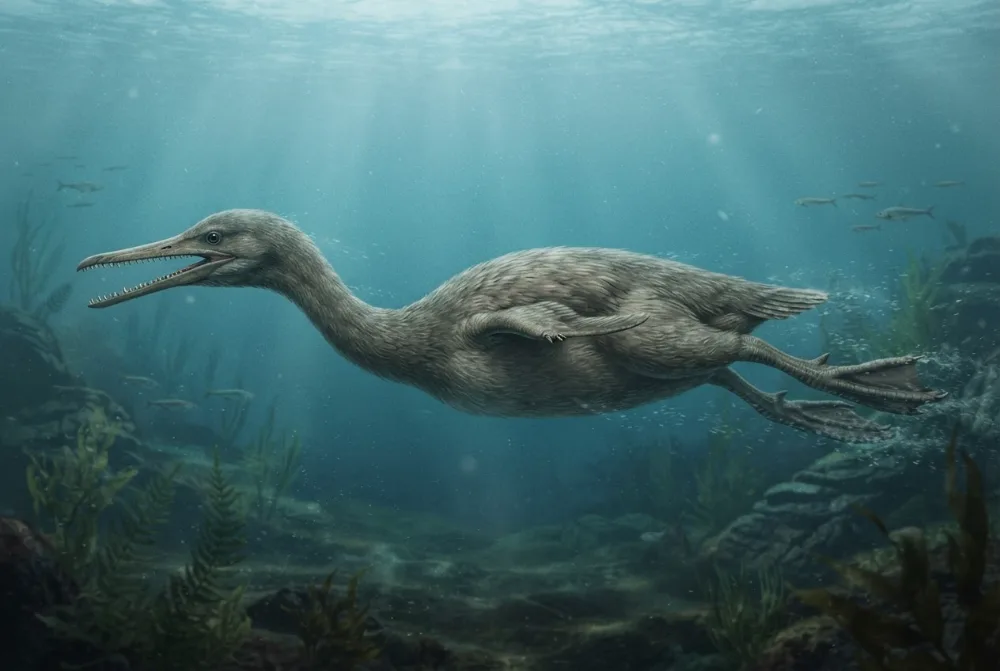
Hesperornis was one of the first birds to give up flying and become a full-time swimmer.2
Its legs were placed far back on its body, like a loon, making it clumsy on land but a powerful diver.1
The first fossils of Hesperornis were found by famous fossil hunter Othniel Charles Marsh in 1870 in Kansas.12
Several species of Hesperornis lived from about 90 to 66 million years ago, during the Late Cretaceous.5
Hesperornis fossils have been found in many places, including Canada, the United States, Russia, and Sweden.5
Gaaffiiwwan waa'ee Hesperornis baay'ee gaafataman
?How big was Hesperornis?
About 1.5 to 2 metres (4.9 to 6.6 ft) long and weighed around 10.6 kilograms (23 lb).1
?Did Hesperornis have teeth?
Yes, it had teeth in its beak, which is rare for birds. The teeth sat in a groove, not in individual sockets.1
?Could Hesperornis fly?
No, it could not fly. Its wings were tiny and useless for flight, and its breastbone lacked a keel for flight muscles.13
?What did Hesperornis eat?
It ate fish, which it caught with its tooth-lined beak while diving in the sea.4
?When did Hesperornis live?
It lived during the Late Cretaceous period, about 83.6 to 72 million years ago, and possibly into the early Maastrichtian.1
?Where was Hesperornis found?
Fossils have been found in Kansas, Canada, Russia, Sweden, and other places, mostly in marine rocks.1
?Could Hesperornis walk on land?
It was clumsy on land. Its legs were placed far back, so it probably pushed itself along on its belly like a seal.1
Seenaa sobaa diigaa
Seenaa sobaa: Some people think Hesperornis was a dinosaur.
Dhugaa: Hesperornis was a bird, not a dinosaur. Birds evolved from dinosaurs, but Hesperornis itself is classified as a bird.1
Ogeeyyii daayinootiif
- Maqaa saayinsii
- Hesperornis
- Kan maqaa baase
- Marsh 18725
- Garee
- Simbirroota jalqabaa
- Maatii / kilaadii
- Hesperornithidae5
- Ramaddii
- Theropoda > Avialae5
- Umurii dhagaawwanii
- waggaa miliyoona 90 hanga 66 (Coniacian / Maastrichtian)5
- Caasaawwan dhagaa
- Pierre Shale, Rybushka, Niobrara5
- Biyyoota
- Kanaadaa, Ameerikaa, Raashiyaa, Iswiidin5
- Galmee fosilii
- 65 The Paleobiology Database keessa5
- Maqaan biraa
- Coniornis, Hargeria, Lestornis (maqaawwan durii amma akka bineensa tokkootti lakkaa'amu)5
- Argannoo
- Othniel Charles Marsh discovered the first Hesperornis fossil in 1870 near the Smoky Hill River in Kansas. He named it Hesperornis regalis in 1872.12
- Ammallee falmisiisaa
- Scientists are still debating exactly how many species of Hesperornis existed, because many fossils are incomplete.1
Odeeffannoon eessaa dhufa
- Hesperornis (en.wikipedia.org)
- The Hesperornithiformes: A Review of the Diversity, Distribution, and Ecology of the Earliest Diving Birds (mdpi.com)
- Hesperornis - Scholars | Britannica Kids | Encyclopedia (kids.britannica.com)
- Hesperornis Facts, Artwork, Information - National Geographic | National Geographic (nationalgeographic.com)
- Hesperornis in The Paleobiology Database (CC BY 4.0): umurii, bakkeewwan, caasaawwan dhagaa, ramaddii.
Odeeffannoon fuula kana irra jiru hundi lakkoofsa madda isaa agarsiisu qaba. Yoo waa dogoggorre, dhiifama, nuti jaallattoota daayinoo malee joornaalii saayinsii miti. [email protected] irratti nutti himi, nus ni sirreessina.
 Rex beela'eera! Dino Wiki pirojektii abbaa tokkoo kan ilma isaa daayinoo jaallatuuf hojjetame, bilisa, beeksisa malee fi hordoftuu malee. Ga'eessonni akka inni interneetii irra turuuf Rexiif nyaata xiqqoo kennuu danda'u.Rex soori
 Archaeopteryx
 Ichthyornis
 Baptornis
 Jurapteryx
 Gobipteryx
 Martinavis
 Tyrannosaurus
 Triceratops
 Velociraptor
 Spinosaurus
 Ankylosaurus
 Parasaurolophus