 Ati daayinoo kami? Qormaata
 Lola daayinoo
 Dorgommii daayinoo
 Taphoota daayinoo xixiqqoo
 Albamii istiikarii
 Tarreewwan TOP daayinoo
 Na dinqisiisi!
Yoom jiraate?

Hammam guddaa ture?
Hammam dheeraa ture?
Hammam ol-dheeraa ture?
tilmaama
Hammam ulfaataa ture?

 akka saree 6 funyaan hanga eegeetti dheeraa🍌akka muuzii 36 walitti hiriiran dheeraa
 gara ulfaatina arbaa🍉akka habxuu 1000 ulfaata🎒akka kutaalee mana barumsaa guutuu 6 ulfaata🐻❄️akka beeraa adii 11 ulfaata🏃meetira 100 sekondii 28 keessatti fiiguu danda'a (namni hunda caalaa saffisaan 9.6 barbaada)
SI wajjin yoo wal bira qabamu, Hesperosaurus hammam guddaa ture?
Herrega qofa barbaadduu kee keessatti. Wanti tokkollee hin olkaa'amu, eessayyuu hin ergamu.
Hammam saffisaa ture?


Odeeffannoowwan bashannansiisoo
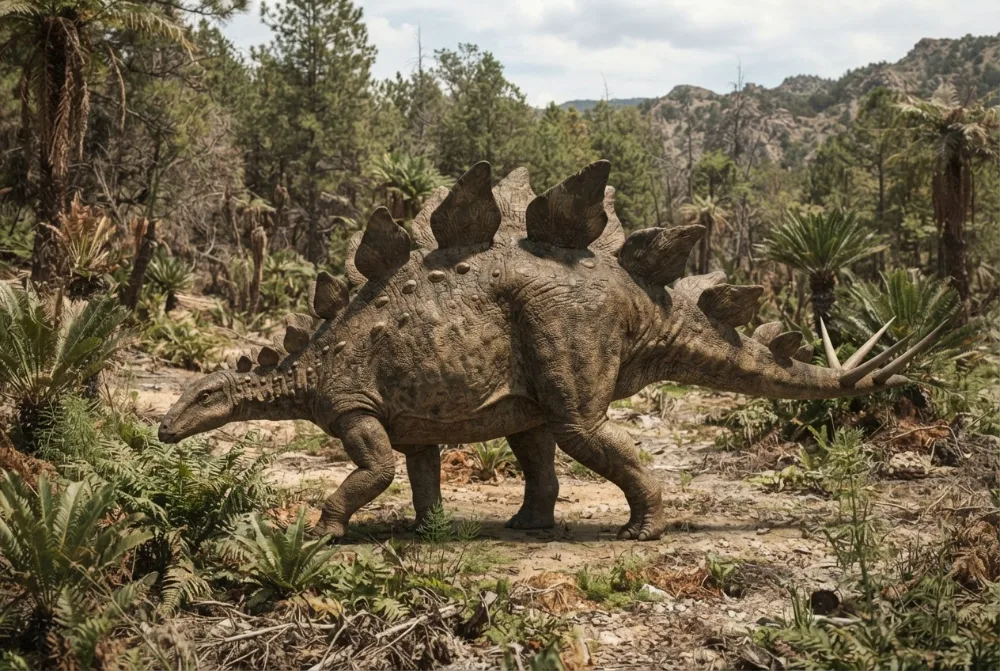
Hesperosaurus is known from a nearly complete skeleton and skull, which is rare for stegosaurs.3
One fossil preserves the first known impression of the horn sheath on a stegosaur back plate.1
Its back plates were longer and lower than those of its close relative Stegosaurus.1
Hesperosaurus lived a little earlier than other stegosaurs from the Morrison Formation.1
The tail spikes, called a thagomizer, had two pairs: the front pair thicker and the rear pair thinner and more horizontal.1
Scientists have debated whether Hesperosaurus should be its own genus or a species of Stegosaurus.1
Gaaffiiwwan waa'ee Hesperosaurus baay'ee gaafataman
?How big was Hesperosaurus?
Hesperosaurus was a large stegosaur, reaching about 6.5 metres (21 feet) in length and weighing around 3.5 metric tons (3.9 short tons). Some large individuals may have reached 5 metric tons (5.5 short tons).1
?What did Hesperosaurus eat?
Hesperosaurus was a herbivore, meaning it ate plants. It was a quadrupedal plant-eater, like other stegosaurs.13
?When did Hesperosaurus live?
Hesperosaurus lived during the Late Jurassic period, about 156 million years ago. It lived a little earlier than other stegosaurs from the Morrison Formation.13
?Where was Hesperosaurus found?
Fossils of Hesperosaurus have been found in the states of Wyoming and Montana in the United States of America. They were first discovered in 1985.1
?Did Hesperosaurus have plates or spikes?
Hesperosaurus had two rows of bony plates on its back and four spikes on its tail. The tail spikes, called a thagomizer, had two pairs: the front pair thicker and the rear pair thinner and more horizontal.1
Ogeeyyii daayinootiif
- Maqaa saayinsii
- Hesperosaurus
- Kan maqaa baase
- Carpenter et al. 20014
- Garee
- Daayinoowwan gabatee qaban
- Maatii / kilaadii
- Stegosauridae4
- Ramaddii
- Ornithischia > Stegosauria > Thyreophora4
- Umurii dhagaawwanii
- waggaa miliyoona 158 hanga 143 ()4
- Caasaawwan dhagaa
- Morrison4
- Biyyoota
- Ameerikaa4
- Galmee fosilii
- 8 The Paleobiology Database keessa4
- Argannoo
- Hesperosaurus was named in 2001 by Kenneth Carpenter, Clifford Miles, and Karen Cloward. The first fossils were found in 1985 on a ranch in Johnson County, Wyoming, USA.1
- Ammallee falmisiisaa
- Scientists still debate whether Hesperosaurus is a separate genus from Stegosaurus or just a species of Stegosaurus.1
Odeeffannoon eessaa dhufa
- Hesperosaurus (en.wikipedia.org)
- PBDB Taxon (paleobiodb.org)
- Hesperosaurus | Natural History Museum (nhm.ac.uk)
- Hesperosaurus in The Paleobiology Database (CC BY 4.0): umurii, bakkeewwan, caasaawwan dhagaa, ramaddii.
Odeeffannoon fuula kana irra jiru hundi lakkoofsa madda isaa agarsiisu qaba. Yoo waa dogoggorre, dhiifama, nuti jaallattoota daayinoo malee joornaalii saayinsii miti. [email protected] irratti nutti himi, nus ni sirreessina.
 Rex beela'eera! Dino Wiki pirojektii abbaa tokkoo kan ilma isaa daayinoo jaallatuuf hojjetame, bilisa, beeksisa malee fi hordoftuu malee. Ga'eessonni akka inni interneetii irra turuuf Rexiif nyaata xiqqoo kennuu danda'u.Rex soori
 Stegosaurus
 Diracodon
 Hypsirophus
 Dacentrurus
 Miragaia
 Kentrosaurus
 Brachiosaurus
 Diplodocus
 Allosaurus
 Brontosaurus
 Compsognathus
 Camarasaurus