 Ati daayinoo kami? Qormaata
 Lola daayinoo
 Dorgommii daayinoo
 Taphoota daayinoo xixiqqoo
 Albamii istiikarii
 Tarreewwan TOP daayinoo
 Na dinqisiisi!
Yoom jiraate?

Hammam guddaa ture?
Hammam dheeraa ture?
 akka saree 4 funyaan hanga eegeetti dheeraa🍌akka muuzii 22 walitti hiriiran dheeraa🏃meetira 100 sekondii 15 keessatti fiiguu danda'a (namni hunda caalaa saffisaan 9.6 barbaada)
SI wajjin yoo wal bira qabamu, Nipponosaurus hammam guddaa ture?
Herrega qofa barbaadduu kee keessatti. Wanti tokkollee hin olkaa'amu, eessayyuu hin ergamu.
Hammam saffisaa ture?


Odeeffannoowwan bashannansiisoo
Nipponosaurus was the first dinosaur ever named from Japanese territory, though Sakhalin Island was later annexed by the Soviet Union.1
The only known skeleton is about 60% complete and belonged to a juvenile, not a full-grown adult.1
Scientists used bone histology (looking at thin slices of bone under a microscope) to confirm that the Nipponosaurus fossil was a youngster.1
Nipponosaurus lived near the coast, and its body was buried in marine sediments, meaning it probably died close to the shore.1
For many years, some scientists thought Nipponosaurus might be the same as other Asian duck-billed dinosaurs, but newer studies show it is a valid, distinct species.1
The fossil was discovered in 1934 by miners digging a hospital foundation on Sakhalin Island.1
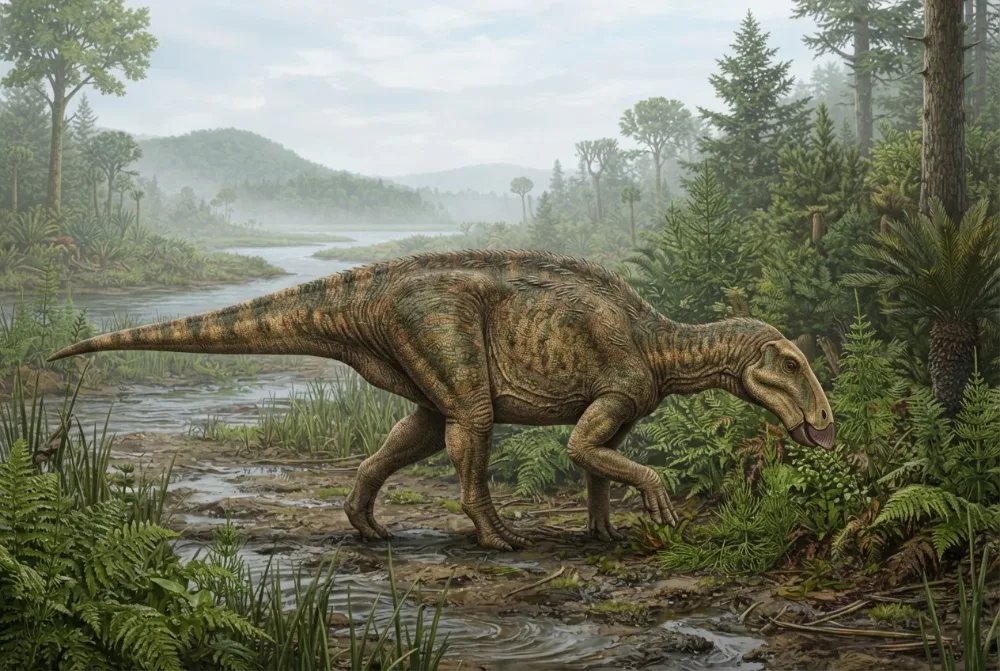
Gaaffiiwwan waa'ee Nipponosaurus baay'ee gaafataman
?How big was Nipponosaurus?
The only known skeleton is about 4 metres (13 feet) long, but it was a juvenile, so adults may have been bigger.1
?What did Nipponosaurus eat?
It was a herbivore, meaning it ate plants. It had a big, flat beak like a duck for cropping vegetation.2
?When did Nipponosaurus live?
It lived during the Late Cretaceous, about 89 to 84 million years ago, or around 80 million years ago according to some estimates.21
?Where was Nipponosaurus found?
Its fossil was found on Sakhalin Island, which is now part of Russia, but was Japanese territory when it was discovered in 1934.12
?Was Nipponosaurus a dinosaur?
Yes, it was a type of duck-billed dinosaur called a hadrosaur, specifically a lambeosaurine.2
Seenaa sobaa diigaa
Seenaa sobaa: Nipponosaurus was a full-grown adult when it died.
Dhugaa: The skeleton is from a juvenile, as shown by its small size and microscopic bone features.1
Ogeeyyii daayinootiif
- Maqaa saayinsii
- Nipponosaurus
- Kan maqaa baase
- Nagao 19363
- Garee
- Afaan-daakiyyee
- Maatii / kilaadii
- Hadrosauridae3
- Ramaddii
- Ornithischia > Ornithopoda > Iguanodontia > Hadrosauridae3
- Umurii dhagaawwanii
- waggaa miliyoona 86 hanga 72 (Santonian / Campanian)3
- Biyyoota
- Raashiyaa3
- Galmee fosilii
- 1 The Paleobiology Database keessa3
- Argannoo
- Nipponosaurus was named in 1936 by Japanese paleontologist Takumi Nagao, based on a skeleton found in 1934 on Sakhalin Island.13
- Ammallee falmisiisaa
- Scientists are not sure exactly how big a full-grown Nipponosaurus was, because only a juvenile skeleton has been found.1
Odeeffannoon eessaa dhufa
- Nipponosaurus (en.wikipedia.org)
- Nipponosaurus (nhm.ac.uk)
- Nipponosaurus in The Paleobiology Database (CC BY 4.0): umurii, bakkeewwan, caasaawwan dhagaa, ramaddii.
Odeeffannoon fuula kana irra jiru hundi lakkoofsa madda isaa agarsiisu qaba. Yoo waa dogoggorre, dhiifama, nuti jaallattoota daayinoo malee joornaalii saayinsii miti. [email protected] irratti nutti himi, nus ni sirreessina.
 Rex beela'eera! Dino Wiki pirojektii abbaa tokkoo kan ilma isaa daayinoo jaallatuuf hojjetame, bilisa, beeksisa malee fi hordoftuu malee. Ga'eessonni akka inni interneetii irra turuuf Rexiif nyaata xiqqoo kennuu danda'u.Rex soori
 Parasaurolophus
 Edmontosaurus
 Saurolophus
 Hypacrosaurus
 Corythosaurus
 Kritosaurus
 Tyrannosaurus
 Triceratops
 Velociraptor
 Spinosaurus
 Ankylosaurus
 Pteranodon