 Quiz: Tge dino es ti?
 Cumbat da dinos
 Cursa da dinos
 Mini-gieus da dinos
 Album d'adesivs
 TOP-glistas da dinos
 Ma surprenda!
Dsungaripterus
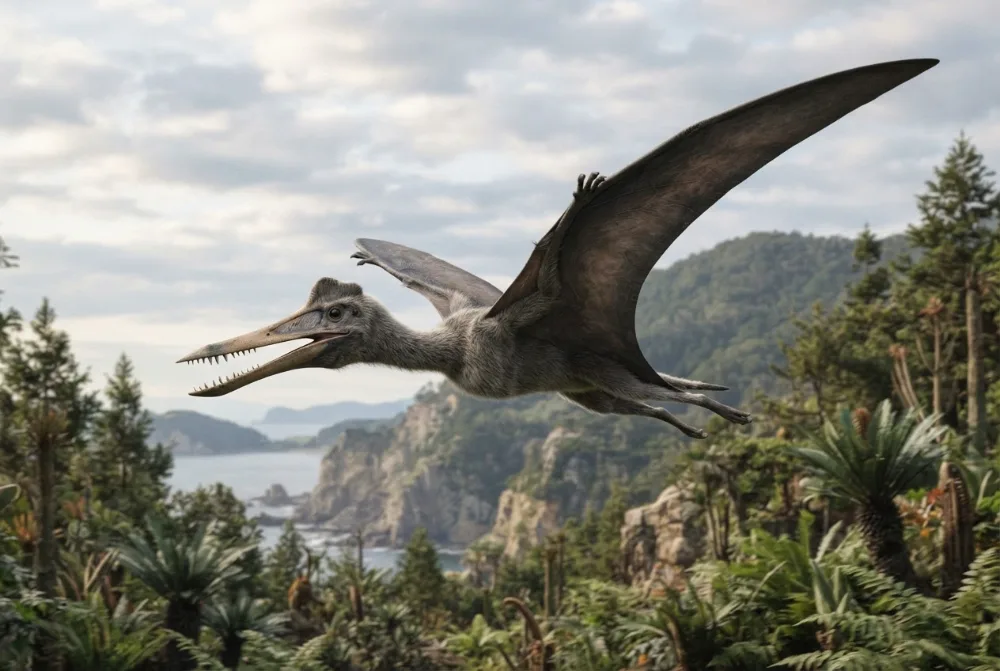
Dsungaripterus was a flying reptile with long, narrow, upturned jaws that worked like tweezers. It used its toothless beak tip to poke into cracks and grab hard-shelled prey, then crushed them with flat, knobbly teeth at the back of its mouth.12
Cura viveva el?
Quant grond era el?
Quant ladas eran sias alas?
 alas uschè ladas sco 2 velos in suenter l'auter⚽pudess sgular sur in entir plaz da ballape en 6,4 secundas
Quant grond era Dsungaripterus cumpareglià cun TAI?
Mo matematica en tes navigatur. Nagut na vegn arcunà u tramess.
Quant spert era el?


Fatgs divertents
Dsungaripterus had a skull over 46 centimeters (18 inches) long, and its head and neck together were almost 1 meter (3.3 feet) long.1
Its jaws curved upward at the tip, and the front part had no teeth, probably covered by a horny sheath.2
It had bulbous, flat teeth at the back of its jaws, perfect for crushing the armor of shellfish.1
The bones of Dsungaripterus were thick-walled and sturdy, suggesting it spent a lot of time walking on the ground.1
It likely landed abruptly and flapped a lot, rather than soaring for long distances.1
Dsungaripterus had a low bony crest on top of its skull, running from the base of the skull to halfway to the beak.1
Fossils show grooves on the jaws that might have held a horny covering, protecting the beak while it probed for food.2
Las dumondas las pli frequentas davart Dsungaripterus
?How big was Dsungaripterus?
Dsungaripterus had a wingspan of 3 to 3.5 metres (9.8 to 11.5 feet). Its skull was over 46 centimetres (18 inches) long, and its head and neck together were almost 1 metre (3.3 feet) long.1
?What did Dsungaripterus eat?
It ate hard-shelled prey like shellfish. It used its toothless, upturned beak tip to poke into cracks and grab food, then crushed shells with its flat, knobbly back teeth.12
?Was Dsungaripterus a dinosaur?
No, Dsungaripterus was a pterosaur, a flying reptile, not a dinosaur. Pterosaurs were the first vertebrates to evolve powered flight.3
?Why did Dsungaripterus have an upturned beak?
The upturned, toothless beak tip was probably used to probe and remove prey from cracks in rocks or sandy, muddy environments. It may have been covered by a horny sheath for protection.12
?Could Dsungaripterus walk on the ground?
Yes, its thick-walled, sturdy bones suggest it was mostly terrestrial and spent a lot of time walking on the ground. Pterosaurs could walk on all four limbs.13
?When did Dsungaripterus live?
Dsungaripterus lived during the Early Cretaceous period, about 145 to 100 million years ago. Its fossils were found in China and possibly South Korea.1
Chatschader da mitus
Mitus: Dsungaripterus is often called a dinosaur.
Vardad: It was actually a pterosaur, a flying reptile that lived alongside dinosaurs but is not a dinosaur.1
Per experts da dinos
- Num scientific
- Dsungaripterus
- Numnà da
- Young 19644
- Gruppa
- Reptils sgulants
- Famiglia / clada
- Dsungaripteridae4
- Classificaziun
- Pterosauria > Pterodactyloidea4
- Vegliadetgna da la crappa
- 137 fin 121 milliuns onns (Valanginian / Barremian)4
- Formaziuns da crap
- Lianmuqin, Tsagaantsav, Hutubihe4
- Pajais
- China, Mongolia4
- Chats da fossils
- 4 en The Paleobiology Database4
- Scuverta
- Dsungaripterus was named by Yang Zhongjian in 1964, based on a partial skull and skeleton from the Lianmuqin Formation in China. The species name weii honors paleontologist C.M. Wei.1
- Anc discutà
- Scientists are still debating whether Dsungaripterus and Noripterus lived in the same place at the same time, or in different layers.2
Danunder che vegnan ils fatgs
- Dsungaripterus (en.wikipedia.org)
- New anatomical information on Dsungaripterus weii Young, 1964 with focus on the palatal region (pmc.ncbi.nlm.nih.gov)
- Pterosaurs: The truth about these ‘flying dinosaurs’ | Natural History Museum (nhm.ac.uk)
- Dsungaripterus in The Paleobiology Database (CC BY 4.0): vegliadetgna, lieus, formaziuns da crap, classificaziun.
Mintga fatg sin questa pagina ha in numer che maina tar sia funtauna. Sche nus avain fatg in sbagl, perstgisa, nus essan fans da dinos, betg ina revista scientifica. Scriva a nus sin [email protected] e nus il curregin.
 Rex ha fom! Dino Wiki è in project d'in bab per ses figl che ama ils dinos, gratuit, senza reclama e senza trackers. Ils creschids pon dar ina marenda a Rex per gidar a tegnair la pagina online.Pavlar Rex
 Pteranodon
 Quetzalcoatlus
 Dorygnathus
 Rhamphorhynchus
 Anhanguera
 Pterodactylus
 Stegosaurus
 Iguanodon
 Archaeopteryx
 Giganotosaurus
 Microraptor
 Deinonychus