 Quiz: Tge dino es ti?
 Cumbat da dinos
 Cursa da dinos
 Mini-gieus da dinos
 Album d'adesivs
 TOP-glistas da dinos
 Ma surprenda!
Haliskia
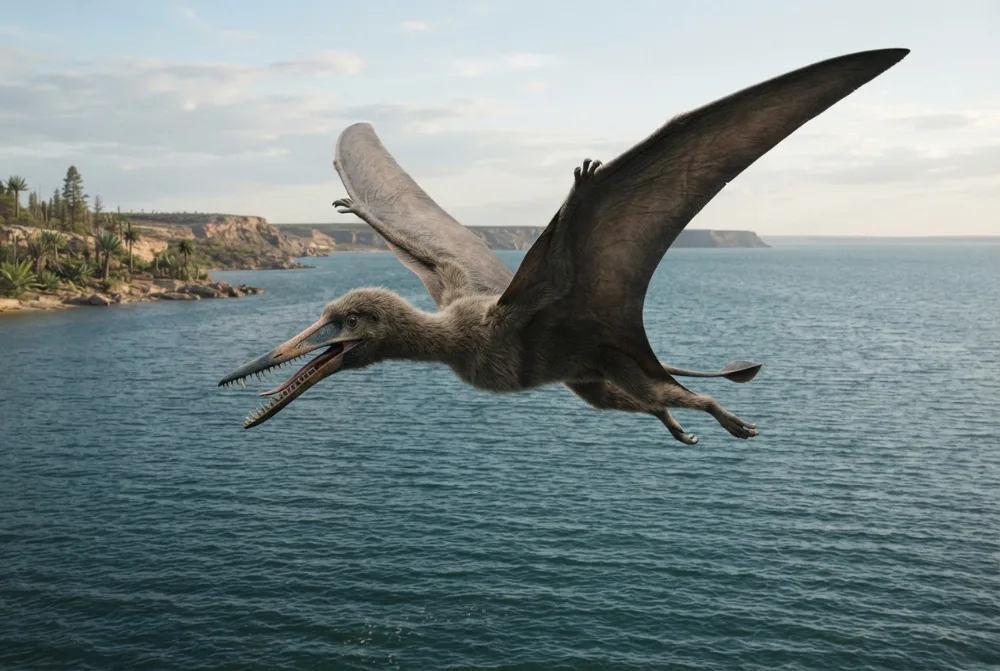
Haliskia was a flying reptile that soared over an ancient inland sea in Australia 100 million years ago. With a wingspan as wide as a car, it used its long, muscular tongue and curved teeth to catch slippery fish and squid. It is the most complete pterosaur skeleton ever found in Australia.12
Cura viveva el?
Quant grond era el?
Quant ladas eran sias alas?
 alas uschè ladas sco 2,5 velos in suenter l'auter⚽pudess sgular sur in entir plaz da ballape en 5,7 secundas
Quant grond era Haliskia cumpareglià cun TAI?
Mo matematica en tes navigatur. Nagut na vegn arcunà u tramess.
Quant spert era el?


Fatgs divertents
Haliskia is 22% complete, more than twice as complete as any other partial pterosaur skeleton from Australia.2
Its hyoid bone (the tongue bone) is 70% as long as its lower jaw, the highest ratio of any pterosaur known. This means Haliskia had a very strong, muscular tongue.1
The fossil was found in 2021 by Kevin Petersen, a museum curator, at a site called Dig Site 3 near Richmond, Queensland.12
Haliskia lived during the Albian age, about 106 to 100 million years ago, when much of Queensland was covered by a shallow inland sea.31
Its teeth are curved and interlock when the mouth closes, forming a trap that stopped fish from wriggling out.1
Haliskia belongs to a group called Anhangueria, which were pterosaurs with crests on their snouts and teeth that stuck out sideways.1
Las dumondas las pli frequentas davart Haliskia
?How big was Haliskia?
About 4.6 metres (15 feet) across the wings, which is about as wide as a small car.12
?What did Haliskia eat?
It ate fish and soft-bodied animals like squid (cephalopods). Its curved, interlocking teeth formed a trap to stop slippery prey from escaping.12
?Is Haliskia a dinosaur?
No, it is a pterosaur, which is a flying reptile that lived at the same time as dinosaurs but is not a dinosaur.2
Per experts da dinos
- Num scientific
- Haliskia
- Numnà da
- Pentland et al. 20244
- Gruppa
- Reptils sgulants
- Famiglia / clada
- Anhangueridae4
- Classificaziun
- Pterosauria > Pterodactyloidea4
- Vegliadetgna da la crappa
- 106 fin 100 milliuns onns (Albian)4
- Formaziuns da crap
- Toolebuc4
- Pajais
- Australia4
- Chats da fossils
- 1 en The Paleobiology Database4
- Scuverta
- Haliskia was discovered by Kevin Petersen, curator of Kronosaurus Korner museum, in November 2021 at a site in Queensland, Australia. It was named and described by Adele Pentland and colleagues in 2024.12
- Anc discutà
- Scientists are not sure whether Haliskia ate only fish or also soft-bodied animals like squid. Its teeth have few wear marks, which could mean it ate soft prey, but its 'fish grab' teeth suggest it caught fish too.1
Danunder che vegnan ils fatgs
- Haliskia peterseni, a new anhanguerian pterosaur from the late Early Cretaceous of Australia | Scientific Reports (nature.com)
- No bones about it: 100-million-year-old bones reveal new species of pterosaur | Curtin University (curtin.edu.au)
- PBDB Taxon (paleobiodb.org)
- Haliskia in The Paleobiology Database (CC BY 4.0): vegliadetgna, lieus, formaziuns da crap, classificaziun.
Mintga fatg sin questa pagina ha in numer che maina tar sia funtauna. Sche nus avain fatg in sbagl, perstgisa, nus essan fans da dinos, betg ina revista scientifica. Scriva a nus sin [email protected] e nus il curregin.
 Rex ha fom! Dino Wiki è in project d'in bab per ses figl che ama ils dinos, gratuit, senza reclama e senza trackers. Ils creschids pon dar ina marenda a Rex per gidar a tegnair la pagina online.Pavlar Rex
 Pteranodon
 Quetzalcoatlus
 Dorygnathus
 Rhamphorhynchus
 Anhanguera
 Pterodactylus
 Stegosaurus
 Iguanodon
 Archaeopteryx
 Giganotosaurus
 Microraptor
 Deinonychus