 Quiz: Tge dino es ti?
 Cumbat da dinos
 Cursa da dinos
 Mini-gieus da dinos
 Album d'adesivs
 TOP-glistas da dinos
 Ma surprenda!
Longipteryx
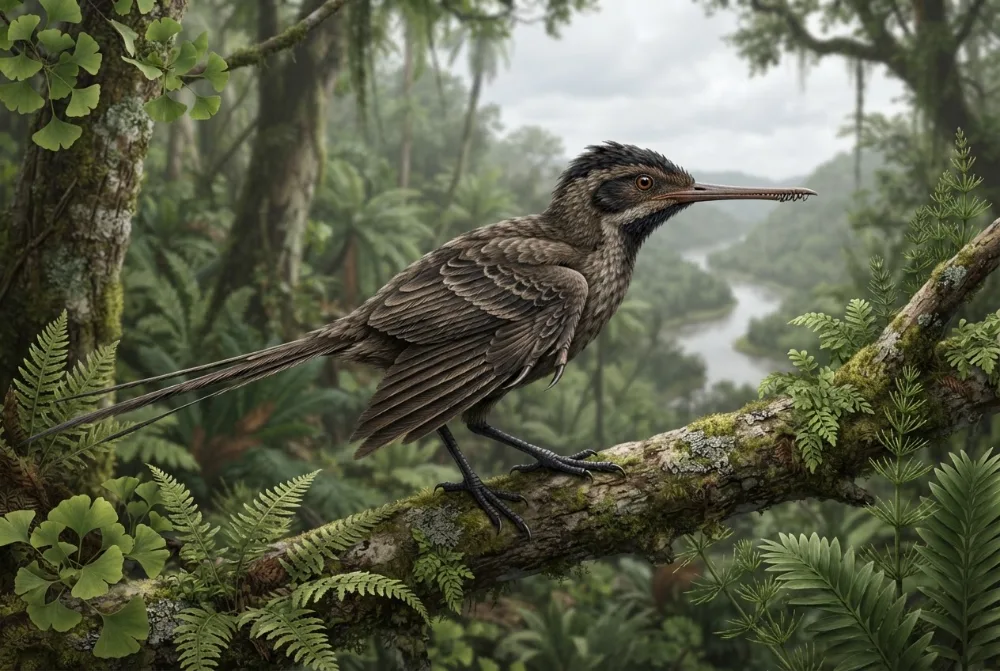
Longipteryx was a tiny bird that lived about 120 million years ago in what is now China. It had long, strong wings and a very long snout with hooked teeth at the tip. This little bird was a great flyer and could perch on branches like modern birds.12
Cura viveva el?
Quant grond era el?
Quant ladas eran sias alas?
Quant grev era el?
Quant grond era Longipteryx cumpareglià cun TAI?
Mo matematica en tes navigatur. Nagut na vegn arcunà u tramess.
Quant spert era el?


Fatgs divertents
Longipteryx had a very long snout that was longer than the rest of its head, with a few hooked teeth at the tip.1
Its wings were much longer than its legs, with the upper arm bone (humerus) being 1.56 times the length of the thigh bone (femur).1
Unlike most other early birds, Longipteryx had uncinate processes on its ribs, which helped strengthen its ribcage and improve breathing.12
Its feet were built for perching, with all four toe bones (metatarsals) ending at nearly the same level, just like modern perching birds.2
Scientists once thought Longipteryx ate fish or insects, but in 2024 a study found it actually ate seeds and fruits.1
Longipteryx had a big breastbone with a well-developed keel, which gave it powerful flight muscles.2
Las dumondas las pli frequentas davart Longipteryx
?How big was Longipteryx?
Longipteryx was very small, with a wingspan of about 46.3 cm (1.52 ft) and a body mass of about 193 g (6.8 oz).1
?What did Longipteryx eat?
Longipteryx ate fish. A 2024 study found fish remains in its stomach, showing it was a piscivore.13
?Did Longipteryx have feathers?
Yes, Longipteryx had feathers. The holotype preserves body feathers, wing coverts and down, but no long tail feathers.1
?Could Longipteryx fly?
Yes, Longipteryx was a good flyer. It had long, strong wings and a well-developed breastbone with a keel for powerful flight muscles.1
Chatschader da mitus
Mitus: Longipteryx was a fish-eater because of its long snout and teeth.
Vardad: Scientists now know from fossil evidence that Longipteryx ate seeds and fruits, not fish.1
Per experts da dinos
- Num scientific
- Longipteryx
- Numnà da
- Zhang et al. 20004
- Gruppa
- Utschels primitivs
- Famiglia / clada
- Longipterygidae4
- Classificaziun
- Theropoda > Avialae4
- Vegliadetgna da la crappa
- 121 fin 113 milliuns onns (Aptian)4
- Formaziuns da crap
- Jiufotang4
- Pajais
- China4
- Chats da fossils
- 3 en The Paleobiology Database4
- Scuverta
- Longipteryx was named in 2000 by Zhang Fucheng and colleagues from a nearly complete skeleton found in the Jiufotang Formation in Chaoyang, China.42
- Anc discutà
- Scientists are not sure whether Longipteryx used its long snout and teeth to catch prey or for some other purpose.1
Danunder che vegnan ils fatgs
- Longipteryx (en.wikipedia.org)
- Early diversification of birds: Evidence from a new opposite bird (ivpp.cas.cn)
- Direct evidence of frugivory in the Mesozoic bird Longipteryx contradicts morphological proxies for diet (cell.com)
- Longipteryx in The Paleobiology Database (CC BY 4.0): vegliadetgna, lieus, formaziuns da crap, classificaziun.
Mintga fatg sin questa pagina ha in numer che maina tar sia funtauna. Sche nus avain fatg in sbagl, perstgisa, nus essan fans da dinos, betg ina revista scientifica. Scriva a nus sin [email protected] e nus il curregin.
 Rex ha fom! Dino Wiki è in project d'in bab per ses figl che ama ils dinos, gratuit, senza reclama e senza trackers. Ils creschids pon dar ina marenda a Rex per gidar a tegnair la pagina online.Pavlar Rex
 Archaeopteryx
 Hesperornis
 Ichthyornis
 Baptornis
 Jurapteryx
 Gobipteryx
 Stegosaurus
 Iguanodon
 Giganotosaurus
 Microraptor
 Deinonychus
 Baryonyx