 Uri dinozore iyihe? Umukino w'ibibazo
 Intambara ya dinozore
 Isiganwa rya dinozore
 Imikino mito ya dinozore
 Alubumu ya sitikeri
 Intonde za TOP za dinozore
 Ntungura!
Yabayeho ryari?

Yanganaga ite?
Yari ndende ite?
Yari iremereye ite?

 ndende nk'imodoka 2 ziparitse ku murongo🍌ndende nk'imineke 56 ikurikiranye🍉iremereye nk'imbuto 200 za watermelon🧸iremereye nk'abana 53 bo mu ishuri ry'incuke🎒iremereye nk'abanyeshuri 31🐻❄️iremereye nk'idubu 2 zo mu rubura🏃yashoboraga kwiruka metero 100 mu masegonda 9,2 (umuntu wihuta kurusha abandi akenera 9,6)
Aerosteon yanganaga ite ugereranyije NAWE?
Ni imibare gusa ibarirwa muri mushakisha yawe. Nta kintu kibikwa cyangwa cyoherezwa ahandi.
Yihutaga ite?


Utuntu dushimishije
Aerosteon had air sacs inside its bones, like modern birds. These air sacs helped it breathe more efficiently.2
Its furcula (wishbone) and ilium (hip bone) were hollowed out by air sacs. In birds, these bones are connected to air sacs that help pump air through the lungs.2
Aerosteon lived about 84 million years ago, during the Late Cretaceous period.2
The first fossils of Aerosteon were found in 1996, but the dinosaur was not named until 2008.1
Aerosteon was a megaraptoran, a group of predatory dinosaurs that were common in South America.4
Its name means 'air bone' because of the many air-filled spaces in its skeleton.1
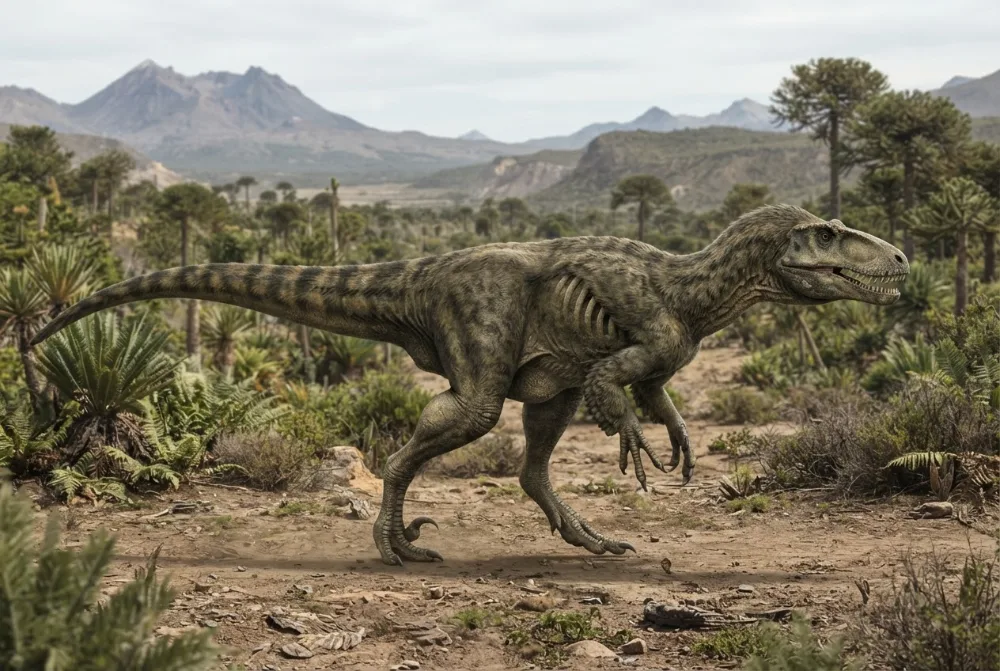
Ibibazo bibazwa cyane kuri Aerosteon
?How big was Aerosteon?
Scientists disagree on its size. Early estimates said 9 to 10 metres (30 to 33 ft) long, but later estimates range from 6 metres (20 ft) to 7.5 metres (25 ft) and weigh about 500 kg to 1 metric ton.1
?Did Aerosteon have feathers?
No fossil feathers have been found with Aerosteon, so nobody knows for sure. It was a megaraptoran dinosaur, and some close relatives may have had simple feathers, but there is no direct evidence.1
?What did Aerosteon eat?
Aerosteon was a meat-eater. It ate other animals, though no one knows exactly which ones.1
?Could Aerosteon fly?
No, Aerosteon could not fly. It was a large, two-legged dinosaur that walked on the ground.1
?When did Aerosteon live?
Aerosteon lived about 84 million years ago, during the Late Cretaceous period.12
?Why is Aerosteon called air bone?
Its name means 'air bone' because its skeleton had many air-filled spaces, like the hollow bones of modern birds.1
Ku bazobereye muri dinozore
- Izina rya siyansi
- Aerosteon
- Yiswe na
- Sereno et al. 20084
- Itsinda
- Dinozore zirya inyama
- Umuryango / ishami
- Megaraptoridae4
- Ishyirwa mu byiciro
- Theropoda > Megaraptora4
- Imyaka y'amabuye
- imyaka miliyoni 84 kugeza 72 (Campanian)4
- Inzego z'amabuye
- Anacleto4
- Ibihugu
- Arijantine4
- Ibisigazwa byanditswe
- 1 muri The Paleobiology Database4
- Ivumburwa
- Aerosteon was named by paleontologist Paul Sereno and his team in 2008. The fossils were found in the Anacleto Formation in Argentina, near the Rio Colorado river.41
- Biracyagibwaho impaka
- Scientists are not sure exactly where Aerosteon fits on the dinosaur family tree. Some think it is a megaraptoran, while others link it to allosauroids from the Jurassic.2
Aho amakuru yakuwe
- Aerosteon (en.wikipedia.org)
- Evidence for Avian Intrathoracic Air Sacs in a New Predatory Dinosaur from Argentina (pmc.ncbi.nlm.nih.gov)
- Aerosteon (en.wikipedia.org)
- Aerosteon in The Paleobiology Database (CC BY 4.0): imyaka, ahantu, inzego z'amabuye, ishyirwa mu byiciro.
Buri kintu kiri kuri uru rupapuro gifite nimero yerekana aho cyakuwe. Niba hari icyo twibeshye, tubabarire, turi abakunzi ba dinozore, ntituri ikinyamakuru cya siyansi. Tubwire kuri [email protected] tuzagikosora.
 Rex arashonje! Dino Wiki ni umushinga wa papa umwe yakoreye umuhungu we ukunda dinozore, ni ubuntu, nta matangazo kandi nta bigukurikirana. Abantu bakuru bashobora guha Rex akantu ko kurya kugira ngo Dino Wiki ikomeze kuboneka kuri interineti.Gaburira Rex
 Allosaurus
 Carnotaurus
 Dilophosaurus
 Giganotosaurus
 Compsognathus
 Paronychodon
 Tyrannosaurus
 Triceratops
 Velociraptor
 Spinosaurus
 Ankylosaurus
 Parasaurolophus