 Uri dinozore iyihe? Umukino w'ibibazo
 Intambara ya dinozore
 Isiganwa rya dinozore
 Imikino mito ya dinozore
 Alubumu ya sitikeri
 Intonde za TOP za dinozore
 Ntungura!
Carinodens
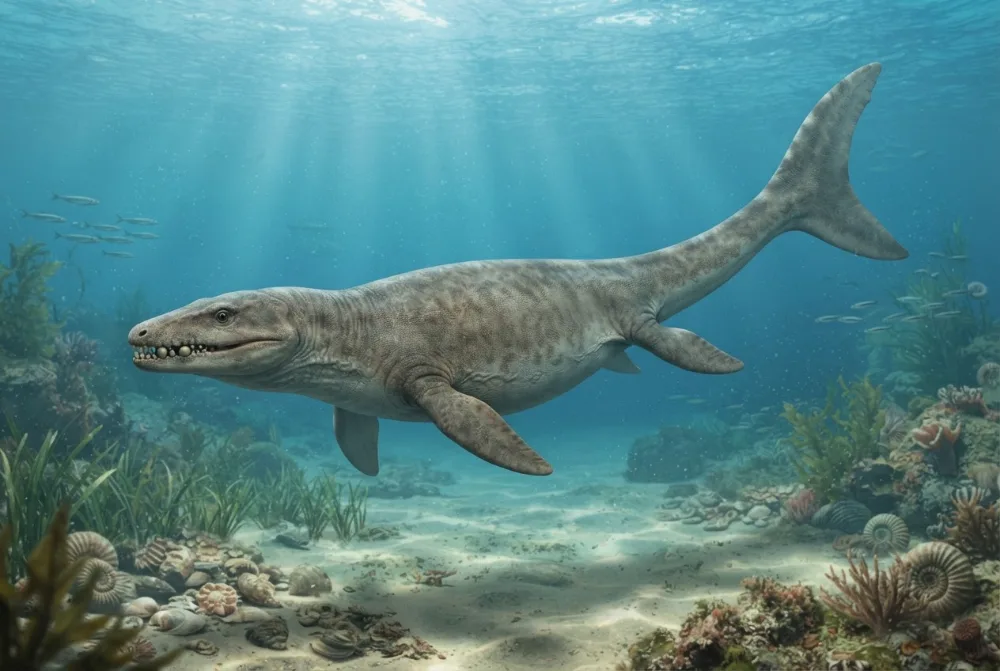
Carinodens was a small mosasaur, a marine lizard that lived in the late Cretaceous seas. It had round, blunt teeth like a set of nutcrackers for crushing hard-shelled animals. At only about 2 to 2.6 metres long, it was one of the tiniest mosasaurs ever.1
Yabayeho ryari?
Yanganaga ite?
Yari ndende ite?
 ndende nk'imbwa 2,5 zikurikiranye🍌ndende nk'imineke 14 ikurikiranye🏊yashoboraga koga uburebure bwa pisine nini (50 m) mu masegonda 6
Carinodens yanganaga ite ugereranyije NAWE?
Ni imibare gusa ibarirwa muri mushakisha yawe. Nta kintu kibikwa cyangwa cyoherezwa ahandi.
Yihutaga ite?


Utuntu dushimishije
Carinodens was first thought to be a crocodile! A fossil jaw was originally named Bottosaurus belgicus and considered a crocodilian before being recognized as a mosasaur.1
Its teeth were very different from each other. The front teeth were round and curved, while the back teeth were flat and blade-like with a keel on each side.1
Scientists can tell what Carinodens ate by looking at tiny scratches on its teeth. The wear patterns show it munched on hard-shelled animals that lived on the seafloor.1
Carinodens is closely related to Globidens, another mosasaur with crushing teeth. Together they belong to a group called Globidensini.1
The name Carinodens means 'keel teeth' because its teeth have a ridge like the keel of a boat. It replaced the older name Compressidens, which was already used for a different animal.1
Ibibazo bibazwa cyane kuri Carinodens
?What did Carinodens eat?
Carinodens ate hard-shelled animals like clams, oysters, and sea urchins. Its blunt teeth were perfect for crushing them, and scratches on the teeth show it munched on creatures that lived on the seafloor.12
?How big was Carinodens?
Carinodens was about 2 to 2.6 metres (6.6 to 8.5 feet) long. That makes it one of the smallest mosasaurs ever.1
?Where did Carinodens live?
Carinodens lived in the late Cretaceous seas, and its fossils have been found in Europe, North America, South America, and North Africa. Most skull fossils come from the Netherlands and Belgium.1
?Is Carinodens a dinosaur?
No, Carinodens is not a dinosaur. It is a marine lizard called a mosasaur that lived in the sea during the time of the dinosaurs.1
Ku bazobereye muri dinozore
- Izina rya siyansi
- Carinodens
- Yiswe na
- Thurmond 19693
- Itsinda
- Mozazore
- Umuryango / ishami
- Mosasauridae3
- Ishyirwa mu byiciro
- Mosasauroidea3
- Imyaka y'amabuye
- imyaka miliyoni 72 kugeza 66 (Maastrichtian)3
- Inzego z'amabuye
- Maastricht, Gramame, Bereza Beds3
- Ibihugu
- Ubuholandi, Maroke, Burezili, Ukereni, Uburusiya, Ububiligi3
- Ibisigazwa byanditswe
- 16 muri The Paleobiology Database3
- Ivumburwa
- The first fossils were found in Belgium and described by Louis Dollo in 1913 as Globidens fraasi. In 1969, J.T. Thurmond gave it the new name Carinodens because the old name was already taken.1
- Biracyagibwaho impaka
- Scientists are not sure how many species of Carinodens existed. Some think C. belgicus and C. fraasi might be the same species, while others believe they are different based on tooth shape.1
Aho amakuru yakuwe
- Carinodens (en.wikipedia.org)
- Feeding the Mechanical Mosasaur: what did Carinodens eat? | Netherlands Journal of Geosciences | Cambridge Core (cambridge.org)
- Carinodens in The Paleobiology Database (CC BY 4.0): imyaka, ahantu, inzego z'amabuye, ishyirwa mu byiciro.
Buri kintu kiri kuri uru rupapuro gifite nimero yerekana aho cyakuwe. Niba hari icyo twibeshye, tubabarire, turi abakunzi ba dinozore, ntituri ikinyamakuru cya siyansi. Tubwire kuri [email protected] tuzagikosora.
 Rex arashonje! Dino Wiki ni umushinga wa papa umwe yakoreye umuhungu we ukunda dinozore, ni ubuntu, nta matangazo kandi nta bigukurikirana. Abantu bakuru bashobora guha Rex akantu ko kurya kugira ngo Dino Wiki ikomeze kuboneka kuri interineti.Gaburira Rex
 Mosasaurus
 Prognathodon
 Tylosaurus
 Platecarpus
 Clidastes
 Globidens
 Tyrannosaurus
 Triceratops
 Velociraptor
 Spinosaurus
 Ankylosaurus
 Parasaurolophus