 Uri dinozore iyihe? Umukino w'ibibazo
 Intambara ya dinozore
 Isiganwa rya dinozore
 Imikino mito ya dinozore
 Alubumu ya sitikeri
 Intonde za TOP za dinozore
 Ntungura!
Yabayeho ryari?

Yanganaga ite?
Yari ndende ite?
Ubutumburuke bwayo bwanganaga iki?
Yari iremereye ite?
 ndende nk'imodoka 2 ziparitse ku murongo🍌ndende nk'imineke 50 ikurikiranye
 iremereye nk'imbwa 100🍉iremereye nk'imbuto 400 za watermelon🎒iremereye nk'ibyumba 2,5 by'amashuri byuzuye abana🐻❄️iremereye nk'idubu 4 zo mu rubura🏃yashoboraga kwiruka metero 100 mu masegonda 13 (umuntu wihuta kurusha abandi akenera 9,6)
Ceratosuchops yanganaga ite ugereranyije NAWE?
Ni imibare gusa ibarirwa muri mushakisha yawe. Nta kintu kibikwa cyangwa cyoherezwa ahandi.
Yihutaga ite?


Utuntu dushimishije
Ceratosuchops was named in 2021, making it a very recently discovered dinosaur.2
Its name means 'horned crocodile face' because of the bumpy horns above its eyes and its long, crocodile-like snout.1
It lived about 125 to 121 million years ago during the Early Cretaceous period.2
Ceratosuchops belonged to a group of spinosaurid dinosaurs that often had crocodile-like skulls and may have eaten fish.1
Its fossils were found on the Isle of Wight, a famous place for dinosaur discoveries in England.1
Scientists think Ceratosuchops lived near rivers and hunted like a modern heron, wading in shallow water to catch prey.1
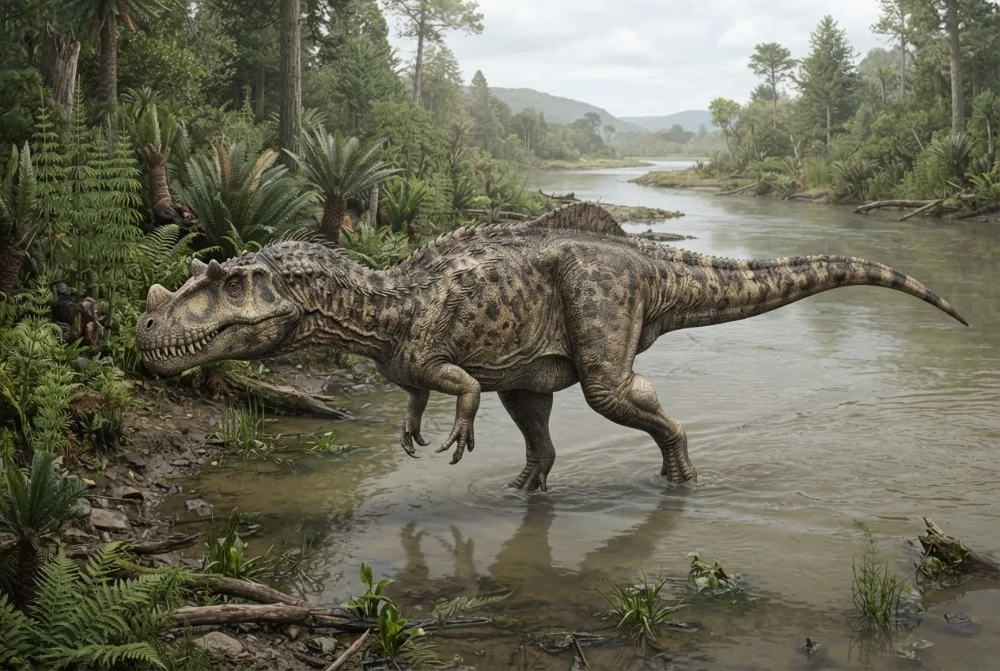
Ibibazo bibazwa cyane kuri Ceratosuchops
?How big was Ceratosuchops?
About 9 metres (30 feet) long, with a skull about 1 metre (3.3 feet) long.3
?What did Ceratosuchops eat?
It ate fish, small turtles, young crocodiles, baby dinosaurs, and mammals.4
?When was Ceratosuchops discovered?
It was named in 2021, based on fossils found between 2013 and 2017.4
?Why does Ceratosuchops have horns?
The bony bumps above its eyes might have been used for signalling to other animals or for fighting.4
?Is Ceratosuchops a dinosaur?
Yes, it is a theropod dinosaur in the spinosaurid group.4
Ku bazobereye muri dinozore
- Izina rya siyansi
- Ceratosuchops
- Yiswe na
- Barker et al. 20216
- Itsinda
- Spinozore
- Umuryango / ishami
- Spinosauridae6
- Ishyirwa mu byiciro
- Theropoda > Spinosauridae6
- Imyaka y'amabuye
- imyaka miliyoni 126 kugeza 121 (Barremian)6
- Inzego z'amabuye
- Wessex6
- Ibihugu
- Ubwongereza6
- Ibisigazwa byanditswe
- 1 muri The Paleobiology Database6
- Ivumburwa
- Ceratosuchops was named by Barker and colleagues in 2021 based on fossils found on the Isle of Wight, England, between 2013 and 2017.1
- Biracyagibwaho impaka
- Scientists are not sure exactly how big Ceratosuchops grew, because only a few skull bones have been found so far.2
Aho amakuru yakuwe
- New spinosaurids from the Wessex Formation (Early Cretaceous, UK) and the European origins of Spinosauridae (pmc.ncbi.nlm.nih.gov)
- PBDB Taxon (paleobiodb.org)
- Two New Species Of Large Predatory Dinosaur Discovered On Isle of Wight | University of Southampton (southampton.ac.uk)
- Ceratosuchops (en.wikipedia.org)
- New spinosaurids from the Wessex Formation (Early Cretaceous, UK) and the European origins of Spinosauridae | Scientific Reports (nature.com)
- Ceratosuchops in The Paleobiology Database (CC BY 4.0): imyaka, ahantu, inzego z'amabuye, ishyirwa mu byiciro.
Buri kintu kiri kuri uru rupapuro gifite nimero yerekana aho cyakuwe. Niba hari icyo twibeshye, tubabarire, turi abakunzi ba dinozore, ntituri ikinyamakuru cya siyansi. Tubwire kuri [email protected] tuzagikosora.
 Rex arashonje! Dino Wiki ni umushinga wa papa umwe yakoreye umuhungu we ukunda dinozore, ni ubuntu, nta matangazo kandi nta bigukurikirana. Abantu bakuru bashobora guha Rex akantu ko kurya kugira ngo Dino Wiki ikomeze kuboneka kuri interineti.Gaburira Rex
 Spinosaurus
 Baryonyx
 Suchomimus
 Angaturama
 Camarillasaurus
 Iberospinus
 Stegosaurus
 Iguanodon
 Archaeopteryx
 Giganotosaurus
 Microraptor
 Deinonychus