 Uri dinozore iyihe? Umukino w'ibibazo
 Intambara ya dinozore
 Isiganwa rya dinozore
 Imikino mito ya dinozore
 Alubumu ya sitikeri
 Intonde za TOP za dinozore
 Ntungura!
Yabayeho ryari?

Yanganaga ite?
Yari ndende ite?
Ubutumburuke bwayo bwanganaga iki?
igereranya
 ndende nk'injangwe 1,5 zo mu rugo zikurikiranye🍌ndende nk'imineke 4 ikurikiranye🪑nto ku buryo yanyura munsi y'intebe🏊yashoboraga koga uburebure bwa pisine nini (50 m) mu masegonda 22
Chupkaornis yanganaga ite ugereranyije NAWE?
Ni imibare gusa ibarirwa muri mushakisha yawe. Nta kintu kibikwa cyangwa cyoherezwa ahandi.
Yihutaga ite?


Utuntu dushimishije
Chupkaornis is the oldest known hesperornithiform bird from Asia, living about 89 to 83 million years ago.2
Its name comes from the Ainu word 'chupka' meaning 'eastern', because it was found in East Asia, unlike its relative Hesperornis which means 'western bird'.1
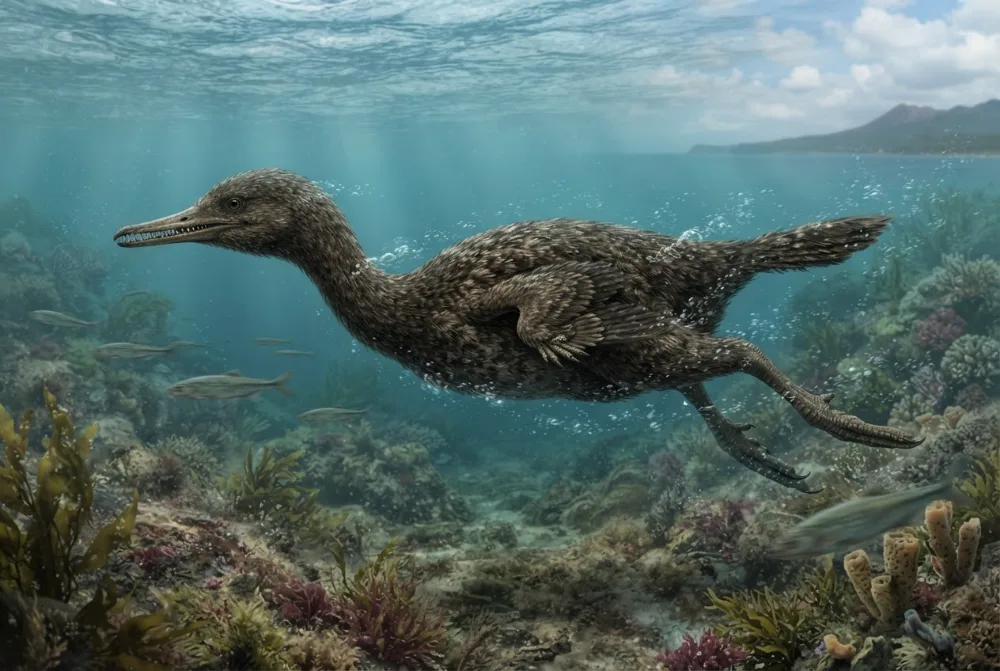
Chupkaornis could not fly. Its wings were tiny, and it used its strong legs and feet to push itself through the water.2
The only known fossil of Chupkaornis includes nine bones: neck vertebrae, back vertebrae, part of the thigh bone, and part of the shin bone.1
It was discovered in 1996 by two amateur fossil collectors, Masatoshi and Yasuji Kera, and was named after them.1
Chupkaornis had special joints in its backbone that allowed it to bend its neck and body while diving.2
Ibibazo bibazwa cyane kuri Chupkaornis
?How big was Chupkaornis?
Chupkaornis was about 70 to 80 centimetres (2.3 to 2.6 feet) long, roughly the size of a small penguin.1
?Could Chupkaornis fly?
No, Chupkaornis could not fly. It had very small wings and used its strong legs and webbed feet to swim underwater.12
?What did Chupkaornis eat?
Chupkaornis was a predatory diving bird that likely caught fish underwater with its sharp teeth.2
?When did Chupkaornis live?
Chupkaornis lived during the Late Cretaceous, about 89 to 83 million years ago.1
Ku bazobereye muri dinozore
- Izina rya siyansi
- Chupkaornis
- Yiswe na
- Tanaka et al. 20184
- Itsinda
- Inyoni za mbere
- Umuryango / ishami
- Hesperornithiformes4
- Ishyirwa mu byiciro
- Theropoda > Avialae4
- Imyaka y'amabuye
- imyaka miliyoni 90 kugeza 84 (Coniacian / Santonian)4
- Inzego z'amabuye
- Kashima4
- Ibihugu
- Ubuyapani4
- Ibisigazwa byanditswe
- 1 muri The Paleobiology Database4
- Ivumburwa
- Chupkaornis was discovered in August 1996 by Masatoshi and Yasuji Kera in Hokkaido, Japan. It was named and described by Tomonori Tanaka and colleagues in 2018.13
- Biracyagibwaho impaka
- Scientists are not sure exactly how large Chupkaornis was, because only a few bones have been found.1
Aho amakuru yakuwe
- Chupkaornis (en.wikipedia.org)
- The oldest Asian hesperornithiform from the Upper Cretaceous of Japan, and the phylogenetic reassessment of Hesperornithiformes (perot-m.imgix.net)
- PBDB Taxon (paleobiodb.org)
- Chupkaornis in The Paleobiology Database (CC BY 4.0): imyaka, ahantu, inzego z'amabuye, ishyirwa mu byiciro.
Buri kintu kiri kuri uru rupapuro gifite nimero yerekana aho cyakuwe. Niba hari icyo twibeshye, tubabarire, turi abakunzi ba dinozore, ntituri ikinyamakuru cya siyansi. Tubwire kuri [email protected] tuzagikosora.
 Rex arashonje! Dino Wiki ni umushinga wa papa umwe yakoreye umuhungu we ukunda dinozore, ni ubuntu, nta matangazo kandi nta bigukurikirana. Abantu bakuru bashobora guha Rex akantu ko kurya kugira ngo Dino Wiki ikomeze kuboneka kuri interineti.Gaburira Rex
 Archaeopteryx
 Hesperornis
 Ichthyornis
 Baptornis
 Jurapteryx
 Gobipteryx
 Tyrannosaurus
 Triceratops
 Velociraptor
 Spinosaurus
 Ankylosaurus
 Parasaurolophus