 Uri dinozore iyihe? Umukino w'ibibazo
 Intambara ya dinozore
 Isiganwa rya dinozore
 Imikino mito ya dinozore
 Alubumu ya sitikeri
 Intonde za TOP za dinozore
 Ntungura!
Eremiasaurus
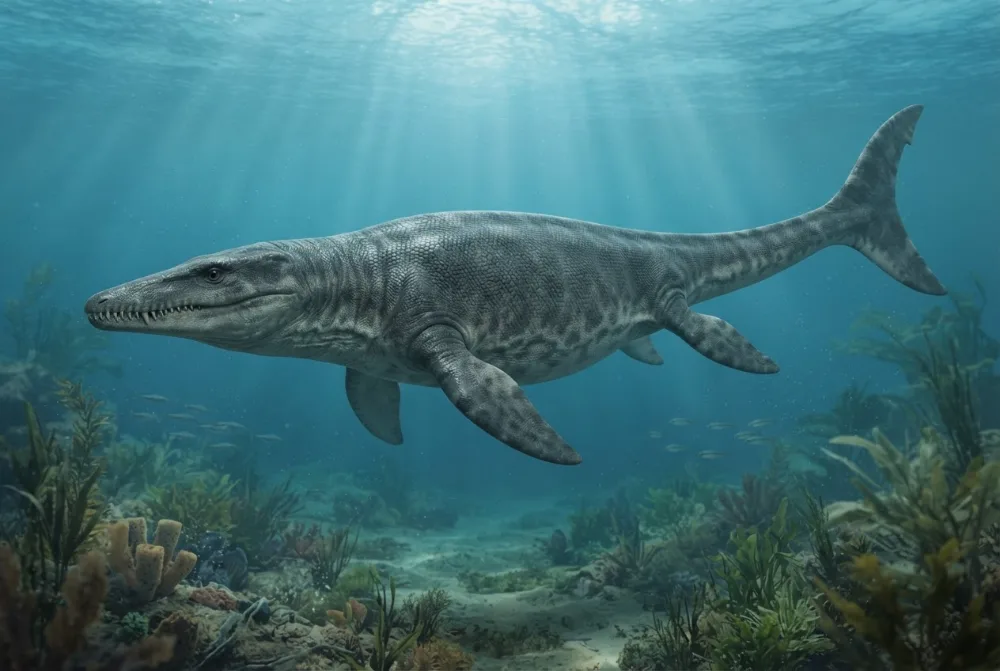
Eremiasaurus was a marine reptile that swam in warm seas during the time of the dinosaurs. It was a mosasaur, not a dinosaur, and it lived about 70 to 66 million years ago. This predator had a streamlined body and a long tail to help it zoom through the water.1
Yabayeho ryari?
Yanganaga ite?
Yari ndende ite?
 ndende nk'imbwa 5 zikurikiranye🍌ndende nk'imineke 28 ikurikiranye🏊yashoboraga koga uburebure bwa pisine nini (50 m) mu masegonda 4,7
Eremiasaurus yanganaga ite ugereranyije NAWE?
Ni imibare gusa ibarirwa muri mushakisha yawe. Nta kintu kibikwa cyangwa cyoherezwa ahandi.
Yihutaga ite?


Utuntu dushimishije
Eremiasaurus had very different-shaped teeth in its jaws, a rare trait for mosasaurs. Its species name heterodontus means 'different teeth'.1
The first fossils of Eremiasaurus were teeth found in Morocco in 1952. Scientists at first thought they belonged to another mosasaur called Mosasaurus.1
Eremiasaurus was named in 2012 from two nearly complete skeletons. One skeleton was found by a scientist, and the other came from a commercial fossil collector.1
This mosasaur had a tail that bent downward and a fan of bones in its tail, which helped it swim fast. Its tail was similar to the fast-swimming mosasaur Plotosaurus.1
Eremiasaurus lived in a warm, shallow sea called the Mediterranean Tethys. Many other mosasaurs and fish lived there too.1
Scientists think Eremiasaurus ate different food than its larger mosasaur neighbors, like Thalassotitan and Prognathodon. This helped them avoid competing for the same prey.1
Ibibazo bibazwa cyane kuri Eremiasaurus
?How big was Eremiasaurus?
About 5 metres (16 feet) long, which is a bit shorter than a minibus.1
?What did Eremiasaurus eat?
Nobody knows for sure. Its different-shaped teeth make it unclear what prey it ate.1
?Could Eremiasaurus swim fast?
Yes. Its tail bones suggest it was a high-speed pursuit predator, built for fast swimming.1
?Where did Eremiasaurus live?
It lived in a warm, shallow sea called the Mediterranean Tethys, near what is now Morocco.1
Ku bazobereye muri dinozore
- Izina rya siyansi
- Eremiasaurus
- Yiswe na
- LeBlanc et al. 20122
- Itsinda
- Mozazore
- Umuryango / ishami
- Mosasauridae2
- Ishyirwa mu byiciro
- Mosasauroidea2
- Imyaka y'amabuye
- imyaka miliyoni 72 kugeza 66 (Maastrichtian)2
- Inzego z'amabuye
- Phosphates, Couche III2
- Ibihugu
- Maroke2
- Ibisigazwa byanditswe
- 7 muri The Paleobiology Database2
- Ivumburwa
- Eremiasaurus was named in 2012 by paleontologists Aaron LeBlanc, Michael Caldwell, and Nathalie Bardet. They described it from two skeletons found in the phosphate mines of the Ouled Abdoun Basin in Morocco.1
- Biracyagibwaho impaka
- Scientists are not sure exactly what Eremiasaurus ate. Its unusual teeth make it hard to guess its favorite prey.1
Aho amakuru yakuwe
- Eremiasaurus (en.wikipedia.org)
- Eremiasaurus in The Paleobiology Database (CC BY 4.0): imyaka, ahantu, inzego z'amabuye, ishyirwa mu byiciro.
Buri kintu kiri kuri uru rupapuro gifite nimero yerekana aho cyakuwe. Niba hari icyo twibeshye, tubabarire, turi abakunzi ba dinozore, ntituri ikinyamakuru cya siyansi. Tubwire kuri [email protected] tuzagikosora.
 Rex arashonje! Dino Wiki ni umushinga wa papa umwe yakoreye umuhungu we ukunda dinozore, ni ubuntu, nta matangazo kandi nta bigukurikirana. Abantu bakuru bashobora guha Rex akantu ko kurya kugira ngo Dino Wiki ikomeze kuboneka kuri interineti.Gaburira Rex
 Mosasaurus
 Prognathodon
 Tylosaurus
 Platecarpus
 Clidastes
 Globidens
 Tyrannosaurus
 Triceratops
 Velociraptor
 Spinosaurus
 Ankylosaurus
 Parasaurolophus