 Uri dinozore iyihe? Umukino w'ibibazo
 Intambara ya dinozore
 Isiganwa rya dinozore
 Imikino mito ya dinozore
 Alubumu ya sitikeri
 Intonde za TOP za dinozore
 Ntungura!
Fortipesavis
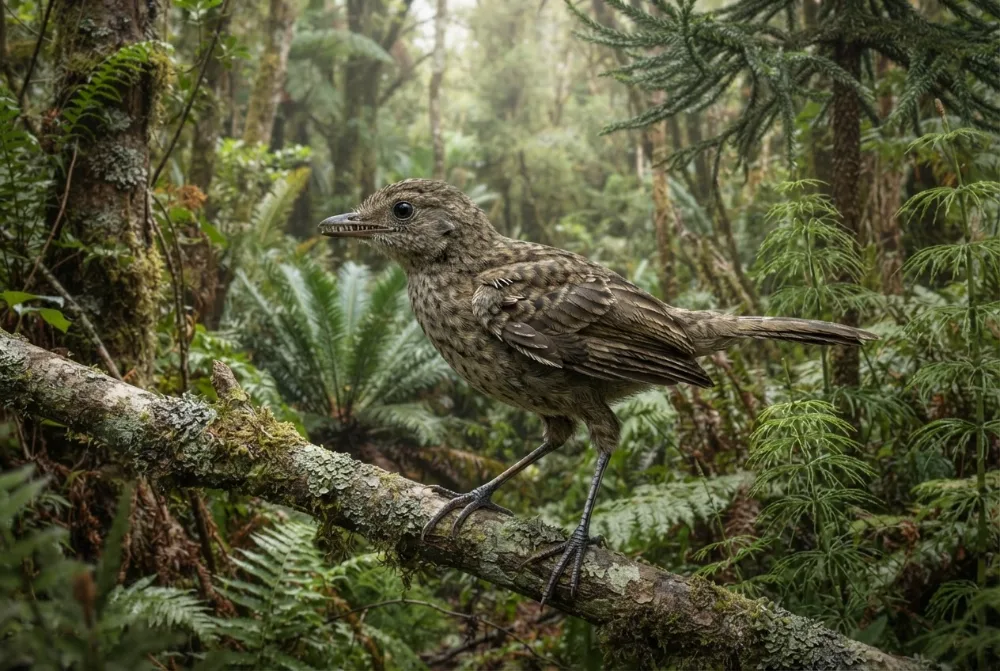
Fortipesavis was a tiny bird that lived about 98 million years ago. It had a very strong and wide fourth toe, which helped it grip onto thin, wobbly branches like a kingfisher. Its foot was so unusual that scientists named it the 'strong-footed bird'.12
Yabayeho ryari?
Yihutaga ite?


Utuntu dushimishije
Fortipesavis is known only from a partial left foot preserved in amber, which is a piece of fossilized tree resin.1
Its fourth toe was almost twice as wide as its second toe, a feature not seen in any other bird, living or extinct.12
The foot of Fortipesavis had thick, padded toes with deep grooves between them, which helped it grip tightly onto branches.2
This bird lived in a mangrove forest environment, where it probably perched on thin, swaying branches while hunting for insects.12
The fossil of Fortipesavis was found in a piece of amber that weighs only 2.68 grams and is about the size of a large coin.1
Scientists used micro-CT scanning to study the foot inside the amber without damaging the fossil.1
Ku bazobereye muri dinozore
- Izina rya siyansi
- Fortipesavis
- Yiswe na
- Clark and O’Connor 20214
- Itsinda
- Inyoni za mbere
- Umuryango / ishami
- Enantiornithes4
- Ishyirwa mu byiciro
- Theropoda > Avialae4
- Imyaka y'amabuye
- imyaka miliyoni 100 kugeza 94 (Cenomanian)4
- Ibihugu
- Myanimari4
- Ibisigazwa byanditswe
- 1 muri The Paleobiology Database4
- Ivumburwa
- Fortipesavis was named in 2021 by Alexander Clark and Jingmai O'Connor based on a foot preserved in amber from Myanmar. The fossil was first described in 2019 by Lida Xing and colleagues.13
- Biracyagibwaho impaka
- Scientists are not sure whether Fortipesavis ate insects or fish, because its foot is similar to both modern kingfishers (which eat fish) and bee-eaters (which eat insects).2
Aho amakuru yakuwe
- Fortipesavis (en.wikipedia.org)
- Frontiers | Exploring the Ecomorphology of Two Cretaceous Enantiornithines With Unique Pedal Morphology (frontiersin.org)
- PBDB Taxon (paleobiodb.org)
- Fortipesavis in The Paleobiology Database (CC BY 4.0): imyaka, ahantu, inzego z'amabuye, ishyirwa mu byiciro.
Buri kintu kiri kuri uru rupapuro gifite nimero yerekana aho cyakuwe. Niba hari icyo twibeshye, tubabarire, turi abakunzi ba dinozore, ntituri ikinyamakuru cya siyansi. Tubwire kuri [email protected] tuzagikosora.
 Rex arashonje! Dino Wiki ni umushinga wa papa umwe yakoreye umuhungu we ukunda dinozore, ni ubuntu, nta matangazo kandi nta bigukurikirana. Abantu bakuru bashobora guha Rex akantu ko kurya kugira ngo Dino Wiki ikomeze kuboneka kuri interineti.Gaburira Rex
 Archaeopteryx
 Hesperornis
 Ichthyornis
 Baptornis
 Jurapteryx
 Gobipteryx
 Tyrannosaurus
 Triceratops
 Velociraptor
 Spinosaurus
 Ankylosaurus
 Parasaurolophus