 Uri dinozore iyihe? Umukino w'ibibazo
 Intambara ya dinozore
 Isiganwa rya dinozore
 Imikino mito ya dinozore
 Alubumu ya sitikeri
 Intonde za TOP za dinozore
 Ntungura!
Gondwananectes
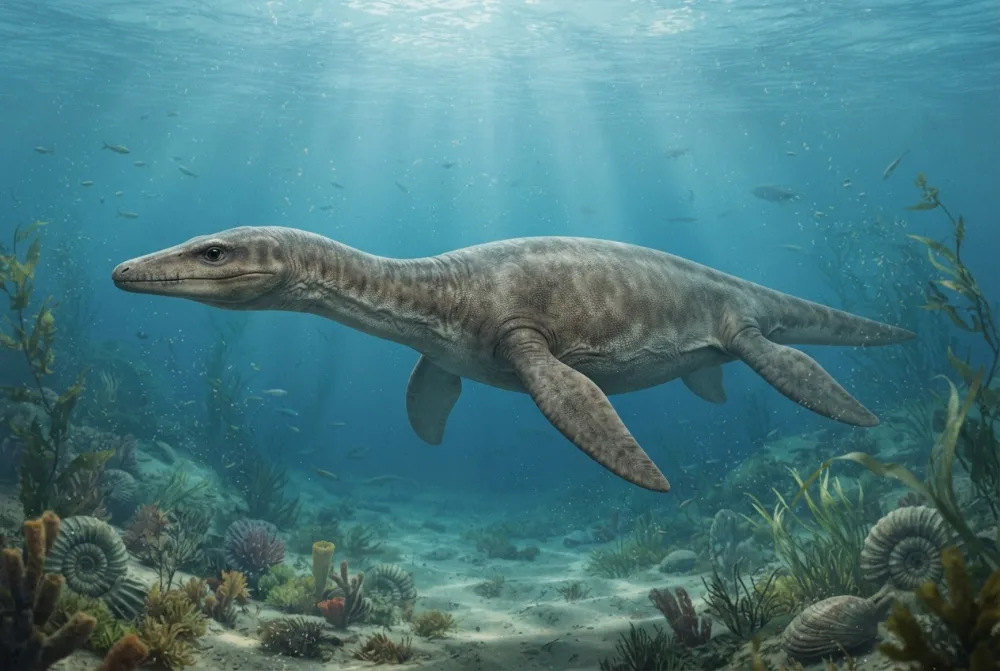
Gondwananectes was a medium-sized plesiosaur that swam in the warm seas of the Jurassic period. It had a long neck, a short tail, and four flippers that helped it glide through the water like a sea turtle. This marine reptile lived about 170 million years ago in what is now Chile.13
Yabayeho ryari?
Yanganaga ite?
Yari ndende ite?
 ndende nk'injangwe 4 zo mu rugo zikurikiranye🍌ndende nk'imineke 11 ikurikiranye🏊yashoboraga koga uburebure bwa pisine nini (50 m) mu masegonda 7,8
Gondwananectes yanganaga ite ugereranyije NAWE?
Ni imibare gusa ibarirwa muri mushakisha yawe. Nta kintu kibikwa cyangwa cyoherezwa ahandi.
Yihutaga ite?


Utuntu dushimishije
Gondwananectes is one of the oldest plesiosaurs ever found in the southern supercontinent Gondwana, which is why it got its name.1
The only known fossil of Gondwananectes was discovered in 2014 by Osvaldo Rojas, a museum director, and his team.1
Scientists originally thought some of its bones were part of the hips, but later preparation showed they were actually from the shoulder area.1
Gondwananectes had heart-shaped neck vertebrae, which is a unique feature not seen in other plesiosaurs.2
The fossil of Gondwananectes was found scattered in pieces, but scientists were able to put it back together to study it.1
Gondwananectes lived during the Bajocian age of the Middle Jurassic, about 170 to 168 million years ago.3
Ibibazo bibazwa cyane kuri Gondwananectes
?How big was Gondwananectes?
It was about 1.5 to 2 metres (4.9 to 6.6 feet) long, which is roughly the size of a small dolphin.1
?What did Gondwananectes eat?
It was a carnivore, meaning it ate meat, probably fish and other small sea creatures.3
?Is Gondwananectes a dinosaur?
No, it is not a dinosaur. It is a plesiosaur, a type of marine reptile that lived in the ocean.1
Ku bazobereye muri dinozore
- Izina rya siyansi
- Gondwananectes
- Yiswe na
- Otero et al. 20263
- Itsinda
- Plesiyozore
- Umuryango / ishami
- Plesiosauroidea3
- Ishyirwa mu byiciro
- Plesiosauria > Sauropterygia3
- Imyaka y'amabuye
- imyaka miliyoni 171 kugeza 168 (Bajocian)3
- Inzego z'amabuye
- Quehuita3
- Ibihugu
- Shili3
- Ibisigazwa byanditswe
- 1 muri The Paleobiology Database3
- Ivumburwa
- Gondwananectes was named in 2026 by Rodrigo Otero and colleagues. The fossil was found in 2014 by Osvaldo Rojas near Calama, Chile, and is now kept at the Museum of Natural and Cultural History of the Atacama Desert.1
- Biracyagibwaho impaka
- Scientists are still unsure about the exact size of Gondwananectes because only a partial skeleton has been found. The total length is estimated between 1.5 and 2 metres.1
Aho amakuru yakuwe
- Gondwananectes (en.wikipedia.org)
- PBDB Taxon (paleobiodb.org)
- Gondwananectes in The Paleobiology Database (CC BY 4.0): imyaka, ahantu, inzego z'amabuye, ishyirwa mu byiciro.
Buri kintu kiri kuri uru rupapuro gifite nimero yerekana aho cyakuwe. Niba hari icyo twibeshye, tubabarire, turi abakunzi ba dinozore, ntituri ikinyamakuru cya siyansi. Tubwire kuri [email protected] tuzagikosora.
 Rex arashonje! Dino Wiki ni umushinga wa papa umwe yakoreye umuhungu we ukunda dinozore, ni ubuntu, nta matangazo kandi nta bigukurikirana. Abantu bakuru bashobora guha Rex akantu ko kurya kugira ngo Dino Wiki ikomeze kuboneka kuri interineti.Gaburira Rex
 Elasmosaurus
 Pliosaurus
 Plesiosaurus
 Cimoliasaurus
 Colymbosaurus
 Trinacromerum
 Ichthyosaurus
 Khudiakovia
 Ophthalmosaurus
 Pterodactylus
 Rhamphocephalus
 Gongbusaurus