 Uri dinozore iyihe? Umukino w'ibibazo
 Intambara ya dinozore
 Isiganwa rya dinozore
 Imikino mito ya dinozore
 Alubumu ya sitikeri
 Intonde za TOP za dinozore
 Ntungura!
Gondwanatitan
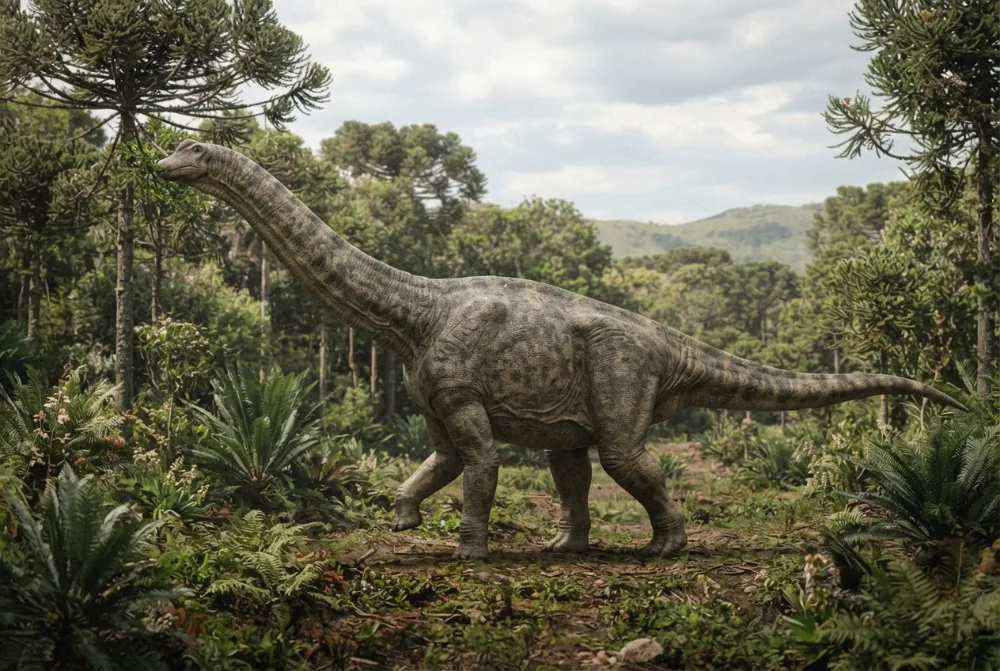
Gondwanatitan was a long-necked plant-eater that stomped around Brazil near the end of the Age of Dinosaurs. It was small for a sauropod, about as long as a school bus, and probably used its tall neck to munch leaves from high trees.1
Yabayeho ryari?
Yanganaga ite?
Yari ndende ite?
Ubutumburuke bwayo bwanganaga iki?
igereranya
Yari iremereye ite?
 ndende nk'imbwa 7 zikurikiranye🍌ndende nk'imineke 39 ikurikiranye🍉iremereye nk'imbuto 200 za watermelon🧸iremereye nk'abana 53 bo mu ishuri ry'incuke🎒iremereye nk'abanyeshuri 31🐻❄️iremereye nk'idubu 2 zo mu rubura🏃yashoboraga kwiruka metero 100 mu masegonda 12 (umuntu wihuta kurusha abandi akenera 9,6)
Gondwanatitan yanganaga ite ugereranyije NAWE?
Ni imibare gusa ibarirwa muri mushakisha yawe. Nta kintu kibikwa cyangwa cyoherezwa ahandi.
Yihutaga ite?


Utuntu dushimishije
Gondwanatitan's middle tail bones are shaped like hearts, which helps scientists tell it apart from its close relative Aeolosaurus.1
Its limb bones were slender and graceful, not as heavy as those of many other sauropods.1
The shallow depressions on its vertebrae are similar to those seen in Saltasaurus, Alamosaurus, and Malawisaurus.1
The neural spines on its middle tail vertebrae point forward, a feature also seen in Cedarosaurus and Venenosaurus.1
In 2001, some scientists thought Gondwanatitan was the same as Aeolosaurus, but most now treat it as a separate genus.1
The type specimen was found on a farm in 1983, but it took until 1997 before scientists started preparing the bones.1
Ibibazo bibazwa cyane kuri Gondwanatitan
?How big was Gondwanatitan?
It was about 7 to 8 metres long and weighed around 1 tonne. That is small for a sauropod, about as long as a school bus.12
?What did Gondwanatitan eat?
It was a herbivore, eating tough shoots and leaves from the tops of trees. Its tall neck helped it reach high branches.13
?When did Gondwanatitan live?
It lived during the Late Cretaceous Period, about 70 million years ago.1
Gusenya ibinyoma
Ibivugwa: Gondwanatitan was a giant like other sauropods.
Ukuri: Actually, Gondwanatitan was a fairly small sauropod, only about 7 meters long and weighing about 1 tonne.1
Ku bazobereye muri dinozore
- Izina rya siyansi
- Gondwanatitan
- Yiswe na
- Kellner and Azevedo 19993
- Itsinda
- Izifite amajosi maremare
- Umuryango / ishami
- Aeolosaurini3
- Ishyirwa mu byiciro
- Sauropodomorpha > Sauropoda > Titanosauria > Macronaria3
- Imyaka y'amabuye
- imyaka miliyoni 84 kugeza 66 (Campanian / Maastrichtian)3
- Inzego z'amabuye
- Adamantina, Cambambe3
- Ibihugu
- Burezili3
- Ibisigazwa byanditswe
- 2 muri The Paleobiology Database3
- Ivumburwa
- The type specimen was discovered in 1983 on a farm in São Paulo, Brazil, and was formally named Gondwanatitan faustoi by Kellner and de Azevedo in 1999.13
- Biracyagibwaho impaka
- Scientists still debate whether Gondwanatitan is really a separate genus from Aeolosaurus, since some bones look very similar.1
Aho amakuru yakuwe
- Gondwanatitan (en.wikipedia.org)
- Gondwanatitan (prehistoric-wildlife.com)
- Gondwanatitan in The Paleobiology Database (CC BY 4.0): imyaka, ahantu, inzego z'amabuye, ishyirwa mu byiciro.
Buri kintu kiri kuri uru rupapuro gifite nimero yerekana aho cyakuwe. Niba hari icyo twibeshye, tubabarire, turi abakunzi ba dinozore, ntituri ikinyamakuru cya siyansi. Tubwire kuri [email protected] tuzagikosora.
 Rex arashonje! Dino Wiki ni umushinga wa papa umwe yakoreye umuhungu we ukunda dinozore, ni ubuntu, nta matangazo kandi nta bigukurikirana. Abantu bakuru bashobora guha Rex akantu ko kurya kugira ngo Dino Wiki ikomeze kuboneka kuri interineti.Gaburira Rex
 Brachiosaurus
 Diplodocus
 Brontosaurus
 Argentinosaurus
 Camarasaurus
 Morosaurus
 Tyrannosaurus
 Triceratops
 Velociraptor
 Spinosaurus
 Ankylosaurus
 Parasaurolophus