 Uri dinozore iyihe? Umukino w'ibibazo
 Intambara ya dinozore
 Isiganwa rya dinozore
 Imikino mito ya dinozore
 Alubumu ya sitikeri
 Intonde za TOP za dinozore
 Ntungura!
Gongshuilong
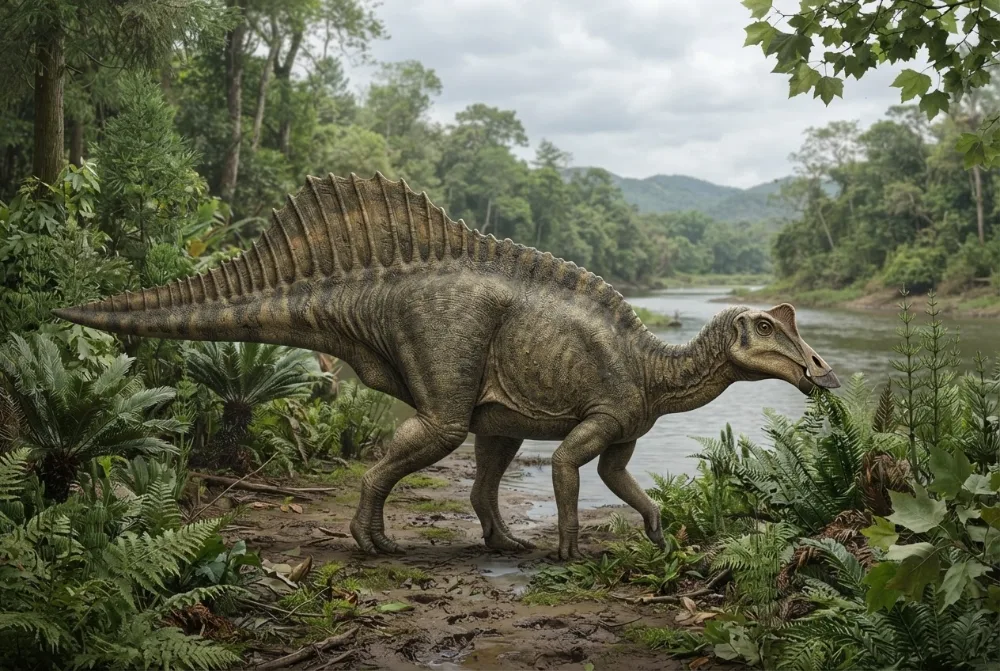
Gongshuilong was a duck-billed dinosaur that lived in China near the end of the Age of Dinosaurs. It had a tall, sail-like tail made of extra-long bones, which made it look really cool. This plant-eater is special because it is the first named hadrosaur from South China!1
Yabayeho ryari?
Yanganaga ite?
Yari ndende ite?
Ubutumburuke bwayo bwanganaga iki?
igereranya
 ndende nk'imbwa 7 zikurikiranye🍌ndende nk'imineke 39 ikurikiranye🏃yashoboraga kwiruka metero 100 mu masegonda 13 (umuntu wihuta kurusha abandi akenera 9,6)
Gongshuilong yanganaga ite ugereranyije NAWE?
Ni imibare gusa ibarirwa muri mushakisha yawe. Nta kintu kibikwa cyangwa cyoherezwa ahandi.
Yihutaga ite?


Utuntu dushimishije
Gongshuilong's tail bones were super long, making the tail look like a sail. The neural spines were 8.5 times as tall as the bones they attached to, which is unique among all iguanodontian dinosaurs.1
It was a medium-sized hadrosaur, about 7 metres (23 feet) long, which is about as long as a small school bus.1
Gongshuilong is the second brachylophosaurin found in Asia, after Wulagasaurus. Most of its close relatives lived in North America, so it helps show that this group might have started in Asia.1
The fossils were found in a bonebed with at least two individuals, because scientists found two left lower jaws, two shoulder blades, and two shin bones of different sizes.1
Its name, Gongshuilong, comes from the Gong River near where it was found, and 'long' means dragon in Chinese.1
The species name 'fanwei' refers to the sail-like tail, because 'fan' means sail in Chinese.1
Ibibazo bibazwa cyane kuri Gongshuilong
?What did Gongshuilong eat?
Gongshuilong was a plant-eater, like other duck-billed dinosaurs. It used its beak and many teeth to chew plants.1
?How big was Gongshuilong?
Gongshuilong was a medium sized hadrosaur, about 7 metres (23 feet) long, roughly the length of a small school bus.1
?When did Gongshuilong live?
Gongshuilong lived during the Late Cretaceous period, specifically in the Maastrichtian age, near the end of the Age of Dinosaurs.1
Gusenya ibinyoma
Ibivugwa: Some people think all duck-billed dinosaurs lived in North America.
Ukuri: Gongshuilong shows that duck-billed dinosaurs also lived in Asia, and it is the first named hadrosaur from South China.1
Ku bazobereye muri dinozore
- Izina rya siyansi
- Gongshuilong
- Yiswe na
- Yao et al. 20263
- Itsinda
- Iminwa y'imbata
- Umuryango / ishami
- Hadrosauridae3
- Ishyirwa mu byiciro
- Ornithischia > Ornithopoda > Iguanodontia > Hadrosauridae3
- Imyaka y'amabuye
- imyaka miliyoni 72 kugeza 66 (Maastrichtian)3
- Inzego z'amabuye
- Lianhe3
- Ibihugu
- Ubushinwa3
- Ibisigazwa byanditswe
- 1 muri The Paleobiology Database3
- Ivumburwa
- In March 2021, construction workers found a bonebed in Ganzhou, China. Scientists from the Jiangxi Geological Survey and Exploration Institute dug out the fossils in two blocks, and in 2026 Han Yao and colleagues named the new species Gongshuilong fanwei.12
- Biracyagibwaho impaka
- Scientists are still debating exactly how Gongshuilong is related to other brachylophosaurins, because the family tree shows a polytomy, meaning the relationships are not fully resolved.1
Aho amakuru yakuwe
- Gongshuilong (en.wikipedia.org)
- MorphoBank V4 (beta.morphobank.org)
- Gongshuilong in The Paleobiology Database (CC BY 4.0): imyaka, ahantu, inzego z'amabuye, ishyirwa mu byiciro.
Buri kintu kiri kuri uru rupapuro gifite nimero yerekana aho cyakuwe. Niba hari icyo twibeshye, tubabarire, turi abakunzi ba dinozore, ntituri ikinyamakuru cya siyansi. Tubwire kuri [email protected] tuzagikosora.
 Rex arashonje! Dino Wiki ni umushinga wa papa umwe yakoreye umuhungu we ukunda dinozore, ni ubuntu, nta matangazo kandi nta bigukurikirana. Abantu bakuru bashobora guha Rex akantu ko kurya kugira ngo Dino Wiki ikomeze kuboneka kuri interineti.Gaburira Rex
 Parasaurolophus
 Edmontosaurus
 Saurolophus
 Hypacrosaurus
 Corythosaurus
 Kritosaurus
 Tyrannosaurus
 Triceratops
 Velociraptor
 Spinosaurus
 Ankylosaurus
 Pteranodon