 Uri dinozore iyihe? Umukino w'ibibazo
 Intambara ya dinozore
 Isiganwa rya dinozore
 Imikino mito ya dinozore
 Alubumu ya sitikeri
 Intonde za TOP za dinozore
 Ntungura!
Helioceratops
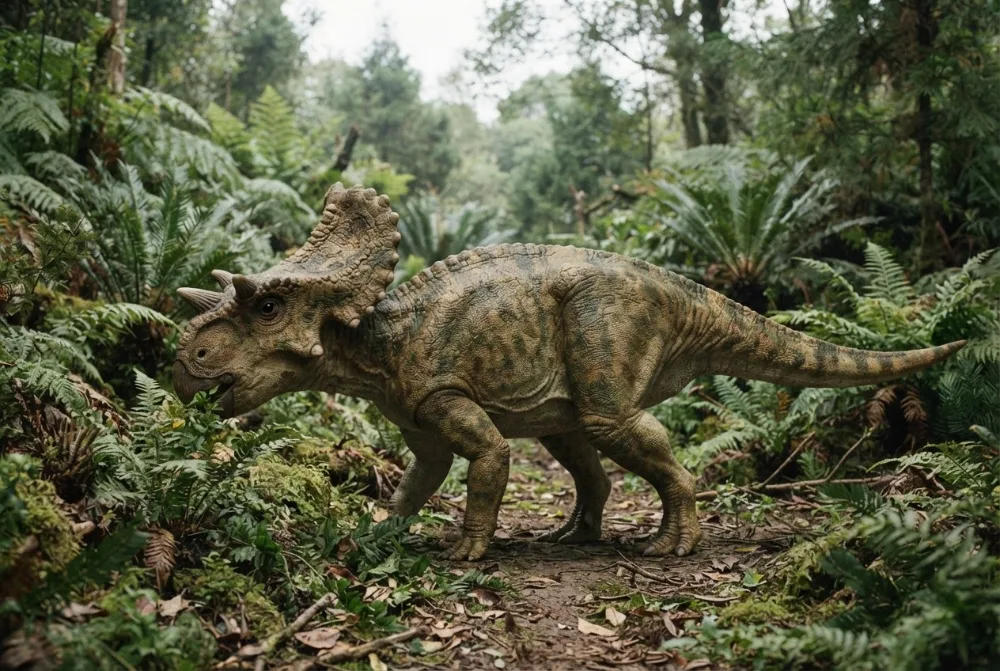
Helioceratops was a small, plant-eating dinosaur that lived about 100 million years ago in what is now China. It had a short lower jaw and walked on four legs. Its name means 'sun horned face' because scientists think horned dinosaurs like it first appeared in the East, where the sun rises.1
Yabayeho ryari?
Yanganaga ite?
Yari ndende ite?
Ubutumburuke bwayo bwanganaga iki?
Yari iremereye ite?
 ndende nk'injangwe 2,5 zo mu rugo zikurikiranye🍌ndende nk'imineke 7 ikurikiranye🍉iremereye nk'imbuto 4 za watermelon🏃yashoboraga kwiruka metero 100 mu masegonda 11 (umuntu wihuta kurusha abandi akenera 9,6)
Helioceratops yanganaga ite ugereranyije NAWE?
Ni imibare gusa ibarirwa muri mushakisha yawe. Nta kintu kibikwa cyangwa cyoherezwa ahandi.
Yihutaga ite?


Utuntu dushimishije
Helioceratops is known from only two jaw bones: a right lower jaw (the holotype) and a left upper jaw (the paratype). They were found close together and may belong to the same animal.1
Its lower jaw is very short and deep. The tooth row is only 60% longer than the height of the jawbone.1
The teeth of Helioceratops have an unusual pattern of ridges: up to nine ridges in front of the main ridge but only four behind it.1
Helioceratops lived during the Albian to Cenomanian stages, about 100 million years ago, at the boundary between the Early and Late Cretaceous.1
Scientists think Helioceratops is a close relative of Auroraceratops, which means 'dawn horned face'.1
Ibibazo bibazwa cyane kuri Helioceratops
?How big was Helioceratops?
Helioceratops was a relatively small dinosaur. In 2010, Gregory S. Paul estimated it was about 1.3 metres (4.3 feet) long and weighed about 20 kilograms (44 pounds).1
?What did Helioceratops eat?
Helioceratops was a herbivore, meaning it ate plants. It lived on land and likely shared its habitat with another plant-eating dinosaur called Changchunsaurus.1
?When did Helioceratops live?
Helioceratops lived about 100 million years ago, during the Albian to Cenomanian stages, which is the boundary between the Early and Late Cretaceous. Its fossils were found in the Quantou Formation in China.14
?Why is it called Helioceratops?
The name means 'sun horned face' because scientists think horned dinosaurs first appeared in the East, where the sun rises. It also refers to its close relationship with Auroraceratops, the 'dawn horned face'.1
Ku bazobereye muri dinozore
- Izina rya siyansi
- Helioceratops
- Yiswe na
- Jin et al. 20094
- Itsinda
- Dinozore zifite amahembe
- Umuryango / ishami
- Leptoceratopsidae4
- Ishyirwa mu byiciro
- Ornithischia > Ceratopsia4
- Imyaka y'amabuye
- imyaka miliyoni 121 kugeza 100 (Aptian / Albian)4
- Inzego z'amabuye
- Quantou4
- Ibihugu
- Ubushinwa4
- Ibisigazwa byanditswe
- 1 muri The Paleobiology Database4
- Ivumburwa
- Helioceratops was named in 2009 by Jin Liyong, Chen Jun, Zan Shuqin and Pascal Godefroit. The fossils were dug up in 2000 and 2002 at the Liufangzi site in Jilin Province, China.12
- Biracyagibwaho impaka
- Scientists are not sure whether Helioceratops had horns. No horn cores have been found, but it is a ceratopsian, so it may have had small horns on its face.1
Aho amakuru yakuwe
- Helioceratops (en.wikipedia.org)
- Newly Discovered Dinosaur Speicies Named 'Helioceratops' -- Beijing Review (bjreview.com)
- Helioceratops | The Sun-Horned Face of Cretaceous China (thedinosaurs.org)
- Helioceratops in The Paleobiology Database (CC BY 4.0): imyaka, ahantu, inzego z'amabuye, ishyirwa mu byiciro.
Buri kintu kiri kuri uru rupapuro gifite nimero yerekana aho cyakuwe. Niba hari icyo twibeshye, tubabarire, turi abakunzi ba dinozore, ntituri ikinyamakuru cya siyansi. Tubwire kuri [email protected] tuzagikosora.
 Rex arashonje! Dino Wiki ni umushinga wa papa umwe yakoreye umuhungu we ukunda dinozore, ni ubuntu, nta matangazo kandi nta bigukurikirana. Abantu bakuru bashobora guha Rex akantu ko kurya kugira ngo Dino Wiki ikomeze kuboneka kuri interineti.Gaburira Rex
 Triceratops
 Protoceratops
 Ojoceratops
 Tatankaceratops
 Psittacosaurus
 Centrosaurus
 Stegosaurus
 Iguanodon
 Archaeopteryx
 Giganotosaurus
 Microraptor
 Deinonychus