 Uri dinozore iyihe? Umukino w'ibibazo
 Intambara ya dinozore
 Isiganwa rya dinozore
 Imikino mito ya dinozore
 Alubumu ya sitikeri
 Intonde za TOP za dinozore
 Ntungura!
Jormungandr
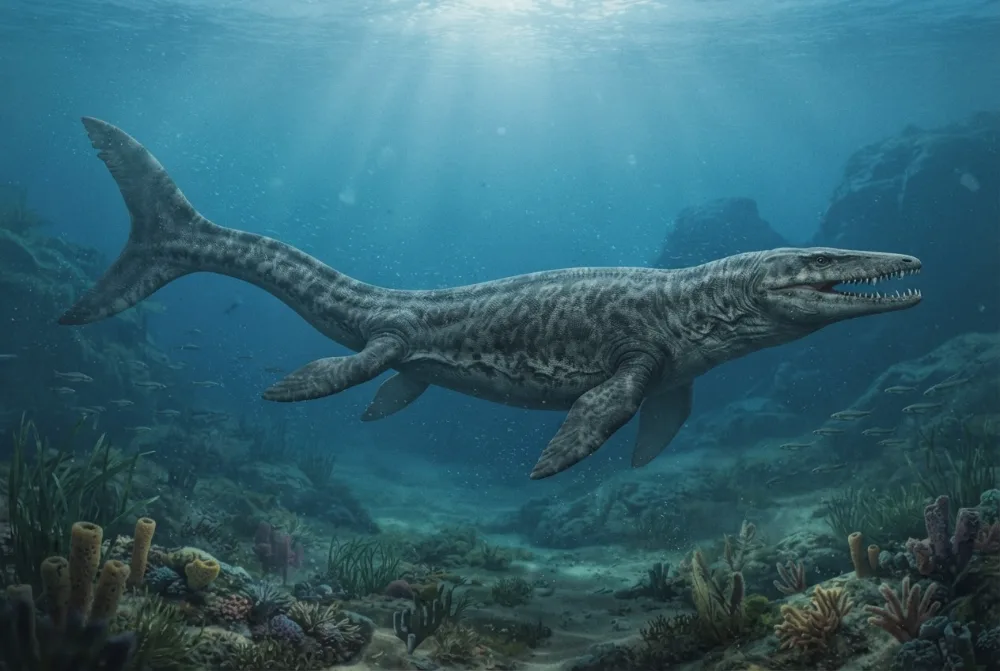
Jormungandr was a huge, swimming lizard that lived in the sea during the time of dinosaurs. It had a long body, strong jaws, and sharp teeth for catching fish and other sea creatures. This marine reptile was not a dinosaur, but a fierce predator of the ancient oceans.1
Yabayeho ryari?
Yanganaga ite?
Yari ndende ite?
 ndende nk'imbwa 7 zikurikiranye🍌ndende nk'imineke 41 ikurikiranye🏊yashoboraga koga uburebure bwa pisine nini (50 m) mu masegonda 4,9
Jormungandr yanganaga ite ugereranyije NAWE?
Ni imibare gusa ibarirwa muri mushakisha yawe. Nta kintu kibikwa cyangwa cyoherezwa ahandi.
Yihutaga ite?


Utuntu dushimishije
Jormungandr's skull was about 72 centimeters (28 inches) long, and its lower jaw measured 80.8 centimeters (31.8 inches).1
The fossil was discovered in 2015 by a fossil collector named Deborah Shepherd near Walhalla, North Dakota.1
Jormungandr lived about 80 million years ago, during the Late Cretaceous period.1
The fourth dorsal vertebra of Jormungandr has marks that scientists think are bite marks from another mosasaur, possibly from a fight or scavenging.1
Jormungandr shares features with both primitive mosasaurs like Clidastes and more advanced ones like Mosasaurus, making it a 'missing link' in mosasaur evolution.1
The species name walhallaensis comes from the town of Walhalla, which is named after Valhalla, the hall of slain warriors in Norse mythology.1
Gusenya ibinyoma
Ibivugwa: Some people think Jormungandr was a dinosaur.
Ukuri: Jormungandr was a mosasaur, a type of marine lizard, not a dinosaur. Mosasaurs are reptiles but belong to a different group than dinosaurs.1
Ku bazobereye muri dinozore
- Izina rya siyansi
- Jormungandr
- Yiswe na
- Zietlow et al. 20232
- Itsinda
- Mozazore
- Umuryango / ishami
- Mosasauridae2
- Ishyirwa mu byiciro
- Mosasauroidea2
- Imyaka y'amabuye
- imyaka miliyoni 84 kugeza 72 (Campanian)2
- Inzego z'amabuye
- Pierre Shale2
- Ibihugu
- Amerika2
- Ibisigazwa byanditswe
- 1 muri The Paleobiology Database2
- Ivumburwa
- The only known fossil of Jormungandr was found in 2015 by fossil collector Deborah Shepherd near Walhalla, North Dakota. It was later described and named by paleontologists Amelia Zietlow, Clint Boyd, and Nathan Van Vranken in 2023.1
- Biracyagibwaho impaka
- Scientists are not sure if Jormungandr is a distinct genus or just a new species of Clidastes. Some researchers think it might be renamed Clidastes walhallaensis in the future.1
Aho amakuru yakuwe
- Jormungandr walhallaensis (en.wikipedia.org)
- Jormungandr in The Paleobiology Database (CC BY 4.0): imyaka, ahantu, inzego z'amabuye, ishyirwa mu byiciro.
Buri kintu kiri kuri uru rupapuro gifite nimero yerekana aho cyakuwe. Niba hari icyo twibeshye, tubabarire, turi abakunzi ba dinozore, ntituri ikinyamakuru cya siyansi. Tubwire kuri [email protected] tuzagikosora.
 Rex arashonje! Dino Wiki ni umushinga wa papa umwe yakoreye umuhungu we ukunda dinozore, ni ubuntu, nta matangazo kandi nta bigukurikirana. Abantu bakuru bashobora guha Rex akantu ko kurya kugira ngo Dino Wiki ikomeze kuboneka kuri interineti.Gaburira Rex
 Mosasaurus
 Prognathodon
 Tylosaurus
 Platecarpus
 Clidastes
 Globidens
 Tyrannosaurus
 Triceratops
 Velociraptor
 Spinosaurus
 Ankylosaurus
 Parasaurolophus