 Uri dinozore iyihe? Umukino w'ibibazo
 Intambara ya dinozore
 Isiganwa rya dinozore
 Imikino mito ya dinozore
 Alubumu ya sitikeri
 Intonde za TOP za dinozore
 Ntungura!
Kaijutitan
Kaijutitan was a giant, long-necked plant-eater that lived in what is now Argentina. It is one of the earliest known titanosaurs, a group that includes the biggest dinosaurs ever. Its neck bones had a strange split shape, like a fork.42
Yabayeho ryari?
Yanganaga ite?
Yari iremereye ite?

Kaijutitan yanganaga ite ugereranyije NAWE?
Ni imibare gusa ibarirwa muri mushakisha yawe. Nta kintu kibikwa cyangwa cyoherezwa ahandi.
Yihutaga ite?


Utuntu dushimishije
Kaijutitan is the latest known basal titanosaur, meaning it lived near the end of the time when early titanosaurs existed.2
Its neck vertebrae had bifid (split) neural spines, a feature that evolved several times among sauropods but is rare in titanosaurs.2
The fossil includes part of the skull, which is very unusual for large titanosaurs because their skulls are rarely preserved.2
Kaijutitan lived about 89 to 86 million years ago, during the Coniacian stage of the Late Cretaceous.4
Its bones were found scattered in an area of about 20 square metres, suggesting the carcass fell apart before being buried.2
The species name maui honors the Museo Municipal Argentino Urquiza (MAU), where the fossil is stored.1
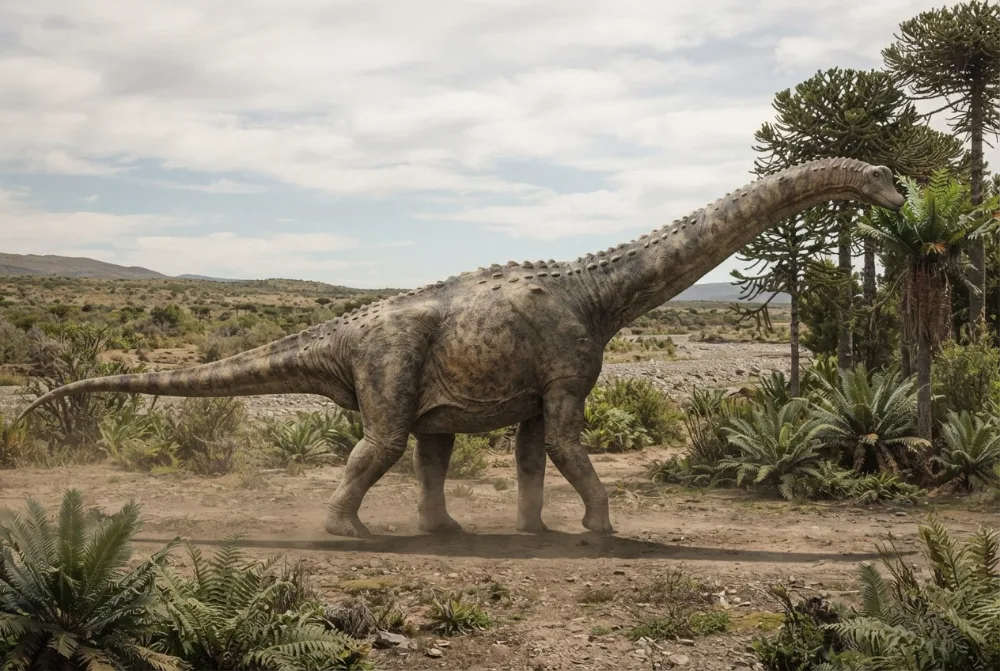
Ibibazo bibazwa cyane kuri Kaijutitan
?How big was Kaijutitan?
Scientists don't know its exact size yet, but it was a huge sauropod, one of the giant titanosaurs. Its bones show it was an adult of huge body size.31
?What did Kaijutitan eat?
Kaijutitan was a plant-eater, like all sauropods. It used its long neck to reach leaves from tall trees.1
Ku bazobereye muri dinozore
- Izina rya siyansi
- Kaijutitan
- Yiswe na
- Filippi et al. 20194
- Itsinda
- Izifite amajosi maremare
- Umuryango / ishami
- Lithostrotia4
- Ishyirwa mu byiciro
- Sauropodomorpha > Sauropoda > Titanosauria > Macronaria4
- Imyaka y'amabuye
- imyaka miliyoni 90 kugeza 86 (Coniacian)4
- Inzego z'amabuye
- Sierra Barrosa4
- Ibihugu
- Arijantine4
- Ibisigazwa byanditswe
- 1 muri The Paleobiology Database4
- Ivumburwa
- Kaijutitan was named in 2019 by paleontologists Leonardo Filippi, Leonardo Salgado, and Alberto Garrido. The skeleton was found by a team from the Museo Municipal Argentino Urquiza and the Museo Provincial de Ciencias Naturales in Argentina.42
- Biracyagibwaho impaka
- Scientists are not sure exactly how big Kaijutitan was, because only a partial skeleton has been found.2
Aho amakuru yakuwe
- Kaijutitan (en.wikipedia.org)
- A new giant basal titanosaur sauropod in the Upper Cretaceous (Coniacian) of the NeuquEn Basin, Argentina (rid.unrn.edu.ar)
- KAIJUTITAN MAUI, A SAUROPOD TITANOSAUR FROM THE UPPER CRETACEOUS (SIERRA BARROSA FORMATION, NEUQUÉN BASIN) OF NORTHERN PATAGONIA ARGENTINA: HISTOLOGICAL AND TAPHONOMIC CONSIDERATIONS | Publicación Electrónica de la Asociación Paleontológica Argentina (peapaleontologica.org.ar)
- Kaijutitan in The Paleobiology Database (CC BY 4.0): imyaka, ahantu, inzego z'amabuye, ishyirwa mu byiciro.
Buri kintu kiri kuri uru rupapuro gifite nimero yerekana aho cyakuwe. Niba hari icyo twibeshye, tubabarire, turi abakunzi ba dinozore, ntituri ikinyamakuru cya siyansi. Tubwire kuri [email protected] tuzagikosora.
 Rex arashonje! Dino Wiki ni umushinga wa papa umwe yakoreye umuhungu we ukunda dinozore, ni ubuntu, nta matangazo kandi nta bigukurikirana. Abantu bakuru bashobora guha Rex akantu ko kurya kugira ngo Dino Wiki ikomeze kuboneka kuri interineti.Gaburira Rex
 Brachiosaurus
 Diplodocus
 Brontosaurus
 Argentinosaurus
 Camarasaurus
 Morosaurus
 Tyrannosaurus
 Triceratops
 Velociraptor
 Spinosaurus
 Ankylosaurus
 Parasaurolophus