 Uri dinozore iyihe? Umukino w'ibibazo
 Intambara ya dinozore
 Isiganwa rya dinozore
 Imikino mito ya dinozore
 Alubumu ya sitikeri
 Intonde za TOP za dinozore
 Ntungura!
Koreaceratops
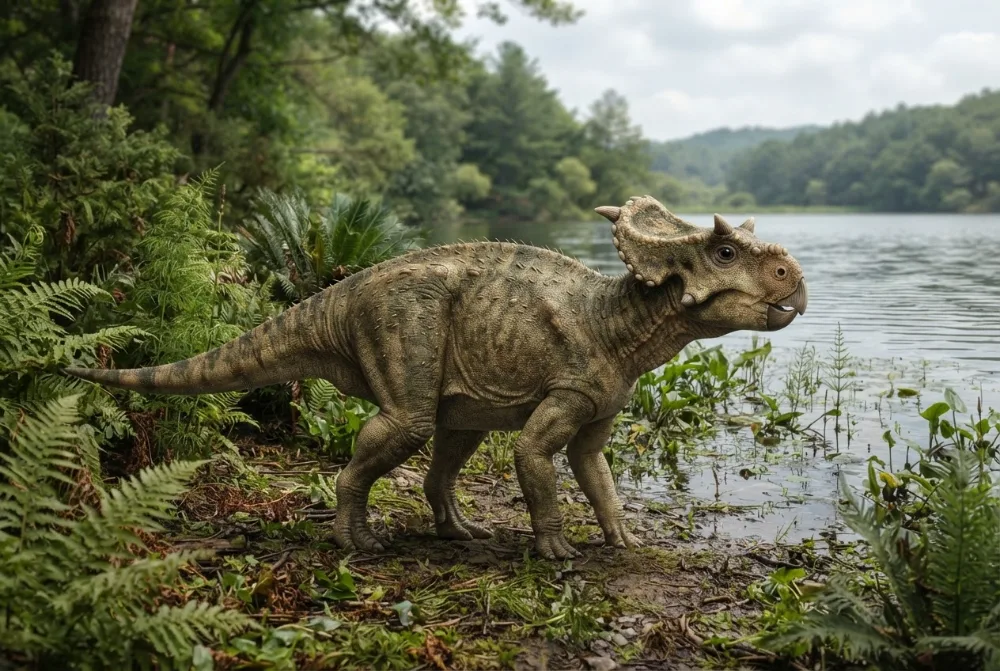
Koreaceratops was a small, plant-eating dinosaur that lived in South Korea during the Early Cretaceous. It had a beak like a parrot and walked on two legs, but scientists think it might have been a good swimmer too!12
Yabayeho ryari?
Yanganaga ite?
Yari ndende ite?
 ndende nk'injangwe 2,5 zo mu rugo zikurikiranye🍌ndende nk'imineke 7 ikurikiranye🏃yashoboraga kwiruka metero 100 mu masegonda 10 (umuntu wihuta kurusha abandi akenera 9,6)
Koreaceratops yanganaga ite ugereranyije NAWE?
Ni imibare gusa ibarirwa muri mushakisha yawe. Nta kintu kibikwa cyangwa cyoherezwa ahandi.
Yihutaga ite?


Utuntu dushimishije
Koreaceratops had very tall spines on its tail bones, some over five times the height of the bone they attached to.12
Scientists think those tall tail spines might have helped Koreaceratops swim, like a paddle or a fin.12
The only known fossil of Koreaceratops was found in a sandstone block that had been used to build a dam.1
The type specimen was about eight years old when it died and had not yet reached full size or maturity.1
Koreaceratops lived in a semiarid environment, like a dry or dusty landscape.1
Ibibazo bibazwa cyane kuri Koreaceratops
?How big was Koreaceratops?
About 1.3 metres (4.3 feet) long, based on an estimate by paleontologist Thomas Holtz.1
?Could Koreaceratops swim?
Maybe! Scientists think its very tall tail spines might have helped it swim like a paddle, but the evidence is not certain.31
?What did Koreaceratops eat?
Koreaceratops was a plant-eater, like other ceratopsian dinosaurs.1
Ku bazobereye muri dinozore
- Izina rya siyansi
- Koreaceratops
- Yiswe na
- Lee et al. 20104
- Itsinda
- Dinozore zifite amahembe
- Umuryango / ishami
- Leptoceratopsidae4
- Ishyirwa mu byiciro
- Ornithischia > Ceratopsia4
- Imyaka y'amabuye
- imyaka miliyoni 113 kugeza 100 (Albian)4
- Inzego z'amabuye
- Tando beds4
- Ibihugu
- Koreya y'Epfo4
- Ibisigazwa byanditswe
- 1 muri The Paleobiology Database4
- Ivumburwa
- Koreaceratops was named in 2011 by Yuong-Nam Lee and colleagues. The fossil was first noticed by a public official in 2008, after it had been built into a dam in Hwaseong City, South Korea.1
- Biracyagibwaho impaka
- Scientists are not sure exactly where Koreaceratops fits on the ceratopsian family tree. Some studies place it near Archaeoceratops, while a 2022 study suggests it is closer to Protoceratops.1
Aho amakuru yakuwe
- Koreaceratops (en.wikipedia.org)
- The first ceratopsian dinosaur from South Korea - Seoul National University (snu.elsevierpure.com)
- Koreaceratops—A Swimming Ceratopsian? (smithsonianmag.com)
- Koreaceratops in The Paleobiology Database (CC BY 4.0): imyaka, ahantu, inzego z'amabuye, ishyirwa mu byiciro.
Buri kintu kiri kuri uru rupapuro gifite nimero yerekana aho cyakuwe. Niba hari icyo twibeshye, tubabarire, turi abakunzi ba dinozore, ntituri ikinyamakuru cya siyansi. Tubwire kuri [email protected] tuzagikosora.
 Rex arashonje! Dino Wiki ni umushinga wa papa umwe yakoreye umuhungu we ukunda dinozore, ni ubuntu, nta matangazo kandi nta bigukurikirana. Abantu bakuru bashobora guha Rex akantu ko kurya kugira ngo Dino Wiki ikomeze kuboneka kuri interineti.Gaburira Rex
 Triceratops
 Protoceratops
 Ojoceratops
 Tatankaceratops
 Psittacosaurus
 Centrosaurus
 Stegosaurus
 Iguanodon
 Archaeopteryx
 Giganotosaurus
 Microraptor
 Deinonychus