 Uri dinozore iyihe? Umukino w'ibibazo
 Intambara ya dinozore
 Isiganwa rya dinozore
 Imikino mito ya dinozore
 Alubumu ya sitikeri
 Intonde za TOP za dinozore
 Ntungura!
Yabayeho ryari?

Yanganaga ite?
Yari ndende ite?
Ubutumburuke bwayo bwanganaga iki?
Yari iremereye ite?

 ndende nk'imbwa 9 zikurikiranye🍌ndende nk'imineke 48 ikurikiranyeiremereye nk'imbwa 190🍉iremereye nk'imbuto 750 za watermelon🎒iremereye nk'ibyumba 5 by'amashuri byuzuye abana🐻❄️iremereye nk'idubu 8 zo mu rubura🏃yashoboraga kwiruka metero 100 mu masegonda 16 (umuntu wihuta kurusha abandi akenera 9,6)
Latirhinus yanganaga ite ugereranyije NAWE?
Ni imibare gusa ibarirwa muri mushakisha yawe. Nta kintu kibikwa cyangwa cyoherezwa ahandi.
Yihutaga ite?


Utuntu dushimishije
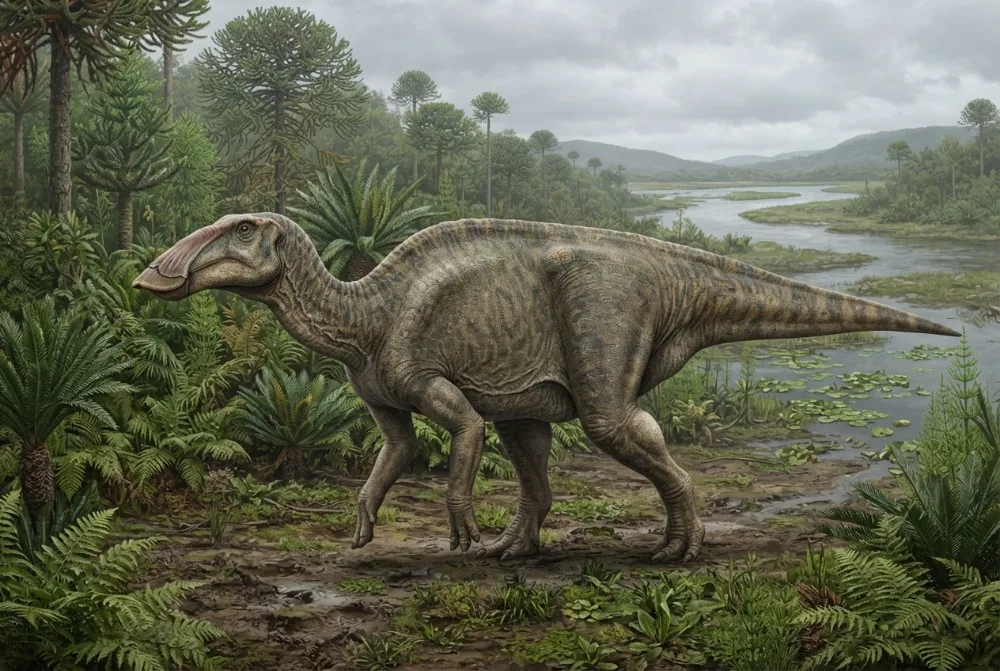
Latirhinus means 'broad nose' in Latin, because its nasal bone was wide and flat.1
The first skeleton of Latirhinus was found in the 1980s by a team from UNAM in Mexico.1
This dinosaur lived about 83 to 72 million years ago, during the Campanian age of the Late Cretaceous.13
The type species is named Latirhinus uitstlani, where 'uitstlani' means 'southern' in the Náhuatl language.1
Some scientists think Latirhinus was a lambeosaurine, a group of duck-billed dinosaurs with hollow head crests.1
The holotype skeleton includes parts of the nose, backbone, arms, legs, and feet.1
Ibibazo bibazwa cyane kuri Latirhinus
?How big was Latirhinus?
It was about 8.7 metres (29 feet) long and weighed around 3.75 metric tons (4.13 short tons). That is roughly as long as a school bus.1
?What did Latirhinus eat?
It was a plant-eater. It munched on plants with its many teeth, like other duck-billed dinosaurs.1
?Where was Latirhinus found?
Its fossils were found in Coahuila, Mexico, in the Cerro del Pueblo Formation. The first skeleton was discovered in the 1980s near the town of Presa de San Antonio.1
?Did Latirhinus have a crest?
Some scientists think it was a lambeosaurine, a group of duck-billed dinosaurs that often had hollow head crests. But its crest is not well known from the fossils.1
Ku bazobereye muri dinozore
- Izina rya siyansi
- Latirhinus
- Yiswe na
- Prieto-Márquez and Serrano Brañas 20124
- Itsinda
- Iminwa y'imbata
- Umuryango / ishami
- Hadrosauridae4
- Ishyirwa mu byiciro
- Ornithischia > Ornithopoda > Iguanodontia > Hadrosauridae4
- Imyaka y'amabuye
- imyaka miliyoni 84 kugeza 72 (Campanian)4
- Inzego z'amabuye
- Cerro del Pueblo4
- Ibihugu
- Megizike4
- Ibisigazwa byanditswe
- 1 muri The Paleobiology Database4
- Ivumburwa
- Latirhinus was named in 2012 by Albert Prieto-Márquez and Claudia Inés Serrano Brañas. The first fossils were found in the 1980s near Presa de San Antonio, Coahuila, Mexico, and were originally thought to be a different dinosaur called Kritosaurus.1
- Biracyagibwaho impaka
- Scientists still debate whether Latirhinus was a basal or a more advanced lambeosaurine within its family.1
Aho amakuru yakuwe
- Latirhinus (en.wikipedia.org)
- Latirhinus Prieto-Márquez & Serrano Brañas 2012 - Encyclopedia of Life (eol.org)
- PBDB Taxon (paleobiodb.org)
- Latirhinus in The Paleobiology Database (CC BY 4.0): imyaka, ahantu, inzego z'amabuye, ishyirwa mu byiciro.
Buri kintu kiri kuri uru rupapuro gifite nimero yerekana aho cyakuwe. Niba hari icyo twibeshye, tubabarire, turi abakunzi ba dinozore, ntituri ikinyamakuru cya siyansi. Tubwire kuri [email protected] tuzagikosora.
 Rex arashonje! Dino Wiki ni umushinga wa papa umwe yakoreye umuhungu we ukunda dinozore, ni ubuntu, nta matangazo kandi nta bigukurikirana. Abantu bakuru bashobora guha Rex akantu ko kurya kugira ngo Dino Wiki ikomeze kuboneka kuri interineti.Gaburira Rex
 Parasaurolophus
 Edmontosaurus
 Saurolophus
 Hypacrosaurus
 Corythosaurus
 Kritosaurus
 Tyrannosaurus
 Triceratops
 Velociraptor
 Spinosaurus
 Ankylosaurus
 Pteranodon