 Uri dinozore iyihe? Umukino w'ibibazo
 Intambara ya dinozore
 Isiganwa rya dinozore
 Imikino mito ya dinozore
 Alubumu ya sitikeri
 Intonde za TOP za dinozore
 Ntungura!
Luskhan
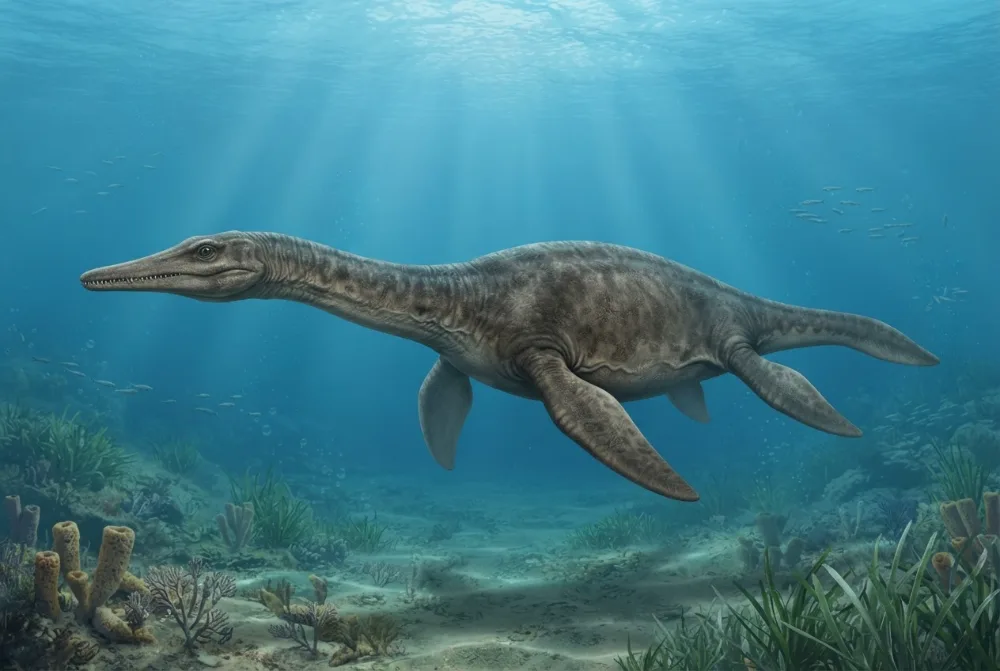
Luskhan was a plesiosaur, a marine reptile that lived in the ancient seas of what is now Russia. It had a long, slender snout and small teeth, perfect for catching soft, squishy prey like squid. Unlike many other pliosaurs, Luskhan was not a giant apex predator but a specialized hunter of small animals.12
Yabayeho ryari?
Yanganaga ite?
Yari ndende ite?
 ndende nk'imbwa 6 zikurikiranye🍌ndende nk'imineke 36 ikurikiranye🏊yashoboraga koga uburebure bwa pisine nini (50 m) mu masegonda 6,9
Luskhan yanganaga ite ugereranyije NAWE?
Ni imibare gusa ibarirwa muri mushakisha yawe. Nta kintu kibikwa cyangwa cyoherezwa ahandi.
Yihutaga ite?


Utuntu dushimishije
Luskhan is known from a nearly complete, three-dimensionally preserved skeleton, which is rare for pliosaurids.12
Its name comes from Mongolian and Turkic mythology: 'luus' means water spirit and 'khan' means chief.1
Luskhan lived about 128 million years ago, during the Hauterivian stage of the Early Cretaceous.1
Unlike most other pliosaurs, Luskhan had a long, slender snout and small teeth, similar to the distantly related polycotylid plesiosaurs.12
Luskhan evolved its fish-eating features independently from polycotylids, more than 10 million years later.1
The only known specimen was discovered in 2002 by Russian paleontologist Gleb N. Uspensky on the banks of the Volga River.1
Ibibazo bibazwa cyane kuri Luskhan
?How big was Luskhan?
Luskhan was about 6.5 metres (21 feet) long, which is roughly the length of a large boat.1
?What did Luskhan eat?
Luskhan ate small, soft prey like squid. Its slender snout and small teeth were perfect for catching soft animals, not large prey.13
?Was Luskhan a dinosaur?
No, Luskhan was a plesiosaur, a marine reptile that lived in the sea. It was not a dinosaur.1
Ku bazobereye muri dinozore
- Izina rya siyansi
- Luskhan
- Yiswe na
- Fischer et al. 20174
- Itsinda
- Plesiyozore
- Umuryango / ishami
- Pliosauridae4
- Ishyirwa mu byiciro
- Plesiosauria > Pliosauridae > Sauropterygia4
- Imyaka y'amabuye
- imyaka miliyoni 133 kugeza 126 (Hauterivian)4
- Ibihugu
- Uburusiya4
- Ibisigazwa byanditswe
- 1 muri The Paleobiology Database4
- Ivumburwa
- Luskhan was named in 2017 by a team led by Valentin Fischer, based on a skeleton found in 2002 by Gleb N. Uspensky in western Russia.14
- Biracyagibwaho impaka
- Scientists are not sure exactly how large Luskhan grew, because no complete length estimate has been published.1
Aho amakuru yakuwe
- Luskhan (en.wikipedia.org)
- Anatomy and relationships of the bizarre Early Cretaceous pliosaurid Luskhan itilensis | Zoological Journal of the Linnean Society | Oxford Academic (academic.oup.com)
- Plasticity and Convergence in the Evolution of Short-Necked Plesiosaurs: Current Biology (cell.com)
- Luskhan in The Paleobiology Database (CC BY 4.0): imyaka, ahantu, inzego z'amabuye, ishyirwa mu byiciro.
Buri kintu kiri kuri uru rupapuro gifite nimero yerekana aho cyakuwe. Niba hari icyo twibeshye, tubabarire, turi abakunzi ba dinozore, ntituri ikinyamakuru cya siyansi. Tubwire kuri [email protected] tuzagikosora.
 Rex arashonje! Dino Wiki ni umushinga wa papa umwe yakoreye umuhungu we ukunda dinozore, ni ubuntu, nta matangazo kandi nta bigukurikirana. Abantu bakuru bashobora guha Rex akantu ko kurya kugira ngo Dino Wiki ikomeze kuboneka kuri interineti.Gaburira Rex
 Elasmosaurus
 Pliosaurus
 Plesiosaurus
 Cimoliasaurus
 Colymbosaurus
 Trinacromerum
 Stegosaurus
 Iguanodon
 Archaeopteryx
 Giganotosaurus
 Microraptor
 Deinonychus