 Uri dinozore iyihe? Umukino w'ibibazo
 Intambara ya dinozore
 Isiganwa rya dinozore
 Imikino mito ya dinozore
 Alubumu ya sitikeri
 Intonde za TOP za dinozore
 Ntungura!
Yabayeho ryari?

Yanganaga ite?
Yari ndende ite?
Ubutumburuke bwayo bwanganaga iki?
igereranya
Yari iremereye ite?
 ndende nk'imbwa 5 zikurikiranye🍌ndende nk'imineke 28 ikurikiranye🍉iremereye nk'imbuto 190 za watermelon🧸iremereye nk'abana 51 bo mu ishuri ry'incuke🎒iremereye nk'abanyeshuri 30🐻❄️iremereye nk'idubu 2 zo mu rubura🏃yashoboraga kwiruka metero 100 mu masegonda 12 (umuntu wihuta kurusha abandi akenera 9,6)
Magyarosaurus yanganaga ite ugereranyije NAWE?
Ni imibare gusa ibarirwa muri mushakisha yawe. Nta kintu kibikwa cyangwa cyoherezwa ahandi.
Yihutaga ite?


Utuntu dushimishije
Magyarosaurus is a famous example of island dwarfism, where animals become smaller when living on islands with limited resources.2
It lived during the Late Cretaceous period, about 71 to 66 million years ago.1
The first fossils were described by Baron Franz Nopcsa in 1915, who named it Titanosaurus dacus.2
Magyarosaurus was a titanosaur, a group of sauropods that includes some of the largest dinosaurs ever.1
Scientists have found bones from many individuals, including skull pieces, which is rare for sauropods.2
In 2024, a study suggested that there were actually four different titanosaur species living in the same area, including the giant Uriash kadici.2
Ibibazo bibazwa cyane kuri Magyarosaurus
?How big was Magyarosaurus?
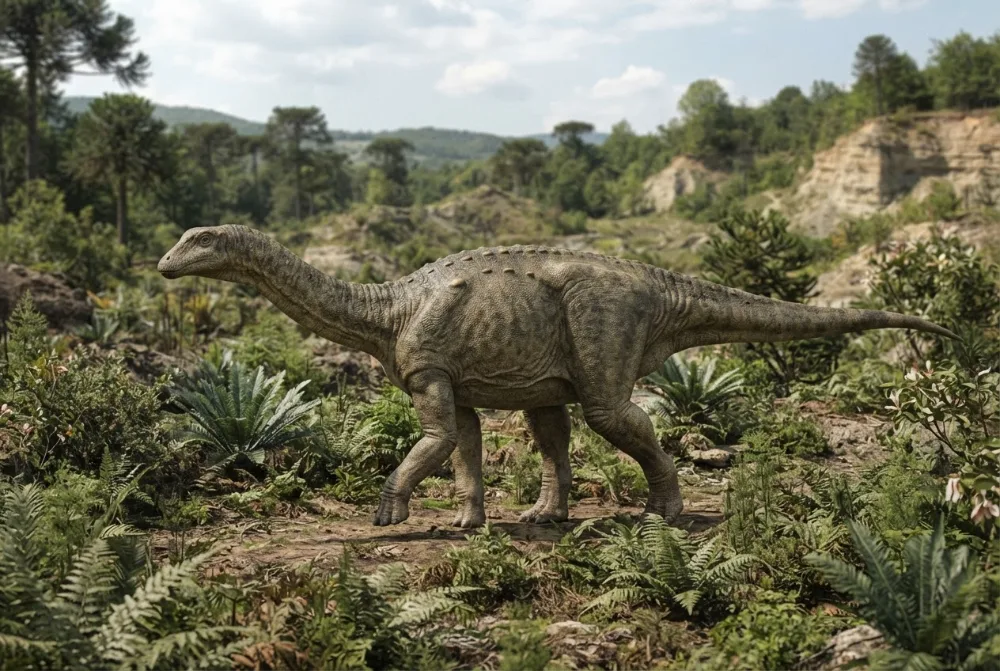
Magyarosaurus was one of the smallest adult sauropods, measuring about 6 metres (20 feet) long and weighing up to 972 kilograms (2,143 pounds).3
?Why was Magyarosaurus so small?
It was a dwarf dinosaur because it lived on an island with limited food, a process called island dwarfism. Scientists confirmed this by studying its bone growth.34
?Did Magyarosaurus have feathers?
No, Magyarosaurus was a sauropod and did not have feathers. It had scaly skin and some bony armour plates called osteoderms.3
?What did Magyarosaurus eat?
Magyarosaurus was a plant-eater, like all sauropods. It ate ferns, cycads and other vegetation that grew on its island home.3
?When did Magyarosaurus live?
Magyarosaurus lived during the Late Cretaceous Period, about 71 to 66 million years ago.3
?Was Magyarosaurus a dinosaur?
Yes, Magyarosaurus was a dinosaur. It was a sauropod, a long-necked plant-eating dinosaur.3
?Could Magyarosaurus swim?
Nobody knows for sure, but like most sauropods it probably lived on land and was not a strong swimmer. It lived on an island, so it may have waded in shallow water.3
?How fast could Magyarosaurus run?
Scientists do not know its exact speed, but as a small sauropod it was likely slower than a modern horse. Its leg bones suggest it was not built for fast running.3
Gusenya ibinyoma
Ibivugwa: Magyarosaurus was a baby or juvenile of a larger sauropod.
Ukuri: Studies of its bones show that Magyarosaurus was a fully grown adult, not a baby. It was a true dwarf species.2
Ku bazobereye muri dinozore
- Izina rya siyansi
- Magyarosaurus
- Yiswe na
- Huene 19325
- Itsinda
- Izifite amajosi maremare
- Umuryango / ishami
- Eutitanosauria5
- Ishyirwa mu byiciro
- Sauropodomorpha > Sauropoda > Titanosauria > Macronaria5
- Imyaka y'amabuye
- imyaka miliyoni 72 kugeza 66 (Maastrichtian)5
- Inzego z'amabuye
- Sebeş, Densuș-Ciula, Pui Beds5
- Ibihugu
- Rumaniya5
- Ibisigazwa byanditswe
- 11 muri The Paleobiology Database5
- Ivumburwa
- Baron Franz Nopcsa first described the fossils in 1915, calling it Titanosaurus dacus. In 1932, Friedrich von Huene gave it its own genus, Magyarosaurus.2
- Biracyagibwaho impaka
- Scientists still debate whether all the small titanosaur fossils from Romania belong to Magyarosaurus or to several different species.2
Aho amakuru yakuwe
- Magyarosaurus (nhm.ac.uk)
- Full article: Revision of Romanian sauropod dinosaurs reveals high titanosaur diversity and body-size disparity on the latest Cretaceous Haţeg Island, with implications for titanosaurian biogeography (tandfonline.com)
- Magyarosaurus (en.wikipedia.org)
- Small body size and extreme cortical bone remodeling indicate phyletic dwarfism in Magyarosaurus dacus (Sauropoda: Titanosauria) (pubmed.ncbi.nlm.nih.gov)
- Magyarosaurus in The Paleobiology Database (CC BY 4.0): imyaka, ahantu, inzego z'amabuye, ishyirwa mu byiciro.
Buri kintu kiri kuri uru rupapuro gifite nimero yerekana aho cyakuwe. Niba hari icyo twibeshye, tubabarire, turi abakunzi ba dinozore, ntituri ikinyamakuru cya siyansi. Tubwire kuri [email protected] tuzagikosora.
 Rex arashonje! Dino Wiki ni umushinga wa papa umwe yakoreye umuhungu we ukunda dinozore, ni ubuntu, nta matangazo kandi nta bigukurikirana. Abantu bakuru bashobora guha Rex akantu ko kurya kugira ngo Dino Wiki ikomeze kuboneka kuri interineti.Gaburira Rex
 Brachiosaurus
 Diplodocus
 Brontosaurus
 Argentinosaurus
 Camarasaurus
 Morosaurus
 Tyrannosaurus
 Triceratops
 Velociraptor
 Spinosaurus
 Ankylosaurus
 Parasaurolophus