 Uri dinozore iyihe? Umukino w'ibibazo
 Intambara ya dinozore
 Isiganwa rya dinozore
 Imikino mito ya dinozore
 Alubumu ya sitikeri
 Intonde za TOP za dinozore
 Ntungura!
Yabayeho ryari?

Yanganaga ite?
Yari ndende ite?
Ubutumburuke bwayo bwanganaga iki?
igereranya
Yari iremereye ite?
 ndende nk'imbwa 3 zikurikiranye🍌ndende nk'imineke 17 ikurikiranye🍉iremereye nk'imbuto 70 za watermelon🧸iremereye nk'abana 18 bo mu ishuri ry'incuke🎒iremereye nk'abanyeshuri 11🏃yashoboraga kwiruka metero 100 mu masegonda 13 (umuntu wihuta kurusha abandi akenera 9,6)
Neimongosaurus yanganaga ite ugereranyije NAWE?
Ni imibare gusa ibarirwa muri mushakisha yawe. Nta kintu kibikwa cyangwa cyoherezwa ahandi.
Yihutaga ite?


Utuntu dushimishije
Neimongosaurus had one of the longest necks of any non-bird theropod, with about 14 neck vertebrae. That is more than most other meat-eating dinosaurs had.1
Its tail was fairly short, with only 22 tail vertebrae, which is unusual for a theropod.1
The front of its lower jaw was toothless, like a beak, and it had only a few teeth further back. This helped it eat plants.1
Its arm bones show a large bump for the biceps muscle, which may have given it strong arms for pulling branches.1
The vertebrae in its spine were hollow and filled with air spaces, a feature also seen in some advanced bird-like dinosaurs.2
Scientists think Neimongosaurus was closely related to oviraptorosaurs because of its long neck and short tail.2
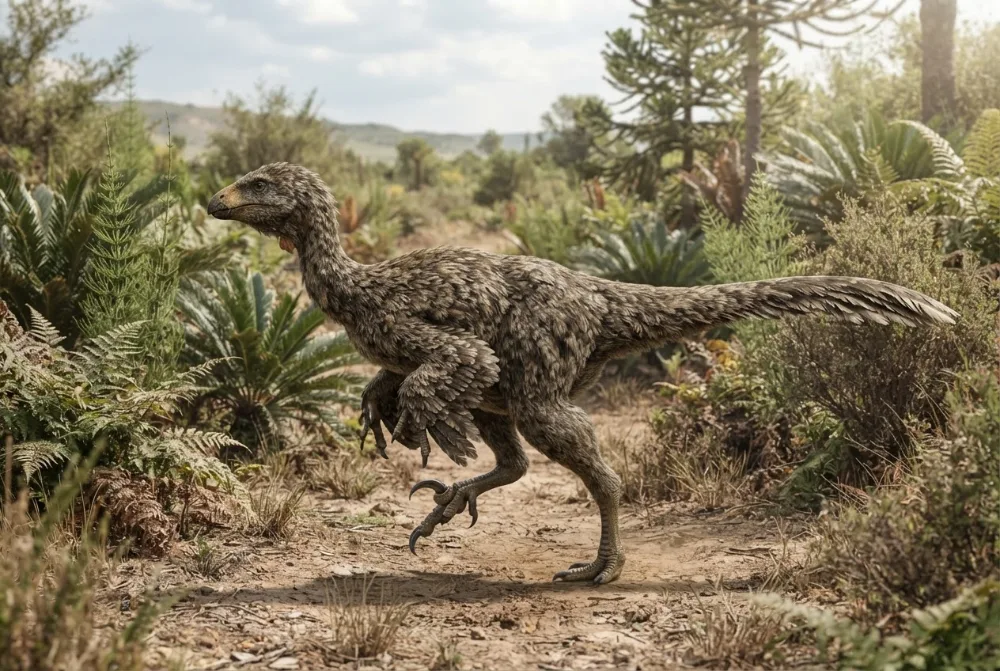
Ibibazo bibazwa cyane kuri Neimongosaurus
?How big was Neimongosaurus?
About 2 to 3 metres long. It weighed around 350 kg, which is about the weight of a small horse.1
?What did Neimongosaurus eat?
It ate plants. Its lower jaw had a toothless, beak-like front and only a few teeth with serrated edges in the back.1
?Did Neimongosaurus have feathers?
Scientists think it likely had feathers, because its relatives (therizinosaurs) are often shown with feathers, but no direct feather fossils have been found for this species.1
Ku bazobereye muri dinozore
- Izina rya siyansi
- Neimongosaurus
- Yiswe na
- Zhang et al. 20014
- Itsinda
- Dinozore zidasanzwe zifite ibyoya
- Umuryango / ishami
- Therizinosauridae4
- Ishyirwa mu byiciro
- Theropoda > Therizinosauria4
- Imyaka y'amabuye
- imyaka miliyoni 86 kugeza 72 (Santonian / Campanian)4
- Inzego z'amabuye
- Iren Dabasu, Bostobe4
- Ibihugu
- Ubushinwa, Kazakisitani4
- Ibisigazwa byanditswe
- 2 muri The Paleobiology Database4
- Ivumburwa
- In 1999, a team from the Ministry of Land and Resources in Inner Mongolia found two skeletons at Sanhangobi, about 20 km southwest of Erenhot. In 2001, scientists named the new species Neimongosaurus yangi, honoring Chinese paleontologist Yang Zhongjian.1
- Biracyagibwaho impaka
- Scientists are not sure exactly where Neimongosaurus sits on the family tree. Some studies place it outside the therizinosaurid group, while others put it inside, close to Therizinosaurus.1
Aho amakuru yakuwe
- Neimongosaurus (en.wikipedia.org)
- A LONG-NECKED THERIZINOSAUROID DINOSAUR FROM THE UPPER CRETACEOUS IREN DABASU FORMATION OF NEI MONGOL, PEOPL E’S REPUBLIC OF CHINA (vertpala.ac.cn)
- Neimongosaurus (en.wikipedia.org)
- Neimongosaurus in The Paleobiology Database (CC BY 4.0): imyaka, ahantu, inzego z'amabuye, ishyirwa mu byiciro.
Buri kintu kiri kuri uru rupapuro gifite nimero yerekana aho cyakuwe. Niba hari icyo twibeshye, tubabarire, turi abakunzi ba dinozore, ntituri ikinyamakuru cya siyansi. Tubwire kuri [email protected] tuzagikosora.
 Rex arashonje! Dino Wiki ni umushinga wa papa umwe yakoreye umuhungu we ukunda dinozore, ni ubuntu, nta matangazo kandi nta bigukurikirana. Abantu bakuru bashobora guha Rex akantu ko kurya kugira ngo Dino Wiki ikomeze kuboneka kuri interineti.Gaburira Rex
 Therizinosaurus
 Oviraptor
 Chirostenotes
 Citipes
 Leptorhynchos
 Avimimus
 Tyrannosaurus
 Triceratops
 Velociraptor
 Spinosaurus
 Ankylosaurus
 Parasaurolophus