 Uri dinozore iyihe? Umukino w'ibibazo
 Intambara ya dinozore
 Isiganwa rya dinozore
 Imikino mito ya dinozore
 Alubumu ya sitikeri
 Intonde za TOP za dinozore
 Ntungura!
Yabayeho ryari?

Yanganaga ite?
Yari ndende ite?
 ndende nk'imbwa 4 zikurikiranye🍌ndende nk'imineke 22 ikurikiranye🏃yashoboraga kwiruka metero 100 mu masegonda 15 (umuntu wihuta kurusha abandi akenera 9,6)
Nipponosaurus yanganaga ite ugereranyije NAWE?
Ni imibare gusa ibarirwa muri mushakisha yawe. Nta kintu kibikwa cyangwa cyoherezwa ahandi.
Yihutaga ite?


Utuntu dushimishije
Nipponosaurus was the first dinosaur ever named from Japanese territory, though Sakhalin Island was later annexed by the Soviet Union.1
The only known skeleton is about 60% complete and belonged to a juvenile, not a full-grown adult.1
Scientists used bone histology (looking at thin slices of bone under a microscope) to confirm that the Nipponosaurus fossil was a youngster.1
Nipponosaurus lived near the coast, and its body was buried in marine sediments, meaning it probably died close to the shore.1
For many years, some scientists thought Nipponosaurus might be the same as other Asian duck-billed dinosaurs, but newer studies show it is a valid, distinct species.1
The fossil was discovered in 1934 by miners digging a hospital foundation on Sakhalin Island.1
Ibibazo bibazwa cyane kuri Nipponosaurus
?How big was Nipponosaurus?
The only known skeleton is about 4 metres (13 feet) long, but it was a juvenile, so adults may have been bigger.1
?What did Nipponosaurus eat?
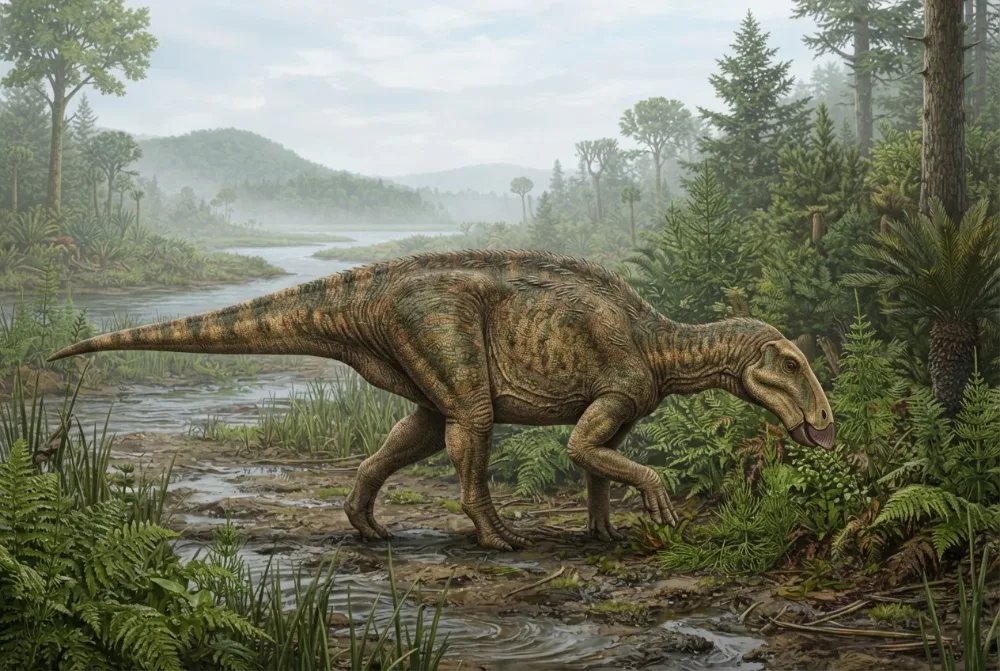
It was a herbivore, meaning it ate plants. It had a big, flat beak like a duck for cropping vegetation.2
?When did Nipponosaurus live?
It lived during the Late Cretaceous, about 89 to 84 million years ago, or around 80 million years ago according to some estimates.21
?Where was Nipponosaurus found?
Its fossil was found on Sakhalin Island, which is now part of Russia, but was Japanese territory when it was discovered in 1934.12
?Was Nipponosaurus a dinosaur?
Yes, it was a type of duck-billed dinosaur called a hadrosaur, specifically a lambeosaurine.2
Gusenya ibinyoma
Ibivugwa: Nipponosaurus was a full-grown adult when it died.
Ukuri: The skeleton is from a juvenile, as shown by its small size and microscopic bone features.1
Ku bazobereye muri dinozore
- Izina rya siyansi
- Nipponosaurus
- Yiswe na
- Nagao 19363
- Itsinda
- Iminwa y'imbata
- Umuryango / ishami
- Hadrosauridae3
- Ishyirwa mu byiciro
- Ornithischia > Ornithopoda > Iguanodontia > Hadrosauridae3
- Imyaka y'amabuye
- imyaka miliyoni 86 kugeza 72 (Santonian / Campanian)3
- Ibihugu
- Uburusiya3
- Ibisigazwa byanditswe
- 1 muri The Paleobiology Database3
- Ivumburwa
- Nipponosaurus was named in 1936 by Japanese paleontologist Takumi Nagao, based on a skeleton found in 1934 on Sakhalin Island.13
- Biracyagibwaho impaka
- Scientists are not sure exactly how big a full-grown Nipponosaurus was, because only a juvenile skeleton has been found.1
Aho amakuru yakuwe
- Nipponosaurus (en.wikipedia.org)
- Nipponosaurus (nhm.ac.uk)
- Nipponosaurus in The Paleobiology Database (CC BY 4.0): imyaka, ahantu, inzego z'amabuye, ishyirwa mu byiciro.
Buri kintu kiri kuri uru rupapuro gifite nimero yerekana aho cyakuwe. Niba hari icyo twibeshye, tubabarire, turi abakunzi ba dinozore, ntituri ikinyamakuru cya siyansi. Tubwire kuri [email protected] tuzagikosora.
 Rex arashonje! Dino Wiki ni umushinga wa papa umwe yakoreye umuhungu we ukunda dinozore, ni ubuntu, nta matangazo kandi nta bigukurikirana. Abantu bakuru bashobora guha Rex akantu ko kurya kugira ngo Dino Wiki ikomeze kuboneka kuri interineti.Gaburira Rex
 Parasaurolophus
 Edmontosaurus
 Saurolophus
 Hypacrosaurus
 Corythosaurus
 Kritosaurus
 Tyrannosaurus
 Triceratops
 Velociraptor
 Spinosaurus
 Ankylosaurus
 Pteranodon