 Uri dinozore iyihe? Umukino w'ibibazo
 Intambara ya dinozore
 Isiganwa rya dinozore
 Imikino mito ya dinozore
 Alubumu ya sitikeri
 Intonde za TOP za dinozore
 Ntungura!
Yabayeho ryari?

Yanganaga ite?
Yari ndende ite?
Ubutumburuke bwayo bwanganaga iki?
igereranya
Yari iremereye ite?
 ndende nk'imbwa 5 zikurikiranye🍌ndende nk'imineke 29 ikurikiranye🍉iremereye nk'imbuto 240 za watermelon🧸iremereye nk'abana 63 bo mu ishuri ry'incuke🎒iremereye nk'abanyeshuri 38🐻❄️iremereye nk'idubu 2,5 zo mu rubura🏃yashoboraga kwiruka metero 100 mu masegonda 16 (umuntu wihuta kurusha abandi akenera 9,6)
Nothronychus yanganaga ite ugereranyije NAWE?
Ni imibare gusa ibarirwa muri mushakisha yawe. Nta kintu kibikwa cyangwa cyoherezwa ahandi.
Yihutaga ite?


Utuntu dushimishije
Nothronychus was the first therizinosaur ever found in the Americas. All earlier therizinosaur fossils came from China and Mongolia.1
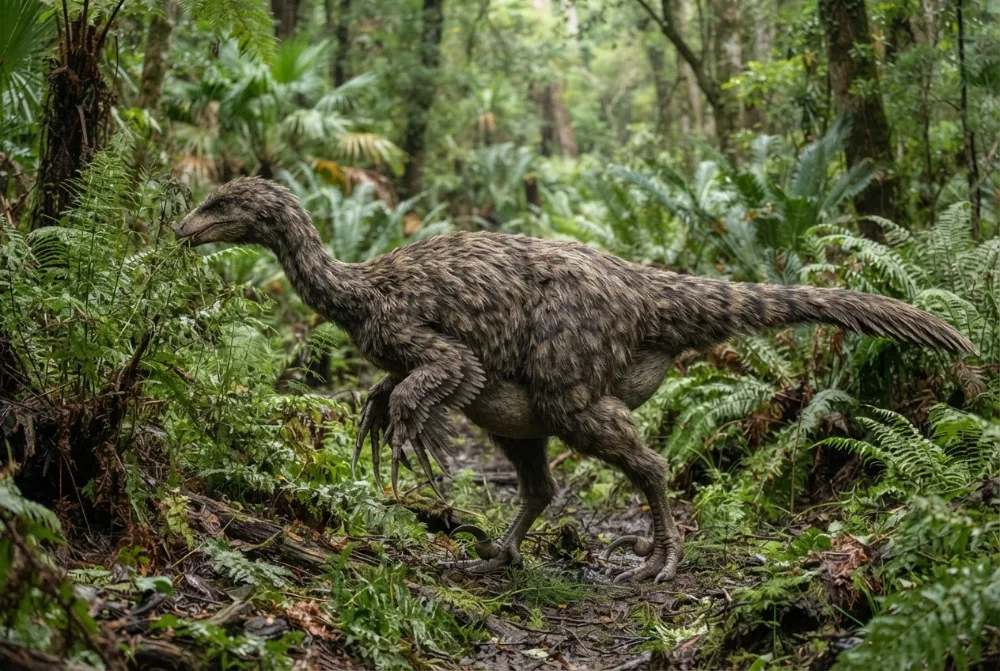
Its claws were up to 30 centimeters (12 inches) long and curved like hooks. Scientists think it used them to pull down branches to eat.1
Nothronychus had four forward-facing toes on each foot, which helped it walk slowly and steadily.1
One species, Nothronychus graffami, was found in rocks that were once under a shallow sea called the Western Interior Seaway. The dinosaur's bones were mixed with marine reptile fossils.1
The first Nothronychus bone was mistaken for part of a horned dinosaur's skull. Only later did scientists realize it was a hip bone from a therizinosaur.1
Ibibazo bibazwa cyane kuri Nothronychus
?How big was Nothronychus?
It was about 4.2 to 5.3 metres (14 to 17 feet) long and weighed 800 to 1,200 kilograms (1,800 to 2,600 pounds).1
?What did Nothronychus eat?
It ate plants. Even though it was a theropod dinosaur, it was a herbivore.12
?Did Nothronychus have feathers?
No feather fossils have been found, but its relatives had feathers, so scientists think it probably did too.3
?When did Nothronychus live?
It lived during the Late Cretaceous period, about 94 to 89 million years ago.2
?Why did Nothronychus have long claws?
It used its long, curved claws to pull down branches so it could eat leaves.1
Ku bazobereye muri dinozore
- Izina rya siyansi
- Nothronychus
- Yiswe na
- Kirkland and Wolfe 20014
- Itsinda
- Dinozore zidasanzwe zifite ibyoya
- Umuryango / ishami
- Therizinosauridae4
- Ishyirwa mu byiciro
- Theropoda > Therizinosauria4
- Imyaka y'amabuye
- imyaka miliyoni 94 kugeza 90 (Turonian)4
- Inzego z'amabuye
- Moreno Hill, Tropic Shale4
- Ibihugu
- Amerika4
- Ibisigazwa byanditswe
- 2 muri The Paleobiology Database4
- Ivumburwa
- Nothronychus was named in 2001 by paleontologists James Kirkland and Douglas Wolfe. The first fossils were found in New Mexico on land owned by rancher Bobby McKinley, who the species N. mckinleyi is named after.1
- Biracyagibwaho impaka
- Scientists are not sure if Nothronychus had feathers. Since it is a theropod closely related to birds, it might have had feathers, but no direct fossil evidence has been found yet.1
Aho amakuru yakuwe
- Nothronychus (en.wikipedia.org)
- Nothronychus | Natural History Museum (nhm.ac.uk)
- Nothronychus Fact Sheet - Enchanted Learning (enchantedlearning.com)
- Nothronychus in The Paleobiology Database (CC BY 4.0): imyaka, ahantu, inzego z'amabuye, ishyirwa mu byiciro.
Buri kintu kiri kuri uru rupapuro gifite nimero yerekana aho cyakuwe. Niba hari icyo twibeshye, tubabarire, turi abakunzi ba dinozore, ntituri ikinyamakuru cya siyansi. Tubwire kuri [email protected] tuzagikosora.
 Rex arashonje! Dino Wiki ni umushinga wa papa umwe yakoreye umuhungu we ukunda dinozore, ni ubuntu, nta matangazo kandi nta bigukurikirana. Abantu bakuru bashobora guha Rex akantu ko kurya kugira ngo Dino Wiki ikomeze kuboneka kuri interineti.Gaburira Rex
 Therizinosaurus
 Oviraptor
 Chirostenotes
 Citipes
 Leptorhynchos
 Avimimus
 Tyrannosaurus
 Triceratops
 Velociraptor
 Spinosaurus
 Ankylosaurus
 Parasaurolophus