 Uri dinozore iyihe? Umukino w'ibibazo
 Intambara ya dinozore
 Isiganwa rya dinozore
 Imikino mito ya dinozore
 Alubumu ya sitikeri
 Intonde za TOP za dinozore
 Ntungura!
Opisthocoelicaudia
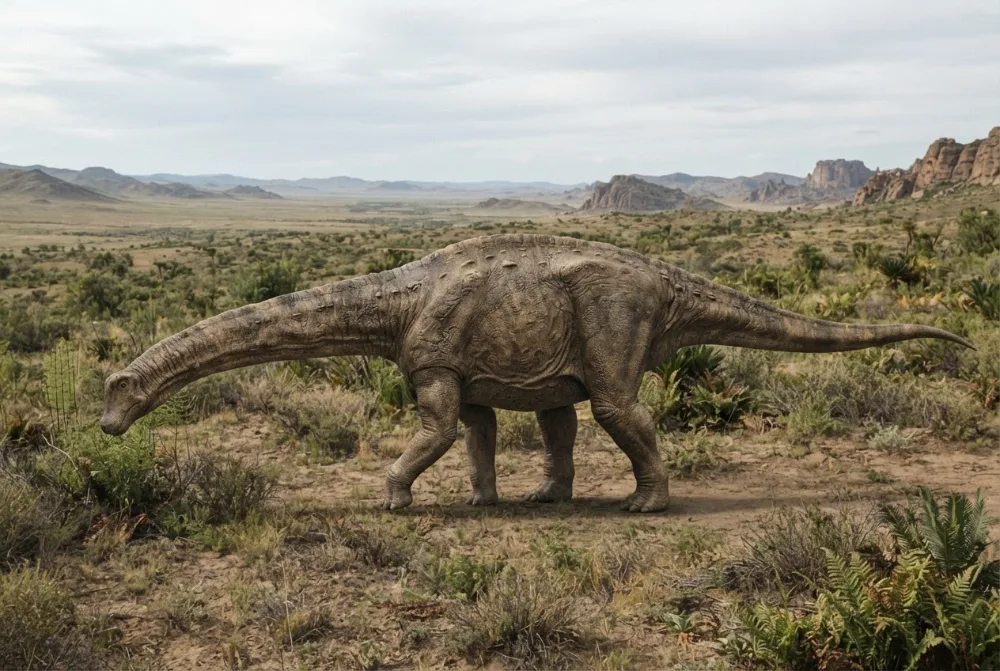
Opisthocoelicaudia was a big, long-necked plant eater that lived in the Late Cretaceous. It had a barrel-shaped body and four thick legs, like an elephant. Scientists found a nearly complete skeleton without the head and neck, so they know a lot about its body.1
Yabayeho ryari?
Yanganaga ite?
Yari ndende ite?
Ubutumburuke bwayo bwanganaga iki?
Yari iremereye ite?

 ndende nk'imodoka 3 ziparitse ku murongo🍌ndende nk'imineke 72 ikurikiranyeiremereye nk'imodoka 17🍉iremereye nk'imbuto 5100 za watermelon🎒iremereye nk'ibyumba 32 by'amashuri byuzuye abana🐻❄️iremereye nk'idubu 56 zo mu rubura🏃yashoboraga kwiruka metero 100 mu masegonda 28 (umuntu wihuta kurusha abandi akenera 9,6)
Opisthocoelicaudia yanganaga ite ugereranyije NAWE?
Ni imibare gusa ibarirwa muri mushakisha yawe. Nta kintu kibikwa cyangwa cyoherezwa ahandi.
Yihutaga ite?


Utuntu dushimishije
Its tail vertebrae were shaped like ball-and-socket joints, which is unusual and gives it the name 'posterior cavity tail'.1
The skeleton had tooth marks from big meat-eating dinosaurs, which probably ate the carcass and carried away the head and neck.1
It could probably rear up on its hind legs to reach higher food, because its tail was strong and could act like a tripod.12
Its back vertebrae had split spines, creating a double row of bumps along its spine, a feature also seen in Diplodocus.1
It had six hip vertebrae, one more than most sauropods, which made its hips extra strong.1
The neck was about 5 meters (16 feet) long, which is medium for a sauropod.1
Ibibazo bibazwa cyane kuri Opisthocoelicaudia
?How big was Opisthocoelicaudia?
It was a relatively small sauropod, measuring about 11.4 to 13 metres (37 to 43 feet) long. Its body mass has been estimated at between 8.4 and 25.4 tonnes in different studies.1
?What did Opisthocoelicaudia eat?
Like other sauropods, it was a herbivore that ate plants. It probably fed on a variety of vegetation in its floodplain and riverine environment.3
?When did Opisthocoelicaudia live?
It lived during the Late Cretaceous Period, specifically in the ?Upper Campanian or Lower Maastrichtian, about 72 to 66 million years ago.12
?Where was Opisthocoelicaudia found?
Its fossils were discovered in the Gobi Desert of Mongolia, in the Nemegt Formation. The type specimen was found at Altan Uul in Ömnögovi Province.1
?Could Opisthocoelicaudia rear up on its hind legs?
Yes, scientists think it could rear up on its hind legs to reach higher food. Its strong tail could act like a tripod to support its weight.1
?Is Opisthocoelicaudia a dinosaur?
Yes, it is a sauropod dinosaur. It belongs to the group Titanosauria and lived during the Late Cretaceous.1
Gusenya ibinyoma
Ibivugwa: Some people think Opisthocoelicaudia was a kind of camarasaur, but scientists now know it was a titanosaur.
Ukuri: It was first classified as a camarasaurid, but later studies placed it in Titanosauria, a group of sauropods.1
Ku bazobereye muri dinozore
- Izina rya siyansi
- Opisthocoelicaudia
- Yiswe na
- Borsuk-Bialynicka 19774
- Itsinda
- Izifite amajosi maremare
- Umuryango / ishami
- Saltasauridae4
- Ishyirwa mu byiciro
- Sauropodomorpha > Sauropoda > Titanosauria > Macronaria4
- Imyaka y'amabuye
- imyaka miliyoni 72 kugeza 66 (Maastrichtian)4
- Inzego z'amabuye
- Nemegt4
- Ibihugu
- Mongoliya4
- Ibisigazwa byanditswe
- 1 muri The Paleobiology Database4
- Ivumburwa
- It was discovered in 1965 by a Polish-Mongolian expedition in the Gobi Desert. Polish paleontologist Maria Magdalena Borsuk-Białynicka named it in 1977.12
- Biracyagibwaho impaka
- Scientists debate whether Opisthocoelicaudia and Nemegtosaurus are actually the same species, because only the skull of Nemegtosaurus is known and Opisthocoelicaudia lacks a skull.1
Aho amakuru yakuwe
- Opisthocoelicaudia (en.wikipedia.org)
- A NEW CAMARASAURID SAUROPOD OPISTHOCOELICAUDIA SKARZYNSKII GEN. N., SP. N. FROM THE UPPER CRETACEOUS OF MONGOLIA (palaeontologia.pan.pl)
- Opisthocoelicaudia: a Late Cretaceous Mongolian titanosaur (en.alegsaonline.com)
- Opisthocoelicaudia in The Paleobiology Database (CC BY 4.0): imyaka, ahantu, inzego z'amabuye, ishyirwa mu byiciro.
Buri kintu kiri kuri uru rupapuro gifite nimero yerekana aho cyakuwe. Niba hari icyo twibeshye, tubabarire, turi abakunzi ba dinozore, ntituri ikinyamakuru cya siyansi. Tubwire kuri [email protected] tuzagikosora.
 Rex arashonje! Dino Wiki ni umushinga wa papa umwe yakoreye umuhungu we ukunda dinozore, ni ubuntu, nta matangazo kandi nta bigukurikirana. Abantu bakuru bashobora guha Rex akantu ko kurya kugira ngo Dino Wiki ikomeze kuboneka kuri interineti.Gaburira Rex
 Brachiosaurus
 Diplodocus
 Brontosaurus
 Argentinosaurus
 Camarasaurus
 Morosaurus
 Tyrannosaurus
 Triceratops
 Velociraptor
 Spinosaurus
 Ankylosaurus
 Parasaurolophus