 Uri dinozore iyihe? Umukino w'ibibazo
 Intambara ya dinozore
 Isiganwa rya dinozore
 Imikino mito ya dinozore
 Alubumu ya sitikeri
 Intonde za TOP za dinozore
 Ntungura!
Paralitherizinosaurus
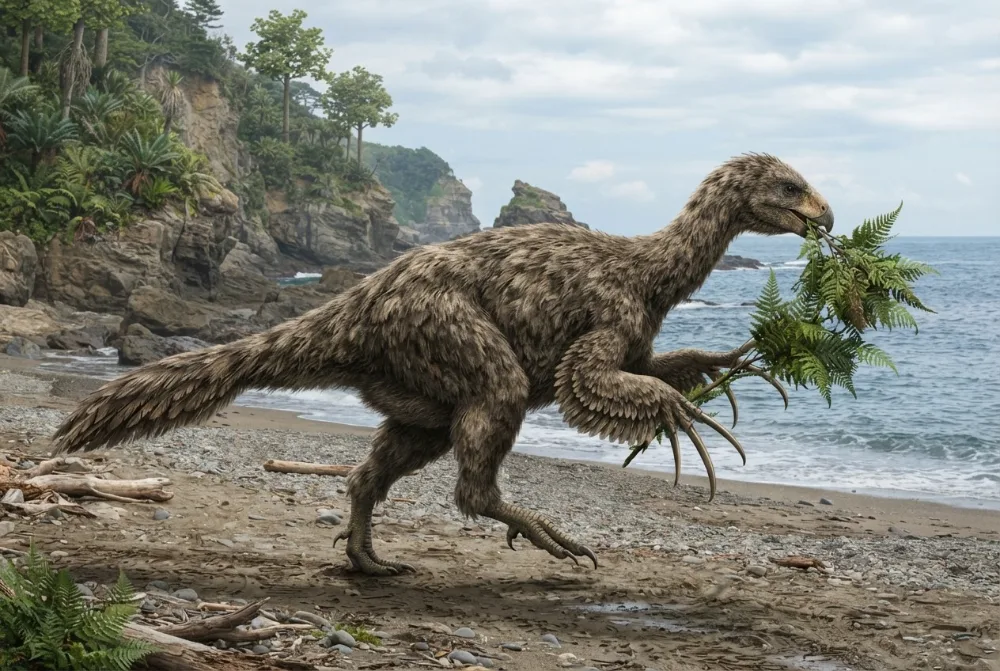
Paralitherizinosaurus was a strange, plant-eating dinosaur with long, curved claws on its hands. It lived near the coast of ancient Japan and used its claws to pull leaves and branches toward its mouth. This dinosaur was covered in feathers and looked a bit like a giant, slow-moving bird.14
Yabayeho ryari?
Yanganaga ite?
Yari ndende ite?
Ubutumburuke bwayo bwanganaga iki?
igereranya
Yari iremereye ite?
 ndende nk'imbwa 4 zikurikiranye🍌ndende nk'imineke 20 ikurikiranye🍉iremereye nk'imbuto 56 za watermelon🧸iremereye nk'abana 15 bo mu ishuri ry'incuke🎒iremereye nk'abanyeshuri 9🏃yashoboraga kwiruka metero 100 mu masegonda 13 (umuntu wihuta kurusha abandi akenera 9,6)
Paralitherizinosaurus yanganaga ite ugereranyije NAWE?
Ni imibare gusa ibarirwa muri mushakisha yawe. Nta kintu kibikwa cyangwa cyoherezwa ahandi.
Yihutaga ite?


Utuntu dushimishije
Paralitherizinosaurus is the youngest therizinosaur ever found in Japan, living about 83 to 72 million years ago.1
Its fossils were discovered in a marine rock layer, meaning it lived near the coast and its body washed out to sea after death.1
Only a partial hand and a single vertebra have been found, but those bones show it had very slender, curved claws like its relative Therizinosaurus.1
The first bone of its thumb (metacarpal I) was flattened from top to bottom, a unique feature that helps scientists tell it apart from other dinosaurs.1
Its claws had weak flexor tubercles (the bump where a muscle attaches), which means it used a hook-and-pull motion to bring branches to its mouth, not to slash or stab.1
Paralitherizinosaurus is one of the few therizinosaurs found in marine sediments anywhere in the world, along with Nothronychus from North America.1
Ibibazo bibazwa cyane kuri Paralitherizinosaurus
?What did Paralitherizinosaurus eat?
It was a plant-eater. It used its long, curved claws to hook and pull leaves and branches toward its mouth.1
?How big was Paralitherizinosaurus?
Nobody knows for sure because only a partial hand and a neck bone have been found. It was probably medium-sized, but its exact size is unknown.3
?Did Paralitherizinosaurus have feathers?
Yes, it was a feathered theropod dinosaur, related to other feathered dinosaurs like Therizinosaurus. It probably looked like a big, slow-moving bird.3
Ku bazobereye muri dinozore
- Izina rya siyansi
- Paralitherizinosaurus
- Yiswe na
- Kobayashi et al. 20224
- Itsinda
- Dinozore zidasanzwe zifite ibyoya
- Umuryango / ishami
- Therizinosauridae4
- Ishyirwa mu byiciro
- Theropoda > Therizinosauria4
- Imyaka y'amabuye
- imyaka miliyoni 84 kugeza 72 (Campanian)4
- Inzego z'amabuye
- Osoushinai4
- Ibihugu
- Ubuyapani4
- Ibisigazwa byanditswe
- 1 muri The Paleobiology Database4
- Ivumburwa
- The first fossils of Paralitherizinosaurus were found in a concretion (a hard rock nodule) near a river in Hokkaido, Japan. Scientists Murakami and colleagues first described the bones in 2008, but it was not until 2022 that Kobayashi and his team named it as a new species.1
- Biracyagibwaho impaka
- Scientists are not sure exactly where Paralitherizinosaurus fits on the therizinosaur family tree. It might be closely related to Therizinosaurus, Suzhousaurus, and another unnamed form from the Bissekty Formation, but the relationships are still debated.1
Aho amakuru yakuwe
- New therizinosaurid dinosaur from the marine Osoushinai Formation (Upper Cretaceous, Japan) provides insight for function and evolution of therizinosaur claws (pmc.ncbi.nlm.nih.gov)
- Paralitherizinosaurus japonicus | Dinosaur Database by DinoAnimals.com (dinoanimals.com)
- Paralitherizinosaurus (en.wikipedia.org)
- Paralitherizinosaurus in The Paleobiology Database (CC BY 4.0): imyaka, ahantu, inzego z'amabuye, ishyirwa mu byiciro.
Buri kintu kiri kuri uru rupapuro gifite nimero yerekana aho cyakuwe. Niba hari icyo twibeshye, tubabarire, turi abakunzi ba dinozore, ntituri ikinyamakuru cya siyansi. Tubwire kuri [email protected] tuzagikosora.
 Rex arashonje! Dino Wiki ni umushinga wa papa umwe yakoreye umuhungu we ukunda dinozore, ni ubuntu, nta matangazo kandi nta bigukurikirana. Abantu bakuru bashobora guha Rex akantu ko kurya kugira ngo Dino Wiki ikomeze kuboneka kuri interineti.Gaburira Rex
 Therizinosaurus
 Oviraptor
 Chirostenotes
 Citipes
 Leptorhynchos
 Avimimus
 Tyrannosaurus
 Triceratops
 Velociraptor
 Spinosaurus
 Ankylosaurus
 Parasaurolophus